

A well-built cattle fence does far more than just keep livestock contained. It safeguards your herd, protects pastures, and prevents costly disputes with neighbors. Yet, many ranchers still fall into avoidable cattle fencing mistakes that lead to animal escapes, injuries, and mounting repair costs. From using undersized corner posts to choosing the wrong wire gauge or spacing, even minor mistakes in cattle fencing can compromise the entire system’s strength and longevity.
Proper cattle farm fencing is both a science and an investment. It requires understanding soil conditions, animal behavior, and material durability, not just hammering posts into the ground. As modern options like virtual fencing and solar-powered energizers gain traction, the choices and pitfalls are multiplying.
In this guide, we’ll walk you through the eight most common cattle fencing mistakes, explain why they happen, and show you exactly how to avoid them. With careful planning, you can build a fence that reduces animal stress, cuts maintenance costs, and lasts for years.
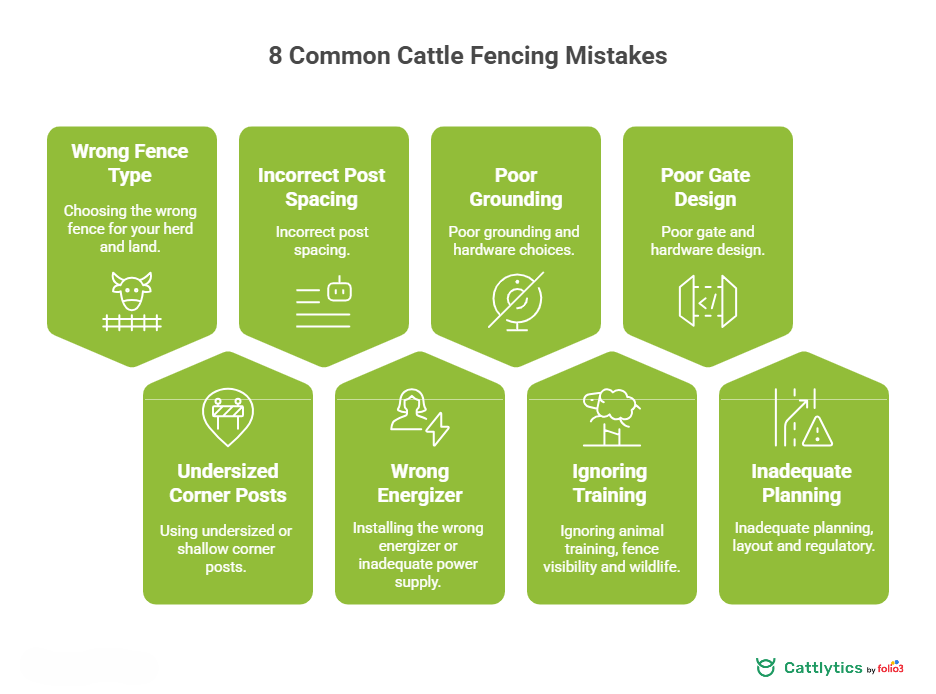
Mistake 1: Choosing the Wrong Type of Fence for Your Herd and Land
Not every fence fits every farm. One of the most common types of cattle fencing mistakes is assuming that what works for a neighbor will work for your herd. The best fencing for cattle depends on breed strength, behavior, terrain, and management goals.
For example, beef cattle and bulls require sturdier structures such as high-tensile electric or heavy-gauge cattle fencing panels to handle their weight and impact. Dairy cattle management, being more docile, can usually be contained with lighter woven or barbed-wire fences. In general, fence height should range between 49 and 60 inches, with taller designs recommended for bulls or farms in predator-prone areas.
Fence type comparison:
- Barbed wire: Affordable but risky for animal injuries.
- High-tensile electric: Long-lasting and easy to repair, but needs reliable power.
- Woven wire or cattle panel fencing: Excellent for safety and longevity, but more expensive upfront.
An emerging alternative, virtual fencing, uses GPS collars and mobile apps to create invisible boundaries that are ideal for rotational grazing or remote pastures. It reduces material costs, offers flexible paddock layouts, and minimizes labor.
Quick checklist for fence selection:
- Herd size and temperament
- Predator presence
- Land topography and soil type
- Long-term budget and maintenance capacity
Mistake 2: Using Undersized or Shallow Corner Posts
Even the best cattle fencing will fail if the corner posts aren’t built to last. Corner posts are the anchors of your fence line as they hold the tension of every wire, brace, and gate. Unfortunately, one of the most common cattle fencing mistakes is using undersized posts or setting them too shallow.
Each fence type demands a matching post diameter for strength:
- 4–5 inches for light-duty, high-tensile fences
- 6–7 inches for five-strand barbed or high-tensile wire
- 8 inches for net-wire fences
Posts should be buried as deep as or deeper than the top-wire height to counter tension and wind load. In sandy or wet soils, go deeper and use proper bracing for stability. Meanwhile, quality braces like H-braces or floating diagonal braces are worth the investment, as a 10-foot brace length significantly boosts support and durability.
Fix it:
- Choose thicker, pressure-treated posts suited to your fence type.
- Drive posts one-third to one-half of their total length into the ground for maximum stability.
- Use a T-post driver or auger instead of manual pounding to prevent splitting or weakening the post.
- Ensure proper bracing and depth now to avoid costly rebuilds later.
Mistake 3: Incorrect Post Spacing
When it comes to fencing, spacing matters more than most realize. One of the most frequent mistakes in cattle fencing is setting posts too close together, often a leftover habit from traditional barbed-wire construction. Many ranchers still place a post every rod length (16.5 feet), but this dense spacing adds unnecessary cost and rigidity. Modern high-tensile fences perform best with posts set 80–100 feet apart, using lightweight “stays” or fiberglass rods to support the wires between them.
For most pastures, posts spaced 50–70 feet apart provide a good balance of strength and flexibility. Wider spacing allows the fence to “give” when cattle bump it like a rubber band rather than snap. It also means fewer posts to buy, less labor, and easier mowing or spraying underneath the line.
Recommended Post Spacing
| Fence Type | Recommended Spacing | Considerations |
| Barbed Wire | 16–20 ft | Traditional but higher cost, less elasticity |
| High-Tensile Electric | 80–100 ft | Use stays or fiberglass rods between posts |
| Cattle Panels | 8–16 ft | Best for pens, corrals, or small paddocks |
Fix it:
- Use fiberglass or composite “stays” for long spans.
- Widen spacing on flat, even terrain; shortened in rough or windy areas.
- Avoid tying wires tightly and let the fence flex under pressure.
Mistake 4: Installing the Wrong Energizer or Inadequate Power Supply
Electric fencing is only as reliable as its power source. One of the most overlooked cattle fencing mistakes is choosing the wrong energizer or under-powering the fence. The rule of thumb: plan for 1 joule of output per mile of fence, regardless of the number of wire strands. An undersized energizer leads to weak shocks that cattle quickly learn to ignore, while an oversized one can short out if vegetation touches the line. Experts recommend maintaining 7,000–8,000 volts on the fence for dependable cattle control.
Modern low-impedance energizers are designed to deliver consistent voltage even through light weeds. Solar-powered and remotely monitored units are also gaining traction; they connect to mobile apps that alert you when voltage drops or batteries need charging. For virtual fencing cattle systems, reliable battery management and software updates are equally vital to ensure accurate GPS boundaries.
Fix it:
- Size your energizer for current acreage + future expansion.
- Install lightning arrestors to prevent surge damage.
- Test fence voltage weekly using a digital voltmeter.
Mistake 5: Poor Grounding and Hardware Choices
Even the most expensive setup can fail if grounding is done wrong. In fact, experts estimate that up to 99 percent of electric-fence problems stem from poor grounding. The rule: install at least 3 feet of ground rods per joule of energizer output. For example, a 6-joule energizer needs 18 feet of ground rods, spaced 10 feet apart.
Many ranchers cluster all their rods near the energizer, but that limits conductivity. Instead, spread rods across the fence line, especially in moist soil, to ensure a steady electrical return. Use galvanized rods and 12.5-gauge galvanized wire for corrosion resistance, and never mix metals (like copper lead-outs on steel wire) since electrolysis quickly eats through connections.
Cheap insulators and over-tight wires also reduce performance. The best fencing for cattle allows wires to flex slightly, not pull rigidly.
Fix it:
- Space ground rods at least 10 ft apart in damp areas.
- Use UV-resistant, high-quality insulators.
- Let wires “float” through line posts for elasticity.
- Match the wire gauge to fence length and voltage.
Mistake 6: Ignoring Animal Training, Fence Visibility, and Wildlife
Even the strongest fence fails if your herd doesn’t respect it. One of the most overlooked cattle fencing mistakes is skipping animal training. Cattle, like predators, must first learn what an electric fence means. Build a training paddock with flagged or taped wires so livestock can safely experience the shock in a controlled space before moving them to open pasture. This simple step reduces escapes and fence damage.
Visibility also matters. Smooth or high-tensile wires are nearly invisible to livestock and wildlife. Adding poly tape, white flags, or bright wire covers makes fences easier to see, preventing collisions and injuries.
For wildlife-friendly operations, avoid rigid, “moose-proof” barriers. Instead, use flexible designs with Powerflex posts or cattle panel fencing. A top wire at ~30 inches and a lower wire at ~18 inches let antelope crawl under and elk step over. Flexible fences bend, not break on impact.
Tips:
- Train cattle before releasing them into large pastures.
- Mark fences visibly to reduce collisions.
- Balance containment with wildlife passage.
- Use virtual fencing for cattle collars for rotational grazing or remote herds.
Mistake 7: Poor Gate and Hardware Design
Gate areas are often the weakest points in a fence line. Poor construction or wiring mistakes here can compromise the entire system. One of the most frequent mistakes in cattle fencing is failing to carry current through the gate opening. Since gate gaps interrupt the electrical flow, experts recommend installing floating diagonal braces on each side and burying insulated hot–cold wires about 1 foot deep beneath the gate to let current bypass safely.
Another error is relying on steel posts in electric fences. Steel conducts electricity and depends heavily on insulators, which can crack or weather over time, leading to shorts. Instead, use flexible plastic or wood-plastic composite posts to prevent grounding out.
Other common hardware issues include tying wires too tightly to posts, skipping tension strainers, letting bottom wires contact vegetation, or using weak gate latches that cattle can push open.
Fix it:
- Add braces and stay on both sides of the gates.
- Bury insulated cables under openings to carry current.
- Use non-conductive posts with high-quality insulators.
- Keep bottom wires clear of heavy vegetation or install cut-off switches for wet seasons.
- Inspect gate latches and hinges regularly for wear.
Mistake 8: Inadequate Planning, Layout, and Regulatory Compliance
No matter how sturdy your materials are, poor planning can turn a new fence into an expensive headache. Many mistakes in cattle fencing happen long before the first post is set, like choosing the wrong materials, placing gates in awkward spots, or fencing outside property boundaries. Others forget to locate underground utilities before digging, resulting in damaged lines and costly delays.
Poorly placed gates are especially risky. A gate that’s too narrow or positioned on a slope can make equipment access difficult, slow livestock movement, and even cause accidents. The best cattle farm fencing layouts consider both livestock flow and machinery access.
Before you dig, verify property lines and contact a utility-location service to prevent accidents. Check local ordinances on fence height, setback distances, and barbed-wire use; regulations vary by county. Always budget for extra posts, wire, and stays to handle on-site changes and leave room for future cross-fencing or virtual fencing additions for rotational grazing.
Tips:
- Draw a clear layout including paddocks, water points, and handling areas.
- Consult neighbors and county offices to avoid boundary disputes.
- Mark utility lines and confirm soil conditions before trenching.
- Keep an extra 10 % of materials for last-minute adjustments.
Conclusion
Building a reliable cattle fence takes more than just wire and posts; it requires smart planning and precision. Avoiding common cattle fencing mistakes means choosing the right materials, post spacing, power supply, and layout. Combine good design with new tools like virtual fencing, and you’ll have the best cattle fencing, safe, durable, and built to last.
With Cattlytics, you can take the next step to map your pastures, track herd movement, and manage virtual fencing all in one place. Start using data-driven insights to plan, monitor, and maintain fences that work as hard as your cattle do.
FAQs
How Far Apart Should Fence Posts Be for Cattle?
For most cattle fences, posts should be placed about 8 to 12 feet apart. However, high-tensile wire fences can stretch that distance to 20–25 feet. The proper spacing depends on your land’s terrain, how much pressure your herd puts on the fence, and the fencing material you’re using. Wider spacing saves cost, but stability should always come first.
What Is The Best Height For A Cattle Fence?
A sturdy cattle fence should stand between 48 and 54 inches high. Using four to five strands of wire gives enough height and strength to contain adult cattle safely while deterring potential predators or escapes.
Should I Use 4×4 Or 6×6 For Fence Posts?
It depends on your fencing needs. 6×6 posts provide greater strength and longevity, ideal for high-tension or heavy-use areas. 4×4 posts are lighter and more affordable, suitable for smaller paddocks or lighter-duty fencing where less pressure is applied.
What Is The Most Economical Fencing For Cattle?
If cost is your priority, electric fencing is typically the most affordable option, especially for temporary setups or rotational grazing. For a long-term solution, barbed wire offers a budget-friendly choice, though it requires upkeep and poses a higher risk of injury compared to smoother alternatives.
Why Can’t Fences Be Over 6 Feet?
A six-foot fence height limit is common in many residential and agricultural zoning laws. These regulations aim to maintain visibility, safety, and community aesthetics while preventing boundary or sightline disputes. Always check your local fencing ordinances before installation.