

If you run a natural-service herd, your bull team quietly determines how many cows breed early, and how heavy your calves are at weaning. Subfertile bulls often take longer to settle cows, pushing calves later in the calving season. So, they’re younger and lighter at weaning, which cuts total pounds to market. A breeding soundness exam is your best pre-season check to prevent that surprise.
In this blog, you’ll learn what to look for on the report, what “satisfactory,” “deferred,” and “unsatisfactory” really mean for your operation in your place, and how to document decisions so you can manage bulls like the high-impact assets they are.
What Is a Breeding Soundness Exam?
In cattle, a breeding soundness exam (BSE) is more than a quick semen check. Your veterinarian assesses the condition and does a physical exam. It includes feet, legs, eyes, and the sheath because a bull that can’t travel, see, or mount can’t breed effectively.
They also examine the reproductive tract, palpate the scrotum and testes, and measure scrotal circumference to estimate sperm capacity. Finally, semen is evaluated for progressive motility and morphology. These results feed the classification you receive.
What a BSE does not guarantee
A breeding soundness exam is an assessment of fertility at that moment, not proof that a bull will perform all season. Routine field BSEs usually can’t practically measure libido or serving capacity, so a bull may “pass” yet still show poor desire to breed.
It also doesn’t guarantee the bull is free of infectious diseases, and it can’t prevent injuries to feet, legs, or the reproductive tract after turnout. Ultimately, pregnancies are the only valid confirmation. That’s why observation remains essential.
Why producers still rely on it
Even with limits, a BSE is the best practical screen you can run before breeding. It helps you identify bulls that are unlikely to achieve a high pregnancy percentage in a defined season and avoid “dominant but subfertile” sires that delay conception. Because later conceptions mean lighter calves and fewer pounds sold, the exam is insurance against significant preventable losses.
When to Schedule the Bull Breeding Soundness Exam
Timing determines whether you have options or regrets. Learn when to schedule a breeding soundness exam so you can retest, replace, and protect conception rates.
The Replacement Buffer
Plan the bull breeding soundness exam early, not as a last-minute chore. Annual testing is recommended, and Extension guidance suggests scheduling at least 60–75 days before your breeding season. That buffer gives you time to buy, lease, or swap in a replacement bull, or to treat a “deferred” bull and schedule a retest. It also lets you set turnout groups and bull power with confidence before cows ever cycle.
Why the ‘~60-day’ Sperm Cycle Matters
Semen results reflect what happened weeks ago, not just today. MSD guidance notes that questionable breeding soundness exam bull outcomes should be followed by reexamination 60 days later to reflect the sperm production cycle. That’s why fever, injury, or heat stress can temporarily depress motility or morphology. Post-illness semen can often look very different later, so let him recover, then retest.
If You’re Inside the Window
If your breeding season is less than 60 days away, test anyway. It’s better to learn now than at pregnancy check or calving that a bull didn’t perform. Even late, the results quickly guide immediate decisions: pull, replace, or reassign.
The 4 Core Components You’ll See on Any Breeding Soundness Exam Bull Report
A bull BSE report isn’t just numbers; it’s a decision tool. Here are the four core components you must understand to evaluate risk confidently.
Physical Exam
On the breeding soundness exam form, the physical exam covers body condition, eyes, feet, and legs for mounting, plus sheath and penis checks. Even a great semen sample won’t help if the bull can’t move, see, or service cows safely.
Scrotal Circumference
On a breeding soundness exam bull report, scrotal circumference is measured at the widest point and compared to age-based minimums. It predicts sperm output; check breed references for your bull.
Sperm Motility
Motility reports the percentage of sperm moving forward progressively. In a bull breeding soundness exam, >30% progressive motility is the minimum threshold for an acceptable breeder.
Sperm Morphology
Morphology is the percentage of normal sperm on a stained count. The minimum is >70% normal sperm. Lower results mean unsatisfactory or deferred.
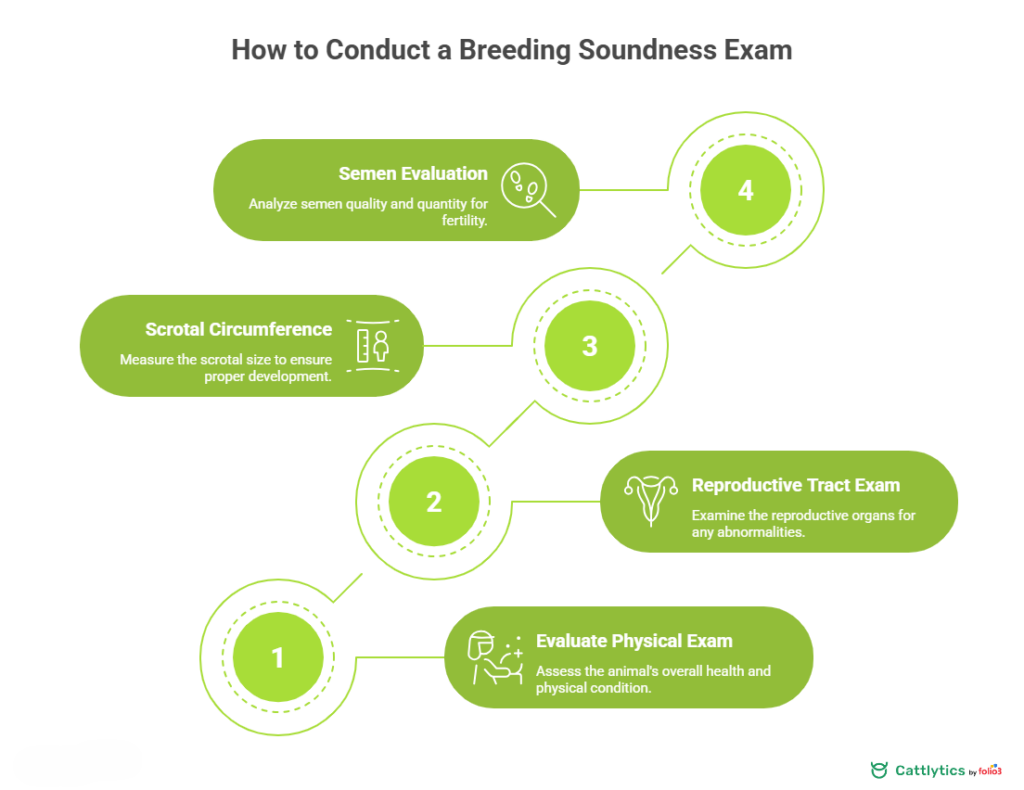
Step 1: Evaluate the Physical Exam
Excellent semen won’t matter if a bull can’t travel, mount, or stay sound. So, you need to evaluate physical fitness for real-world pasture performance.
Feet/legs/locomotion and terrain reality
A bull can “pass” semen thresholds and still miss cows if he can’t travel, mount, or stay sound. That’s why the bull breeding soundness exam starts with feet, legs, and overall movement. You should look for lameness in cattle, joint swelling, injury, or arthritis that can limit pasture athleticism.
On rough terrain or big pastures, those issues get exposed fast and reduce the number of cows a bull can cover, regardless of semen quality. Watch him stand, turn, and walk; this is your practical, visible performance filter before you spend time carefully interpreting semen numbers.
Eyes, teeth, and body condition score
In a breeding soundness exam, basic items determine results. Eyes are examined for a normal blink/menace response and problems that could shorten a bull’s life. Teeth matter in older bulls; if he can’t eat well, he won’t hold condition through breeding. Body condition score (BCS) is recorded because bulls in a poor nutritional state tend to have reduced fertility; a BCS of 5–6 at turnout for arid ranges.
“Pass” vs “Practically Risky”
Producer takeaway: “satisfactory” is a minimum standard, not a performance promise. A bull is classified as satisfactory after passing the physical exam and semen thresholds. Yet libido and serving capacity are not routinely evaluated, and pasture terrain and soundness still limit output. If a bull is sore, lame, or losing condition, treat him as risky, even with good semen numbers.
Producer checklist:
Exam-day quick checks that you must do before the report:
- Stance: stands square on the ground
- Hooves: claws even, no overgrowth
- Gait: walks freely on the surface
- Joints: hocks/knees, swelling or heat
- Eyes: clear, normal blink response
- Mouth: broken teeth or wear
- BCS: adequate reserves for turnout
- Sheath/prepuce: warts, swelling, hair rings
- History: fever, foot rot, injury
Step 2: Reproductive Tract Exam
This exam checks whether the reproductive system can actually deliver sperm. See what normal findings look like and which red flags change decisions immediately.
External exam
On a breeding soundness exam, the external tract exam tells you whether the “hardware” can deliver sperm. The scrotum is palpated to assess testes, epididymides, spermatic cords, and skin. Therefore, testes should be symmetrical, smooth, resilient, and freely movable, and the epididymides should have no palpable masses.
During collection, the penis should be extended and inspected because physical problems like warts, hair rings, persistent frenulum, or deviations can prevent successful service. Also ask about scrotal injury, frostbite, or swelling that could impair semen quality. They often explain problems before semen evaluation.
Internal exam
The internal portion of a breeding soundness exam is done per rectum. Your vet palpates the inguinal rings and accessory sex glands to look for enlargement, pain, or abnormalities. As a key example, seminal vesiculitis is also listed as a common cause when white blood cells are seen in semen. If glands feel abnormal, the bull may be deferred or unsatisfactory and needs prompt follow-up testing.
Red flags that change decisions fast
Some findings should move you from “wait and see” to “make a decision.” Cryptorchidism (a retained testicle) is considered an undesirable heritable trait and makes a bull unsatisfactory, even if the semen looks acceptable.
Meanwhile, congenital or physical defects of the penis and prepuce, such as a persistent frenulum or warts, can be discovered when the bull is extended. Because these issues can prevent effective service, abnormal findings may justify an immediate unsatisfactory classification. Plan replacement before turnout.
Step 3: Scrotal Circumference
Scrotal circumference is one of the clearest pass-fail criteria on a BSE. Understand how it’s measured, age-based minimums, and what borderline results really mean.
Measurement Method
In a bull breeding soundness exam, scrotal circumference is measured with a flexible tape after the testes are pushed down to the bottom of the scrotum (ventrally). The tape is placed around the largest circumference, not mid-scrotum, and read in centimeters. Because size varies by age and breed, your vet records age and may compare it to breed averages for proper context.
Minimum SC Thresholds by Age
Minimum scrotal circumference (SC) is one of the clearest “yes/no” items on a breeding soundness exam cattle report. If your bull falls below the age minimum, he cannot be classified as satisfactory regardless of semen quality. Use these common thresholds (cm):
| Bull age | Minimum SC |
| <15 months | 30 |
| 15–18 months | 31 |
| 19–21 months | 32 |
| 22–24 months | 33 |
| ≥24 months | 34 |
How to interpret borderline SC
Borderline SC on the breeding soundness exam bull report is where judgment matters. If he only clears the minimum, your veterinarian may reference breed averages, because breeds mature larger or smaller. Manage risk by not overstocking him, running a backup bull, and retest if illness or injury could have depressed results.
Step 4: Semen Evaluation
Semen numbers can mislead without context. Let’s uncover motility and morphology clearly, plus common collection and handling factors that skew results.
How Semen Is Collected
Most field breeding soundness exam bull appointments collect semen with electroejaculation because it’s practical in a chute. In semen centers or with trained bulls, an artificial vagina (AV) may be used. Motility should be evaluated immediately, and anything that touches semen should be warm, clean, dry, and nontoxic to avoid temperature shock. Electro-ejaculated samples don’t represent the full ejaculate volume and concentration. So, focus on motility and morphology; SC helps estimate sperm production potential overall on your bull’s test day.
Motility
Motility on a breeding soundness exam is about forward motion, not just “wiggling.” Your vet estimates the percentage of sperm moving progressively across the microscope field. Meanwhile, motility is best assessed when semen is kept around 37°C and evaluated immediately, because temperature shock in field conditions can depress readings. Vets may report gross motility (“swirl pattern”) and individual progressive motility; individual is the more accurate measure.
For pass/fail, >30% individual progressive motility or “fair” gross motility meets the minimum. Motility scoring can vary between veterinarians, so ask whether they scored progressive motility, not just gross movement. Producer interpretation: don’t overreact to one marginal number, confirm the collection method, temperature control, and recent illness or injury.
Morphology
Morphology is the shape check: your vet stains a semen smear and counts at least 100 sperm, recording the percent that are normal. To “pass” a breeding soundness exam, use >70% normal sperm as the minimum. You may also see primary vs secondary abnormalities.
Primary examples include underdeveloped sperm, acrosome defects, narrow heads, coiled tails, and accessory tails; secondary examples include free normal heads, bent tails, and distal droplets. Moreover, primary abnormalities are generally more detrimental to fertility and not expected to improve over time. Practical takeaway: When the normal percent dips below 70%, treat it as a decision point for this breeding season. Ask for a defect breakdown.
A Quick “Quality Control” Question List To Ask Your Vet
Ask these quality-control questions before you make a keep/cull decision: Was the sample kept warm and handled with clean, dry equipment? How long from collection to the microscope? Did you score progressive motility or only gross swirl? What stain/method did you use for morphology, and how many sperm were counted?
How to Interpret the Final Result: Satisfactory vs Deferred vs Unsatisfactory
In a bull breeding soundness exam, “Satisfactory potential breeder” means the bull passed the physical exam and met minimum scrotal circumference, motility, and morphology.
“Deferred” means he missed at least one component due to a condition that may resolve with time or treatment, so your veterinarian recommends a recheck.
“Unsatisfactory potential breeder” means he failed one or more components; he may still impregnate some cows, but he will not breed them efficiently, so turnout is not recommended.
Decision tree
Use the result on your breeding soundness exam bull report to act quickly. Confirm which component failed before deciding today.
| Classification | Likely scenario | Action | Retest timing |
| Satisfactory | Meets minimums | Turn out; monitor closely | Recheck after injury/illness or next season |
| Deferred | Potentially fixable issue | Treat/hold; plan backup | Vet-guided recheck, often 30–60 days |
| Unsatisfactory | Fails one+ minimums | Replace or market | Retest only if vet suspects a temporary cause |
Herd-risk Controls if You Must Use a Borderline Bull
If you must use a borderline bull, manage downside, not upside: keep a lower bull-to-female ratio, watch for social dominance that blocks breeding, and observe activity during the first heat cycles. At the first sign of lameness, injury, or zero interest in cows, pull him and reassess with your veterinarian.
Libido, Serving Capacity, and a Turnout Monitoring Checklist Beyond BSE
A bull can pass the breeding soundness exam that cattle producers rely on and still disappoint you on turnout because libido and serving capacity are hard to measure in field conditions. Libido assessment is often unfeasible during a routine BSE, and many bulls are declared satisfactory before low desire or serving capacity becomes obvious.
Turnout Monitoring Checklist:
- Observe bulls with cycling females; look for active seeking and mounting.
- Confirm services complete (mount → intromission → thrust → dismount) and cows stand.
- Check daily for lameness, swollen joints, or heat in the feet/legs.
- Inspect sheath/prepuce for swelling, bleeding, warts, or hair rings after breeding.
- Watch for dominance problems in multi-sire groups that keep younger bulls off cows.
- Track cycling: if you see many cows still returning to heat, investigate early.
- Re-check bull-to-female ratio; high ratios can delay pregnancies.
- Call your veterinarian if you see no breeding activity, repeated failed mounts, penile deviation/trauma, fever, or sudden loss of condition; semen and soundness can change fast.
A Practical Breeding Soundness Exam Form Template
A breeding soundness exam is most potent when you can compare this year to last year. Standardized breeding soundness exam form records should be used for systematic reporting. When you track trend lines, SC, progressive motility, morphology, injuries, deferrals, and retests, you stop guessing and start managing. You’ll also spot “slow declines” early and avoid turning out a bull who looks fine today but is trending the wrong way.
BSE form template:
Copy this breeding soundness exam bull template into a notebook or spreadsheet, so every bull is documented the same way.
| Field | What to enter |
| Bull ID | Tag/brand/registration # |
| Age | Months or years |
| Breed | Breed/type |
| BCS | 1–9 score (record your system) |
| Feet/legs notes | Lameness, hoof issues, gait |
| Eyes | Clear? injury? normal response |
| Sheath/penis notes | Swelling, warts, hair rings, deviation |
| Scrotal exam notes | Symmetry, lesions, frostbite, firmness |
| SC (cm) | Measure + age minimum check |
| Semen collection method | Electroejaculation or AV |
| Motility (% progressive) | Progressive motility % |
| Morphology (% normal) | Normal sperm % |
| Abnormalities notes | Primary/secondary defects, WBCs if noted |
| Classification | Satisfactory / Deferred / Unsatisfactory |
| Retest date | If deferred, scheduled recheck |
| Final action | Use / Replace / Cull |
| Turnout monitoring notes | Activity, injuries, returns-to-heat observations |
Conclusion
A breeding soundness exam is the best practical screening tool you have before the breeding season, but it only protects your calf crop if you follow through. Schedule it early enough to replace or retest, read the report like a decision document, and monitor bulls after turnout because libido, injuries, and pasture conditions can change outcomes fast.
If you want to tighten this up, we can help you build a simple bull evaluation + recordkeeping system based on our breeding management solution.
FAQs
How Often Should Breeding Soundness Exams Be Conducted for Breeding Males?
Breeding Soundness Exams should be done every year for bulls and other breeding males, ideally 30–60 days before the breeding season. This timing allows you to catch injuries, illness, or semen issues early enough to retest or replace the animal.
Can a Bull Fail a Breeding Soundness Exam and Still Get Cows Pregnant?
Yes, it’s possible. Bulls classified as deferred or sub-fertile may still settle some cows, but they usually do so less efficiently, leading to delayed breeding, later calving, and fewer calves overall.
What Should I Do If My Bull Passes the Breeding Soundness Exam but Doesn’t Breed Cows?
Start by closely observing the bull in the pasture. Look for low libido, dominance issues with other bulls, or physical discomfort such as joint pain or minor lameness, which aren’t fully evaluated during a standard BSE.
How Reliable Is Semen Motility and Morphology Testing in Field Conditions?
Field semen testing can be useful, but results can vary due to handling, temperature changes, timing, and evaluator subjectivity. Because of these factors, numbers should be interpreted with context rather than taken in isolation.
Is a Breeding Soundness Exam Worth the Cost for Small Herds?
Yes. For small herds especially, a BSE is inexpensive insurance. One infertile or sub-fertile bull can cause open cows and major financial losses that far exceed the cost of the exam.