

If you’re starting from zero, the goal isn’t “more cows”, it’s a system you can run every week.
This practical guide to beef cattle farming is built for beginners and experienced ranchers in cattle farming who want results you can measure: healthy animals, manageable chores, and a plan that does not collapse when life gets busy. You will learn how to pick the right production model, set up simple facilities and handling, buy cattle with fewer regrets, feed them through good grass and bad seasons. With a basic health and welfare program, farmers can protect cattle performance and prevent expensive surprises.
Along the way, you’ll connect the biology of cattle with the business side, so your decisions support profitability, predictable cash flow, and animal welfare at the same time. By the end, you’ll have a clear next-step roadmap for farming cattle for beef with confidence. For additional foundational guidance, see our comprehensive guide on how to start a cattle farm.
Beef Cattle Ranching 101: How the Beef System Works
Beef cattle ranching looks complicated until you see the system in “lanes.” Once you know which lane you’re in, farming beef cattle becomes a series of repeatable weekly tasks. Many producers also combine lanes by retaining ownership longer.
The three production “lanes” you can enter
- Cow-calf: You maintain a breeding herd, raise calves, and typically sell weaned feeder calves.
- Stocker/backgrounder: You buy weaned feeder calves and grow them on forage (plus strategic feed) before selling to a feedlot/finisher.
- Finishing: You feed cattle to market weight and sell for harvest/processing.
Lifecycle checkpoints that affect labor + cashflow
- For cow-calf, labor spikes around calving, then again at weaning. Many calves are weaned at roughly 3–7 months, which is when revenue shows up.
- For stockers, the main checkpoint is “gain per day” until they reach the target sale condition.
- For finishing, cattle are commonly marketed around 1,200–1,300 lb, often at about 14–15 months of age, so feed cost and time-on-feed drive cashflow risk.
Plain-English glossary you’ll keep seeing at auctions and feed stores
Feeder calf: A weaned calf sold to be grown/finished.
Stocker/backgrounder: Cattle are being grown before finishing.
Finishing: The final feeding phase to reach market weight.
ADG (average daily gain): Average pounds gained per day, one of the simplest performance numbers to track for your farm records.
Understanding complete cattle care from day one helps you anticipate needs before they become problems.
How to Start Beef Cattle Farming
To learn how to start beef cattle farming without detours, choose a model that matches your land, time, and risk tolerance, then build your routine around it.
Choosing a model before you know your constraints
The fastest way to struggle is picking a lane first and discovering you can’t support it with your resources. Start with these beef cattle farming tips:
- Labor: Who can check cattle and feed on schedule
- Fencing + water: Containment and reliable access.
- Winter feed: Hay supply, storage, and delivery.
- Capital: Animals, facilities, and operating cash.
- Marketing access: Your likely buyers and sale timing.
Which model should you start with?
| Model | Best for (farm type) | Land dependency | Facility intensity | Labor intensity | Cashflow timing | Key risks | Marketing channel |
| Cow-calf | Pasture + hay base | High | Med | Med | Seasonal | Calving, drought | Feeder calf sales |
| Stocker/backgrounding | Forage + no calving | Med-high | Low-med | Med | Months | Forage, health | Feeder/auction |
| Finishing | Feed access + pens | High | High | High | Finished | Feed costs | Packer/processor |
| Direct-to-consumer | Local buyers + brand | Med-high | Med | High | Deposits | Processing slots | Local customers |
Breed selection also impacts your operation’s success, learn more about top beef cattle breeds and their production characteristics.
Your “starter” recommendation
For many beginners, stocker/backgrounding is the safest entry: you avoid calving and breeding management, but still learn feeding, handling, and marketing. If you already have dependable fencing, water, and hay ground, start cow-calf small and scale only after your weekly system is stable.
What You Need Before You Buy Your First Animal
Before you buy your first animal, do a “resource audit.” In agriculture cattle farming, beef cattle farming for beginners gets expensive when you buy cattle before the system is built.
Land + feed resources
To avoid guessing herd size, plan using AU/AUM. An animal unit month (AUM) is the forage one animal unit (AU) consumes in a month, and a standard AU is often defined as a 1,000-lb cow with a young calf. Carrying capacity is commonly expressed as available AUMs for a pasture. Work with your local Extension or NRCS team to estimate stocking rate and set “bad-year” triggers for destocking or supplemental feed. Moreover, modern farm mapping software can help you visualize paddock boundaries, water access points, and grazing rotation plans.
Fencing, water & shelter
Fencing and shelter are significant upfront facility expenses, so plan them before you buy cattle. At a minimum, your perimeter fence needs strong corners and adequate height, and your water system must work in the areas you plan to graze.
Handling facilities
A minimum viable setup is a holding pen, crowding area, working chute, and a squeeze chute or headgate for treatment. Designs that use solid sides and a curved chute improve cattle flow and reduce handling time.
Beef Cattle Farming for Beginners: Buying Your First Cattle
Buying your first animals is where beginners either build momentum or buy problems. To learn how to raise beef cattle with fewer regrets, match cattle type to your lane, forage, and handling capacity before you shop. Budget planning starts here, so understand how much a cow costs in the USA including purchase price, transport, and initial health investments. Before you begin, confirm you have the resources and facilities to care for livestock.
Decide what class of cattle fits your model
- Cows + bull (cow-calf): Breeding and calving management, plus replacements.
- Bred heifers: Faster start, but calving is on you immediately.
- Weaned calves: No calving risk, but nutrition and health management are critical.
- Yearlings/stockers: You focus on gain and sale timing.
Where to source cattle
Auction barn: Bigger selection, but history can be unknown, and stress/commingling can raise health risk.
Private treaty: Direct negotiation and often clearer background information.
Dispersal sales/reputation herds: Can be strong sources if you verify health and production records.
On-the-spot evaluation checklist
If you only remember seven checks, remember these.
- Bright eyes/clean nose;
- Normal breathing/no persistent cough
- Sound feet and legs with a normal gait
- Appropriate body condition
- Healthy coat/skin
- Normal manure
- Calm, workable temperament.
Genetics/breeding basics
In cow-calf herds, the bull is a high-impact investment because one sire influences many calves. Plan bull cost and bull-to-cow coverage before you buy, and choose sellers who can discuss fertility, health, and performance. For precautions, quarantine new arrivals separately for at least 30 days.
The #1 Cost Driver in Beef Cattle Farming
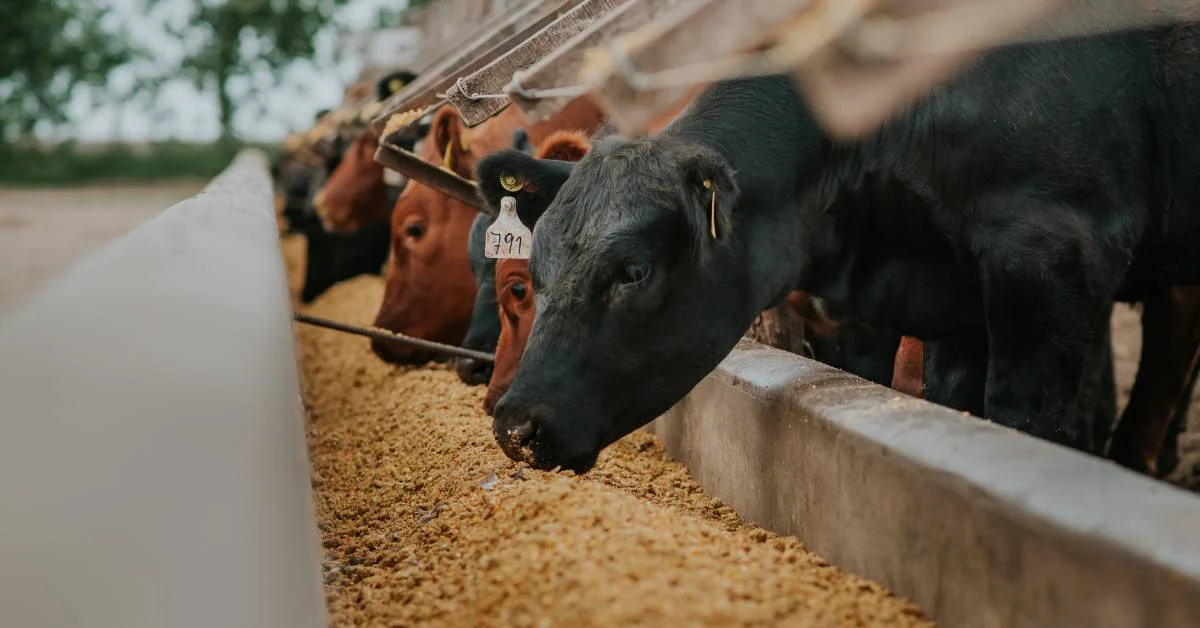
Feeding is where profits are made or lost in farming beef cattle. Feed is typically the single most significant cost in cow-calf systems, so the goal is not “cheap feed”, it’s a plan you can execute week after week, even when the weather turns. These are beef cattle farming tips that can help you control expenses:
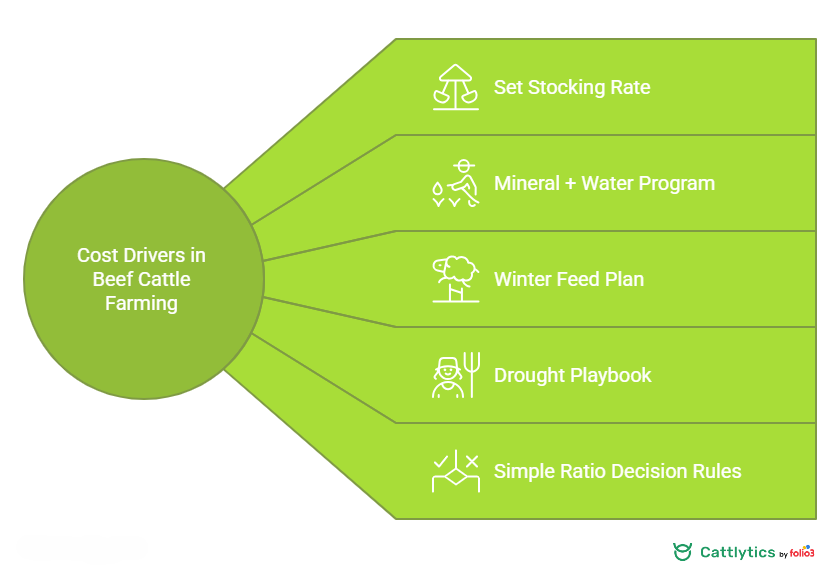
Set stocking rate using forage reality
Start with carrying capacity, not headcount. Defines an animal unit month (AUM) as the amount of forage an animal unit (AU) consumes in one month, with a standard AU often described as a 1,000-lb cow with a young calf. Convert pasture supply into available AUMs, set stocking rate, then adjust as conditions change.
Mineral + water program basics
Provide a consistent mineral program that complements your forage base, and keep salt and clean water available. Minerals are essential across production stages, so track mineral consumption and keep it dry and accessible so cattle actually eat it.
Winter feed plan
Price hay early, then protect what you buy. Storing high-quality hay outside on the ground can lead to 25–30% total loss, and feeding losses can be even higher. Store bales off the ground when possible, and choose feeding locations that protect soil structure and reduce mud.
Drought and “bad year” playbook
When forage drops, act immediately by utilizing early weaning as a drought tool to balance forage demand with forage supply to protect cow condition. Pair that with planned destocking and line up alternative forages or rented pasture before you need them.
Simple ratio decision rules
Match feed to stage: growing cattle need nutrients for gain, lactating cows need higher nutrients, and finishing cattle require a consistent, higher-energy diet. Use body condition scoring (1–9) as a quick, field-ready way to decide when cows need more energy.
Herd Health, Welfare, and Biosecurity
Good beef cattle raising is mostly prevention. A simple herd health plan, consistent observation, and disciplined biosecurity keep minor problems from becoming “weekenders” that drain time and money year after year.
Build a relationship with a veterinarian.
Having a valid veterinarian-client-patient relationship (VCPR) and using it to build protocols you can follow. Work with your vet to set: vaccine timing by class, a parasite-control program, and written treatment protocols. Learn more about the importance of beef cattle vaccines and how proper vaccination protocols protect herd health and reduce treatment costs.
Biosecurity for small farms
Before cattle ever touch your main herd, isolate new arrivals for at least 30 days, observe daily, and handle them last. Separate sick animals immediately, and prevent “shared gear” from moving germs: clean boots, needles, and equipment between groups, and control visitor/vehicle access around pens. Familiarize yourself with common cow diseases, symptoms, and treatments so you can recognize problems early and respond appropriately.
Handling and welfare standards
Follow cattle care and handling guidelines focused on preventing abuse, reducing slips and falls, and using facilities and handling methods that minimize stress. Treat these practices as part of sustainable beef cattle farming practices: they protect animal welfare, reduce injury, and support market credibility when buyers ask how cattle are handled on your operation.
How Cow-Calf Operations Actually Make (or Lose) Money
In beef cattle ranching, reproduction is your profit engine. If you miss pregnancies or stretch calving too long, you pay for it in lighter, less uniform calves and more labor.
Calving season strategy
Define a breeding season, because breeding-season length sets calving-season length. A shorter, planned season improves uniformity, simplifies herd work, and supports stronger marketing because calves are closer in age and weight.
Breeding plan
If you use herd bulls, remember the math: one cow produces one calf per year, but a bull can sire roughly 25 to 60 calves, so his fertility and genetics influence the whole calf crop. That is why bull cost should be viewed as an investment spread across many calves and multiple years.
If buying a bull is not practical, consider AI, leasing, or a shared bull arrangement with clear health and biosecurity rules. Plus, you can track breeding records, calving dates, and performance metrics more efficiently with dedicated cow-calf software designed for reproduction management.
Weaning
Plan weaning around your path: sell at weaning, hold as stockers, or retain ownership. Fence-line weaning, where calves are separated but adjacent to dams, is highlighted as a lower-stress approach. So, focus on rapid feed and water intake post-weaning, then align vaccinations and nutrition with the next stage.
Marketing Your Beef Cattle
In beef cattle farming, marketing is not “the last step”; it’s the plan that decides what you raise, how long you keep cattle, and when you get paid.
The core channels
- Sale barn: Simplest route when you want a fast turnaround.
- Direct to feeder/backgrounder: Best when you can offer health and management history.
- Retained ownership + custom feed: You keep ownership and pay a yard to finish cattle when you lack facilities but want to capture value.
- Freezer beef (direct-to-consumer): Fits operators who can manage customers and processing logistics.
Value-add options for small operators
Small farms can compete by serving niche demand as natural, grass-fed, or source-verified only if you can document claims and deliver a consistent product. Some consumers will pay premiums when producers build trust and share management practices. If you’re marketing to international buyers or serving diverse local communities, a video translator lets you share your farming story and practices in multiple languages, strengthening buyer trust and expanding your market reach.
Pricing reality + timing decisions
The cattle cycle moves through expansions and contractions. Producers may expand herds when prices/revenues are expected to rise, and cut back when revenues are expected to decline. However, the response can look delayed because biology (gestation and holding back heifers) slows herd change.
Budget, Break-Even, and Risk Management
In beef cattle farming, budgeting is what separates a business from a hobby. A simple enterprise budget makes you price feed, labor, and facilities before you scale, and exposes sensitivity to feed and price.
Your enterprise budget categories
Include every cost you pay and the ones you tend to forget:
- Feed
- Vet/health
- Minerals/salt, bedding
- Fencing + facilities, equipment + fuel
- Hauling/transport
- Processing/fees
- Death loss
A simple break-even framework
Stockers: cost per lb of gain = total production costs ÷ pounds gained.
Also, compute the breakeven sale price = total cost ÷ sale weight, and the breakeven purchase price from the sale value minus production costs.
Cow-calf: break-even per weaned calf = total annual cow costs ÷ calves weaned, and then compare to expected sale price. Also, use budget templates to stay realistic.
Cash flow timing
Costs hit early, and revenue may be seasonal (cow-calf) or months out. Therefore, it is necessary to build a month-by-month cash flow view.
Risk controls
- Feed spike: Secure hay early or reduce numbers sooner.
- Disease: Isolate, follow treatment protocols, call your vet.
- Drought: Destock lower-value cattle first; protect breeding stock.
- Price drop: Don’t expand based on one strong year; the cattle cycle turns.
What to track weekly and monthly
Weekly: body condition, water/mineral intake, feed inventory days.
Monthly: ADG (where relevant), pregnancy rate, weaning %, death loss, cost per head.
Meanwhile, a comprehensive cattle management software automates these tracking tasks and generates reports that inform better decisions.
Sustainable Beef Cattle Farming Practices
Sustainable beef cattle farming practices are easiest to sustain when they also make daily work simpler: better forage regrowth, fewer mud problems, and calmer cattle. In agriculture cattle farming, grazing management, and animal care are the two levers you control most often.
Rotational Grazing And Pasture Recovery
Rotate cattle before plants are grazed too short, then give paddocks time to recover. Maintain typical rest periods of roughly 20–30 days during rapid growth and 40+ days during slow growth, and recommend planning so livestock match carrying capacity. Water placement matters: put water where you want grazing pressure, and move or add access points to prevent “camping” in one area. For detailed implementation strategies, see our guide to pasture rotation for cattle ranchers, which covers paddock design, rest periods, and seasonal adjustments
Soil + Water Outcomes You Can Measure Without Fancy Tools
You can monitor pasture health using simple field indicators, including plant cover, uniformity of use, livestock concentration areas, and visible erosion. Add two quick checks: infiltration (how fast water soaks in) and manure distribution patterns (clumping vs even spread).
Aligning With Modern Animal Care And Sustainability Expectations
BQA cattle care and handling guidelines emphasize best practices for feeding and water, disease prevention, shelter, and low-stress handling. Treat these as part of sustainability: healthier cattle, fewer injuries, and fewer avoidable treatments, all of which protect productivity and market credibility.
Conclusion
Your first year in beef cattle farming for beginners can stay simple if your system is simple. Follow a sequence: choose your model, validate resources, buy cattle that fit your lane, then lock in a feed plan and herd-health program. If you run cow-calf, add reproduction planning; if you run stockers or finishers, focus on gain and sale timing. Next, decide how you’ll sell, build a budget, and track a few KPIs like body condition, ADG, pregnancy rate, weaning %, death loss, and feed days on hand.If you want help with how to raise beef cattle on your farm, we can review your startup plan, capacity estimate, handling layout, or a simple budget template with you.
FAQs
Is Beef Cattle Farming Profitable?
Yes, beef cattle farming can be profitable, but results depend on how well you manage costs and timing. Feed prices, market cycles, grazing efficiency, and overhead all matter. Well-run, low-cost operations tend to perform best, especially during strong markets, while poor timing or high feed costs can erase margins.
What Is The 30 Month Rule For Beef?
The 30-month rule is a food safety regulation, notably in the U.S. and U.K, aimed at reducing BSE (Bovine Spongiform Encephalopathy) risk. It requires specific risk materials, such as brain and spinal cord, to be removed from cattle over 30 months, or restricts those animals from entering the food chain.
How Much Money Will 10 Cows Make?
Income from 10 cows varies widely. Profit depends on whether you’re running beef or dairy, your land and feed costs, labor efficiency, and market prices. Some farms may break even or lose money, while efficient, low-cost systems can earn $1,000–$2,000+ per cow annually.
What Age Is Best To Slaughter A Cow?
The ideal slaughter age depends on your finishing method and quality goals. For grain-finished steers targeting tenderness and marbling, 18–30 months is common. Grass-finished cattle may be processed slightly later, depending on growth and condition.
What Is The 1 2 3 Rule For Calves?
The 1-2-3 rule helps ensure strong calf immunity at birth: give the first colostrum from the dam, within the first 2 hours of life, and feed at least 3 liters (about 5–6% of birth weight).
How Many Acres Do I Need For 20 Cows?
Land needs vary by pasture quality, rainfall, and management. As a rough guide, 20 cows may require 40–80 acres. Intensive rotational grazing can reduce that need, while poorer soils or dry climates may require 100+ acres.