
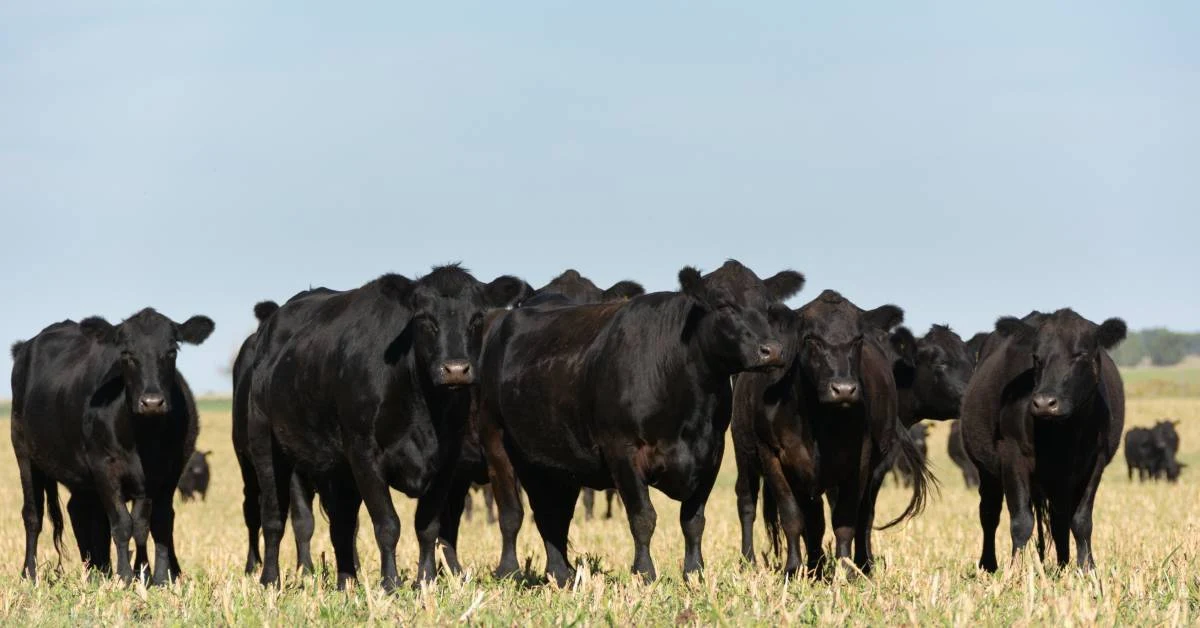

Angus cattle characteristics matter because you’re not just buying a look, you’re buying predictable performance. Angus is widely recognized as a premium Angus beef breed because the breed is strongly associated with high beef quality and a compact, beef-type build that fits commercial systems. It also ties into value-based marketing programs that screen cattle for “Angus-type” eligibility and additional carcass specifications. So, the right Angus-type cattle can be positioned for premiums when they hit the right targets.
In this guide, you’ll get a practical field + genetics view of Angus characteristics based on what you can verify on sight and what you should confirm using records and selection tools before you pay “premium” money.
Angus Breed Characteristics at a Glance
If you need a fast, decision-ready summary of characteristics of Angus cattle, start here. Angus (also called Aberdeen Angus) is a beef breed that’s naturally polled and is commonly black, with red also occurring. Many breed descriptions highlight a compact, low-set body and strong beef quality attributes.
Use this scorecard to separate “marketing claims” from what you can actually manage, measure, and verify in your herd.
| Trait Category | What You’ll Notice | Why It’s Valuable | What to Check/Measure |
| Physical | Polled head, solid coat | Easier handling, fewer injuries | Horn status, structure |
| Maternal | Easy-keeping, dependable cows | Lower labor + replacement stability | Calving history, udder |
| Performance | Early maturity, fertility | More calves, better turnover | Pregnancy rate, weaning % |
| Carcass | Marbling potential | Quality premiums | Carcass data, grid results |
| Marketability | “Angus-type” demand | More buyer pull | Program eligibility rules |
Aberdeen Angus Roots: What “Original Angus” Means Today
Angus and Aberdeen Angus refer to the same historical breed name, rooted in northeastern Scotland. The classic breed identity you still hear producers reference. polled (hornless) and black comes straight from those early cattle types and the way the breed was described and fixed over time. While modern herds include both black and red animals, the “original Angus” idea is really about that foundational type: naturally hornless, beef-focused cattle developed in tough conditions.
Why that origin still matters
Those Scottish conditions created natural selection pressure for hardy, efficient cattle. It is the kind that holds condition, breeds back, and keeps going when the environment is not forgiving.
That’s why many Angus breed characteristics you care about today still trace back to practical profit traits: fertility, easy-keeping cows, and beef quality. In the U.S., Angus influence spread widely after the breed was introduced, and it remains a major force in registrations and commercial use.
Physical Characteristics of Angus Cattle
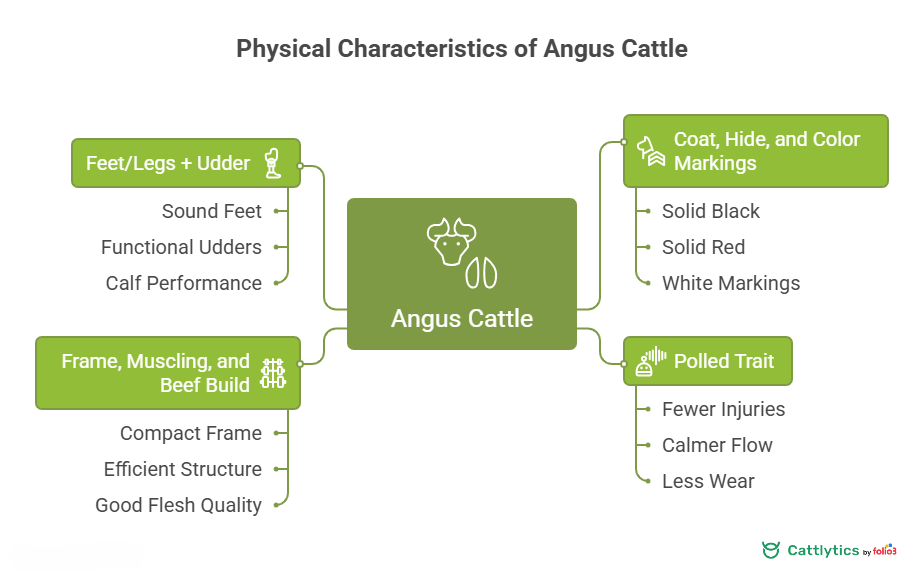
Angus are typically polled, solid black or red, with a compact beef build. You can quickly verify sound feet, structure, and udders before trusting paperwork.
Coat, Hide, and Color Markings
When you think “typical Angus,” you’re usually picturing a solid-coated animal, most commonly black, with red also recognized in breed descriptions. Some descriptions also note that white may occasionally appear on the udder, which matters if you market cattle into programs with strict visual screening. If you’re aiming for branded-beef eligibility, confirm the program’s phenotype rules. Because brand qualification is based on screening criteria, not just what the seller calls the animal.
Polled Trait (Hornless)
Angus cattle are widely described as polled. Operationally, that means fewer horn-related injuries, calmer chute flow, and less facility wear, especially if you run higher headcounts or rely on fewer hands.
Frame, Muscling, and the “Beef Build”
Across breed guides, Angus are commonly characterized as compact and low-set, with a clear beef type and good flesh quality. In practical terms, you’re looking for a balanced, efficient frame, enough depth and thickness to perform, without extremes that make maintenance costs climb or mobility slip.
Feet/Legs + Udder
This is where “premium” herds separate from average ones. Sound feet and legs support longevity and grazing ability, and functional udders protect calf start and weaning efficiency. If you ignore structure, you often pay later through lameness, early culling, and inconsistent calf performance.
Quick field ID checklist
- Polled head
- Solid coat (black/red)
- Beef built with sound movement
Key Angus Traits That Drive Herd Profit
Profit comes from cows that breed back, calve easily, and stay productive. Track pregnancy rate, calving interval, weaning percent, and cull reasons to manage improvement.
Temperament & Handleability
Temperament is not a “nice-to-have”; it’s a working trait that shows up in labor cost, safety, and chute flow. Angus are commonly described as calm and manageable, which can mean fewer wrecks at processing, less stress during shipping, and more predictable cattle movement. Keep selecting for it and cull chronic hot heads.
Fertility + Early Maturity
Fertility and early maturity are where many operations win quietly. If your cows breed back on time and your heifers reach puberty and calve without drama, you expose more females, wean more calves, and turn replacements into payback sooner. Angus are often positioned as efficient, with strong fertility and longevity in breed descriptions, so manage your own herd records to confirm repeatedly.
Calving Ease
Calving ease is an economic trait, not a slogan. Fewer pulls protect your heifers, reduce dead calves, and keep your labor where it belongs. The tradeoff is real: pushing calving ease too hard can cost you growth or carcass in some bloodlines, while chasing growth can raise birth risk. Later, we’ll tie this to Calving Ease and Birth Weight EPDs.
Maternal Function
Maternal function is the full package: milk level, mothering, and stability (how long cows remain productive). In most commercial settings, moderate milk that keeps cows in condition beats extremes in your environment. Thin cows don’t rebreed, no matter the pedigree.
What to track
Track: pregnancy rate, calving interval, weaning percent, replacement retention, and reasons for culls (feet, udder, disposition) by age group each year.
Angus as a Premium Beef Breed: Carcass Traits That Buyers Pay For
Buyers reward cattle that hit quality and yield targets consistently across loads. Focus on marbling potential, ribeye, and finish control, then validate with carcass data.
Marbling & Eating Quality
Marbling is the small flecks of intramuscular fat in the ribeye, and it’s a major driver of USDA quality grade. More marbling is associated with better eating satisfaction because it improves perceived tenderness, juiciness, and flavor, which buyers call “a better bite.” It’s not a guarantee, but it moves your odds in the right direction. Many breed guides point to natural marbling and higher carcass grades as key Angus cattle characteristics. That’s why grid buyers often start with marbling.
Yield, Ribeye, and “Sellable Pounds”
Premium pricing is rarely only about quality grade. Yield grade measures how much trimmed, saleable beef a carcass can produce, and it’s influenced by muscling and fatness. Ribeye area is one practical signal of muscling, which is why many branded programs set ribeye specifications. On grids, you’re paid (or discounted) directly on both quality grade and yield grade, two separate levers.
Consistency
Feedlots and packers like Angus-type cattle because they deliver predictable results at scale. More uniform lots reduce sorting headaches, shrink discounts from outliers, and improve overall buyer confidence. That’s the real value of “consistency”, repeatable cattle that hit specs more often.
Breed vs Brand vs USDA Grade
Here’s the confusion that costs producers money: breed, brand, and USDA grade are not the same thing. “Angus” can mean genetics (registered or Angus-influenced), but it does not automatically mean Certified Angus Beef. CAB first requires an “Angus-type” visual screen at the plant, and then meeting specific carcass specifications.
The “51% black hide” rule is a common myth; the brand describes a predominantly black hide with restrictions on other colors. USDA quality grades (Prime/Choice/Select) reflect palatability, largely driven by marbling and maturity. Yield grades are separate, measuring cutability and yield.
Practical takeaway
If you sell on grids, collect carcass data, align Angus genetics to your target, and validate program rules before you promise premiums. Build selection around records, not labels, to buyers.
Types of Angus Cattle and When Each Fits
Black and Red Angus share core traits, but coat color affects heat load and marketing. Choose types that match your climate, forage, and buyer preferences.
Black Angus vs Red Angus
Across types of Angus cattle, most black Angus cattle characteristics and red Angus cattle characteristics are the same: polled identity, beef build, and buyer pull. The real difference is coat color and heat load. Red Angus is promoted for heat tolerance, with red coats absorbing less heat than black coats in hot conditions.
When to choose: lean Red Angus in hot, humid regions, or where summer heat stress (including on fescue country) is recurring. Choose Black Angus when heat stress is low and your local market rewards black-hided calves most of the year.
Aberdeen Angus vs American Angus
For Aberdeen Angus cattle characteristics, Aberdeen Angus is the historical name for Angus, a polled breed from Scotland. In the U.S., standards evolved, but the foundation is the same.
Lowline/American Aberdeen
Lowline/American Aberdeen cattle are smaller-framed Angus-type cattle. It is quite useful when you want easier handling, moderate mature size, and efficient cows on limited forage and tighter facilities.
Angus-influenced composites
Angus-influenced composites like BrAngus were designed to blend Angus carcass merit with Brahman heat and humidity tolerance. It can be helpful if you need both quality and adaptability.
How to Select Angus Genetics for Your Operation
Start with your production goal, then use EPDs to predict calves’ performance. Balance calving ease, growth, maternal needs, and carcass traits for your environment reliably.
Start with your production goal
Before you chase Angus breed characteristics, decide what you’re paid for. If you keep replacements, you need maternal cows that calve, wean, and stay in the herd. If you sell calves or finish them, you may prioritize growth and feed efficiency. If you sell on grids, carcass EPDs matter. If you grass-finish, you’ll favor moderate size and doers over extremes.
The “EPD Shortlist” (what to prioritize and why)
EPDs (Expected Progeny Differences) are breed tools that estimate how a bull’s calves should perform relative to the breed average, assuming similar management. Use this shortlist to keep selection practical:
- Calving Ease Direct (CED) and Birth Weight (BW) for heifers and tight calving windows
- Weaning Weight (WW) / Yearling Weight (YW) when sale barn demand or feedlot performance drives revenue
- Milk (MILK) to avoid extremes that pull the body condition of cows
- Marbling (MARB) and Ribeye Area (RE) if you’re grid-focused
- Docility plus foot and udder traits (where reported) to protect longevity
Then compare EPDs by percentile and use indexes to balance calving, growth, and carcass instead of chasing one number.
Match genetics to environment & management
Match Angus characteristics to your country, not your neighbor’s. In hot, humid regions, red coats can reduce heat load, and Red Angus are marketed for heat tolerance. If you need even more adaptability, Angus composites like BrAngus were developed to combine Angus carcass strengths with Brahman heat and humidity tolerance. Whatever you pick, plan shade, clean water, and summer handling windows so genetics can express without unnecessary setbacks.
Buyer checklist
Before you buy, ask the breeder for proof, not promises:
- Calving history (heifers): pulls and birth weights
- Health protocol (vaccines, parasite control)
- Disposition and how cattle are handled
- Carcass or grid data (if available)
- Heifer development targets and breeding plan
- Genetic testing used and how it influenced decisions
- Performance in conditions similar to yours
Myths That Cost Producers Money
Angus marketing can confuse breed, brand programs, and USDA grades, costing you money. Avoid shortcuts, verify rules, and select balanced genetics instead of chasing extremes.
- Myth 1: “Angus label = premium eating quality.” Angus is genetics. “Certified Angus Beef” is a brand with its own specifications, and USDA quality grades (Prime/Choice/Select) are separate standards based largely on marbling and maturity.
- Myth 2: “51% black hide is all that matters.” Hide color alone is not the whole screen. Eligibility starts with an “Angus-type” visual appraisal with specific color-location rules, not a simple percentage shortcut.
- Myth 3: “All Angus are the same.” Angus cattle characteristics vary by selection goal. Some herds emphasize feedlot performance, others push maternal efficiency, and “heritage” messaging highlights different priorities.
- Myth 4: “Pick the top EPD in every trait.” Traits trade off. Use selection indexes to balance multiple economically relevant traits toward your objective instead of chasing a single extreme number.
Conclusion
Angus can earn “premium” status, but only when you match genetics to your environment and your market. Start with what you can verify: sound structure, functional udders, and calm cattle that handle well. Then, validate the rest with records and EPD tools, not labels. If you sell on grids, collect carcass feedback, and confirm brand eligibility rules before you chase premiums. Done right, Angus characteristics become a repeatable system, not a gamble.
FAQs
What Are The Key Angus Cattle Characteristics That Affect Profit Most?
Profit comes from cows that breed back, calve unassisted, and stay productive. Prioritize fertility, calving ease, moderate maintenance requirements, sound feet/udder, and carcass value (marbling/yield). Then verify with herd records and EPDs.
Are Black Angus And Red Angus Different Breeds Or Types?
They’re generally types within Angus genetics, distinguished mainly by coat color. Red Angus is often registered separately from Black Angus, but both trace to Aberdeen Angus and share core breed traits; selection goals may differ by herd.
Does “Certified Angus Beef” Mean The Animal Was Purebred Angus?
No. Certified Angus Beef is a brand program, not a proof of purebred status. Carcasses must pass an “Angus-type” visual hide screen and meet additional quality and carcass specifications at harvest to qualify.
Are Angus Cattle Good For Grass Finishing?
Yes, Angus can work well on grass, but results depend on forage quality, stocking rate, and choosing moderate, efficient genetics. Use your own performance data, including average daily gain, finishing time, and carcass feedback, to validate fit.
What Are The Best Angus EPDs For First-Calf Heifers?
For first-calf heifers, start with Calving Ease Direct (CED) and Birth Weight (BW) to reduce dystocia risk. Then balance with reasonable growth and maternal traits (Milk/CEM), so you don’t sacrifice future performance.