

If your cattle breeding results slip, you don’t just lose a calf, you lose a year of feed, labor, and momentum. When you’re breeding cattle, fertility rarely breaks because of one big mistake. It usually leaks through preventable process gaps: heat timing that gets missed, cows going into breeding thin, bulls that aren’t truly ready, heat stress, unmanaged disease risk, or records that don’t tell you who is late, open, or repeatedly cycling.
The stakes are real as the latest U.S. inventory report estimates the 2025 calf crop at 33.1 million head, which makes every successful pregnancy more valuable, not less.
Whether you’re managing a cow-calf operation, running stockers, or finishing cattle, understanding how breeding decisions cascade through your entire production system determines profitability. In this guide, you’ll get a clear cycle blueprint, a practical season plan, a heifer timeline, and a data-driven fertility loop, so you can choose the right breeding approach and lift pregnancy rates with controls you can measure each week.
The Cattle Breeding Cycle at a Glance
See the full 12-month cattle breeding cycle in one clear loop from cow calving through postpartum, breeding, pregnancy, and pre-calving. You’ll know what to do in each phase to stay on schedule.
The 5 Phases That Repeat Every Year
Think of the cattle breeding cycle, the breeding cycle of cattle as a 12-month loop with five phases that repeat successfully in every herd.
- Cow calving starts the clock: you record the calving date, calving ease, and the calf’s vigor.
- Postpartum recovery is your rebuild window; uterus healing, energy balance, and returning to heat.
- Breeding window is where cows reproducing matters most: heat detection and timing (or your bull and pasture plan) decide how many conceive early.
- Early pregnancy is a “protect the embryo” phase; stress, disease, and poor nutrition can quietly turn pregnancies into losses.
- Late pregnancy & pre-calving is where you set up the next calving season with nutrition, minerals, and facilities that reduce dystocia and downtime.
The “North Star” Outcomes This Cycle Must Deliver
Your “north star” in cattle breeding is simple: one live calf per cow, every year, but the path to that outcome is measurable. Start with a defined breeding season so you can tighten calving distribution. Then manage for fewer open cows by controlling the biggest drivers: body condition at breeding, bull/AI readiness, heat stress, and timely pregnancy diagnosis.
Use a short set of controls to keep the cycle on track:
- Breeding season length you can defend, not “whenever”.
- 21-day check-ins on heats bred / cows exposed, then pregnancies confirmed.
- Preg-check decisions: rebreed, resync, or cull fast.
Annual Breeding-Cycle Calendar:
| Phase | Timing | Primary goal | Manager actions | What to record |
| Calving | Week 0 | Live calf + fast recovery | calving prep, reduce dystocia risk, colostrum & calf vigor checks | calving date, calving ease, calf ID/weight |
| Postpartum | Weeks 1–8 | Return to cycling | BCS recovery, health issues, heat stress mitigation | BCS, health events, & anestrus flags |
| Breeding | 45–90 days window | High early conception | heat detection + timing, AI/NS execution, bull management | heats, services, bull exposure |
| Early pregnancy | first trimester | maintain pregnancy | minimize stress, manage disease/nutrition | preg check + recheck |
| Late pregnancy | last trimester | set up next calving | nutrition, minerals, calving facilities | expected calving window |
How Do Cows Reproduce?
Understand how cows’ reproduction actually works on-farm: heat length, ovulation timing, and why missed heat quietly costs pregnancies. You’ll learn the timing rules that protect conception rates.
Estrous Cycle Basics That Matter on Farms
On most farms, the breeding cycle of cattle is won or lost on two numbers: how often cows cycle and how long they stand to be bred. Most females are polyestrous, meaning they can cycle repeatedly through the year when they’re not pregnant. The estrous cycle is typically about 21 days, so if a cow doesn’t conceive, she usually comes back in heat roughly three weeks later.
What matters operationally is “standing heat”, when she will stand to be mounted. In cattle, that receptive window is short, so missed heat becomes the #1 silent loss in many herds. Quick checks once a day often miss it.
Ovulation timing explains why: ovulation occurs close to the end of estrus and commonly around 10–12 hours after estrus ends.
Best Time To Breed (Natural Service vs AI Timing)
Whether you’re using a bull or AI, your goal is the same: get sperm in place before ovulation, without breeding so early that it’s “too old” by the time the egg releases. With natural service, you’re relying on the bull’s ability to detect heat, cover enough cows, and stay sound through the season, so bull fertility and bull: cow management become your timing control.
With AI, timing and technique are the control points. A common guideline is the AM/PM rule: if you observe standing heat in the morning, inseminate that evening; if you see standing heat in the evening, inseminate the next morning.
Choose Your Cow Mating Season by Working Backwards from Your Calving Goal
Start with the calving season you want, then work backward to set your cow mating season and breeding start date. It turns breeding from “whenever” into a calendar you can manage.
The “Backward Plan” Method
Start with the day you want calves on the ground, then work backward to set your cow mating season with intention. Map dates including your desired calving start, your breeding start, and your prep window before breeding, so it’s not left to chance.
Use this backward plan:
- Pick your calving start date by systematically preparing facility readiness, labor, forage, and considering seasonal weather patterns.
- Count back the normal gestation window, about 285 days, to estimate when breeding should start.
- Block 45–60 days before breeding for “pre-breeding readiness”.
- Set your pregnancy-check window early enough to still rebreed, resync, or cull.
This turns cow calving from a surprise into a managed season.
Why Defined Breeding Seasons Outperform Year-Round Breeding
Defined breeding seasons outperform year-round breeding because they force clarity, and clarity drives better decisions. When you breed cows in a defined window, you get a tighter calf crop: calves are more uniform in age, management is simpler, and marketing options improve because you’re not selling a mixed group.
A controlled calving season is often described as a 60–90 day period, which makes nutrition, health work, and labor planning easier because animals are more similar at any given time. Research summaries also report lower returns with year-round calving versus seasonal systems.
It also creates discipline. You can identify late-calving and open cows sooner, track calving distribution in 21-day blocks, and make culling decisions that protect next year’s fertility.
Pre-Breeding Readiness Checklist Where Most Fertility Is Won or Lost
Most fertility losses happen before breeding even begins. This checklist helps you fix the preventable issues early, when changes still impact outcomes.
Nutrition and Body Condition (BCS) Targets that Actually Move Pregnancy rates
BCS is your quickest predictor of whether cows will cycle early and stay pregnant. On the 1–9 beef BCS scale, guidance commonly recommends mature cows around BCS 5–6 at breeding and avoiding cows below 5, which is linked with weaker reproductive performance. Score cows 45–60 days before the breeding date so you can correct the condition before heat cycles:
- Sort thin cows (and first-calf heifers) into a priority group so they can gain condition before breeding starts.
- Fix the ration now; don’t “play catch-up” after breeding begins; early lactation pulls energy to milk first, so late condition gain is less reliable.
- Recheck BCS at turnout/AI start and flag cows still below target for closer heat and pregnancy monitoring consistently.
Health, Vaccination, and Biosecurity
Conception and early pregnancy losses often look like “random opens” until you audit health and biosecurity. Build a comprehensive pre-breeding health plan to address nutrition, preventive care, parasite control, and vaccination protocols. Hence, protection is in place before exposure, and cows enter the breeding season in optimal condition:
- Keep reproductive vaccinations current and time boosters ahead of breeding.
- Replacement heifers may need a two-dose series for some vaccines if not previously immunized.
- Quarantine new or returning animals before mixing, and use testing where appropriate to reduce disease introduction into breeding cattle.
- Minimize early-pregnancy stress: avoid unnecessary commingling/handling and keep nutrition consistent during the first weeks after breeding. Track repeats and abortions.
Bull Readiness
With natural service, one subfertile bull can quietly “open” a whole group. Conduct a comprehensive breeding soundness exam (BSE) every year and schedule it 60–75 days before the breeding season, so you can retest or replace bulls if needed; even proven bulls can change year to year. A good BSE evaluates physical soundness and semen quality.
Then verify performance in the pasture: watch libido and mounting activity in the first week, and remove bulls showing any signs of lameness, or mobility issues that limit their ability to detect heat, mount cows, and cover assigned territories or poor serving behavior. Have a backup plan, like a spare bull or an AI option, ready before turnout. Record dates and bull assignments by group.
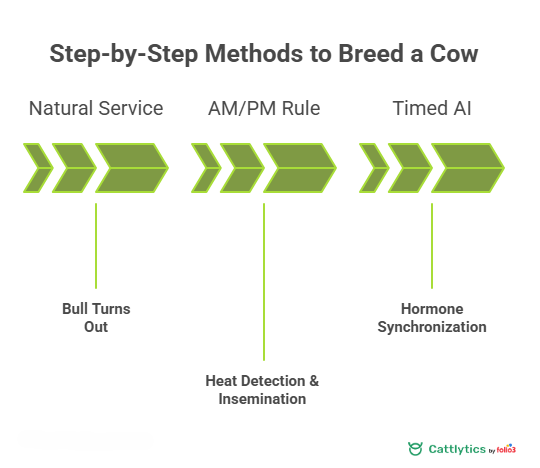
Step-by-Step Methods to Breed a Cow
Learn how to breed a cow using natural service, AI, or timed AI without guesswork. You’ll get clear steps for heat detection, timing, and execution so your system stays consistent.
Method 1: Natural service
Natural service is the simplest answer to “how are cows bred?” You turn out a bull, and he handles heat detection. The upside is lower laborcosts and fewer trips. The downside is the concentration of risk: one subfertile, injured, or low-libido bull can leave many breeding cows open. A pre-season breeding soundness exam and observation of serving ability help reduce that risk.
If you run multi-sire groups, you reduce single-bull failure, but tracking breeding dates and parentage becomes harder unless you have strong ID and records. Because exact service dates are less visible, pregnancy diagnosis becomes your accountability tool. So, schedule it early enough to still rebreed or cull within your season.
Method 2: Artificial insemination (AI) with the AM/PM rule
AI is the most controllable way to “how to breed a cow,” but only if you treat timing like a process. Start with disciplined heat detection focused on standing heat (she will stand to be mounted). Record the first time you see standing heat, then inseminate about 12 hours later using the AM/PM rule: seen in the morning, breed in the evening; seen in the evening, breed the next morning.
Use this tight decision sequence:
- Confirm standing heat (avoid breeding on vague signs).
- Note the first observation time and animal ID.
- Breed ~12 hours after first standing heat.
- Handle cattle calmly and follow standard semen handling and placement practices.
- If you only check once a day, you’ll miss heats; build morning/evening checks into your routine consistently.
Method 3: Timed AI & Synchronization
Timed AI reduces dependence on heat detection by scheduling ovulation and insemination, useful when labor is tight, heats are being missed, or you want a tighter breeding batch. It helps you breed more cows in fewer days.
In simple words, protocols use hormones to “set the clock”:
- PGF2α regresses the corpus luteum (progesterone source), so cows move toward estrus; it only works when a corpus luteum is present.
- GnRH helps synchronize ovulation so AI can be scheduled.
- CIDR-type progesterone devices provide progesterone for a set period to tighten the response.
Quick note (advanced options): ET/IVF is most defensible for multiplying elite females; sexed semen is often recommended for heifers because conception is typically lower than conventional.
Pregnancy Confirmation to Turn Breeding into Decisions
Pregnancy checks replace assumptions with complex numbers, pregnant, open, or needs rework. You’ll know when to test, how to interpret results, and what actions protect your next calf crop.
Pregnancy Diagnosis Options and Timing
Pregnancy diagnosis turns cattle breeding into a managed process, not a guess. Your main options are rectal palpation, ultrasound, and blood tests. Practical timing varies: blood tests can be used from roughly 28 days after breeding, while ultrasound and palpation are commonly used from about 30 days or later, depending on technician skill.
Many herds schedule pregnancy determination soon after the breeding season ends, often 45–60 days, so decisions can be made before high-cost feeding periods. Consider a recheck later if you need more confidence on viability or fetal age, and use early results to sort feeding groups and market nonpregnant cows sooner, and future culling decisions.
What to Do with Open Cows
When you find open cows, decide fast and tie the choice to your season length and feed costs. Use simple rules:
- If time remains in your defined season, resynchronize and rebreed (AI) or re-expose (bull), prioritizing young, healthy cows.
- If you’re near the season cutoff, stop extending the calendar as the market opens before expensive feed kicks in, or cull chronic late-breeders so next year’s calf crop tightens.
- Manage opens as a separate group so they don’t distort your cow calving distribution, and record repeat breeders to spot pattern problems.
Cow Calving + Postpartum Where Next Year’s Pregnancy Rate Is Set Up
Cow calving and early recovery set the stage for rebreeding success and a tighter calving season. You’ll see how calving ease, health events, and nutrition impact days open.
Calving Management That Reduces Rebreeding Problems
Cow calving is not just about getting a live calf; it’s about protecting the cow so she can cycle and conceive again on time. Therefore, understanding the stages of labor from early cervical dilation to placental expulsion and knowing when to intervene versus when to wait directly influences dystocia rates, postpartum uterine health, and the speed at which cows return to cycling.
Practical calving-ease moves you can control:
- Match sires to females: Use calving-ease sires for heifers and more miniature cows, and keep birth-weight risk realistic for your environment.
- Avoid “starving for smaller calves”: Restricting nutrition late in gestation can increase dystocia risk and is associated with prolonged postpartum anestrus and lower subsequent pregnancy rates.
- Reduce stress at calving: Provide clean, dry footing; monitor often enough to assist early when needed; and keep handling calm and efficient.
- Record what matters: Salving date, calving ease score, and any retained placenta or uterine issues; these are your early warning signs for rebreeding risk.
Postpartum Return to Estrus
In the cattle breeding cycle, postpartum timing is why some cows “just don’t get bred back.” The first estrus after parturition can vary widely, so you need proactive management, not waiting and hoping. In cows in adequate body condition, resumption of estrous cycles is commonly around 45–70 days after calving, while many first-calf cows may not resume cycles until 75–120 days postpartum.
What pushes cows later (more “days open”):
- Nutrition and body condition: reproduction ranks low in nutrient priority, especially during lactation.
- Health events: dystocia, retained placenta, uterine infection, and disease extend postpartum intervals and reduce conception opportunity.
- Heat stress/season effects: environmental conditions can lengthen the interval to first ovulation and estrus.
Systematic health monitoring that tracks treatment events, recovery progress, and body condition changes helps you identify which cows need extra recovery time or nutrition support before they’re ready to rebreed successfully.
Heifer Calving Timeline for the Replacement Heifers and First-Calf Rebreed Plan
A clear heifer calving timeline prevents late breeders and open first-calf heifers. You’ll use age and % mature weight targets, then plan breeding so heifers calve early and rebreed on time.
Targets Before First Breeding (Age, Size, Weight)
A reliable heifer calving timeline starts with one practical gate you can measure: percent of mature weight at breeding. Many programs still target heifers reaching roughly 65–75% of projected mature body weight by the start of the breeding season to support pregnancy rates, especially when breeding around 13–15 months to calve as 2-year-olds.
How to make it operational:
- Estimate mature weight from your cow herd, then calculate the 65–75% target.
- Weigh (or tape) heifers at weaning and again 60–90 days pre-breeding to confirm they’re on pace.
- Use reproductive tract scoring as an additional readiness check if you have veterinary support and want better prediction of cycling status.
How to Avoid First-Calf Heifers from Becoming Your “Open Cow Factory”
First-calf heifers are the easiest group to lose on rebreeding because they’re still growing while lactating. A widely recommended strategy is to start heifer breeding about 2–3 weeks before the mature cow herd, so they calve earlier and have more recovery time before the next breeding season.
Pair that with calving-ease sires and tighter monitoring post-calving, and you reduce the chance they fall behind the herd’s cycle.
Heifer Timeline Checklist:
| Stage | Timing | What you do | What you record |
| Weaning | Start point | select replacements, set target gains | weight, ID |
| Pre-breeding | 60–90 days out | verify % mature weight, health plan | weights, RTS (if used) |
| Calving | first calving | calving-ease focus, clean environment | calving date/ease |
| Rebreed | next season | breed 2–3 weeks earlier | exposure dates, preg status |
Improve Herd Fertility with Data + Agtech and Fix Problems Faster
Data and Agtech help you catch fertility problems early before they become open cows and late calvers. By managing cattle breeding records in a system, you’ll track the right KPIs, choose practical tools, and troubleshoot issues in the right order.
The Fertility KPI Dashboard for Weekly Measurements in Breeding Season
If you want cattle breeding to improve, run a “weekly scoreboard” during the breeding window. Start with the end goal: a repeatable annual cycle, with calving-to-calving as close to 365 days as possible. Track four numbers that drive that outcome:
- Calving distribution (21-day blocks): Benchmarks often used in cow-calf herds are 63% calving in the first 21 days, 87% by 42 days, and 96% by 63 days. If you’re under target, tighten your breeding season and fix late-breeder root causes.
- Conception/pregnancy results: Preg-check outcomes by group (cows vs heifers, pasture groups, bull groups) tell you where the leak is.
- Days open / days to conception: Longer open periods push calving later and stretch intervals.
- Recheck outcomes: A second check helps confirm viability and validates whether early losses are occurring.
Agtech Stack that Pays Back
Use Agtech to reduce missed opportunities, not to create more data you never review. Estrus sensors and activity tools work because of movement patterns. In some systems, automated monitoring systems detect temperature changes, activity spikes, and behavioral shifts that signal reproductive events, helping you act faster when cows are hard to watch or when heat detection labor is limited.
- Tail paint/patches to confirm mounting activity on pasture.
- EID + simple digital records so heats, services, treatments, and calving dates stay tied to the right animal and are easy to pull in the field.
- Mobile checklists + calendar reminders for vaccinations, bull exams, synchronization shots, and preg-check windows, so timing doesn’t depend on memory. Also, set alerts for late cows and non-cyclers, then act on them the same week.
Troubleshooting Playbook to Diagnose Low Pregnancy Rates
When pregnancy rate slips, don’t guess, triage in the order that finds the biggest failures fastest:
- Heat detection vs bull failure: If you’re AI-heavy, audit heat detection and submission timing; if you’re natural service, verify bull soundness and libido, and watch early-season serving behavior.
- Nutrition/BCS drift: Check condition and energy balance, especially postpartum groups.
- Disease/vaccination gaps: Review your pre-breeding health plan and any abortions/repeats; adjust biosecurity if new animals are entered.
- Heat stress and handling stress: Heat stress can reduce reproductive success and bull activity; mitigate shade, water access, and handling intensity.
- AI timing/technique and semen handling: If returns are clustered at ~21 days, re-check timing discipline and technique.
Make it Operational!
In the next 30 days, pick your desired calving start date and work backward to set a defined breeding window. Run the pre-breeding checklist and book a pregnancy diagnosis before your high-cost feeding period. Then track KPIs weekly: heats bred or cows exposed, returns, BCS drift, and 21-day calving distribution, and correct the first weak link you see so your cattle breeding decisions stay on schedule and profitable. To ensure the smooth implementation of a cattle breeding management program, consult with our experts at Cattlytics.
FAQs
How Long Is The Cattle Breeding Cycle?
On an individual cow, the estrous (heat) cycle is typically about 21 days, so she can return to heat roughly every three weeks if she doesn’t conceive. In herd planning, the cattle breeding cycle is the calving-to-calving loop you manage.
How Do I Know When A Cow Is In Heat?
The clearest sign is standing to be mounted (“standing heat”). You may also see increased walking and bawling, mounting other cows, and clear, stringy mucus. Because heat often lasts only about 12–18 hours, check cows at least in the morning and evening.
What Is The Best Time To Breed A Cow Using AI?
Aim to inseminate about 12 hours after you see standing heat, the AM/PM rule(seen in the morning, breed that evening; seen in the evening, breed next morning. It works because ovulation occurs after estrus ends, so sperm need lead time.
How Soon After Calving Can A Cow Get Pregnant Again?
A cow’s uterus needs time to return to normal after calving, so breeding is commonly started around 45–60 days postpartum. Mature cows in good condition resume cycling about 45–70 days after calving, while first-calf cows can take longer.
What Does A Heifer Calving Timeline Look Like For First Calving At 2 Years?
For first calving at 2 years, most systems breed heifers at 13–15 months once they reach about 65–70% of mature weight. Many herds start heifers 2–3 weeks before the cow herd, then manage nutrition so they rebreed on time.