

If you manage cows for a living, “how long do cows live?” is not a trivia question; it’s a replacement-cost and milk-per-stall question.
In this guide, you’ll get quick, credible numbers for cow life expectancy. We’ll unpack what actually drives cow lifespan on-farm and what you can do to extend it without sacrificing profitability.
Quick Answer: How Long Do Cows Live for?
The answer to this most important question among the ranchers lies between two segments as defined below:
Natural lifespan vs. managed lifespan
Biologically, cattle can live for decades; the natural lifespan of a cow can be around 20 years when health, nutrition, and environment are favorable. That’s the ceiling. Managed lifespan is what happens in real herds, shaped by disease pressure, fertility, facility comfort, and the economics of keeping versus replacing a cow. When involuntary issues drive exits, cows leave earlier even if their genetic potential is higher. So the practical question is: what keeps her productive, problem-free, and worth saving?
Average dairy cow lifespan
If you’re asking how long cows live on a dairy, the practical answer is far shorter than the biological ceiling. Usually, the productive life averages about 3–4 years in high-producing systems. With first calving typically around 2 years of age, that often translates to total life from birth to exit around 4.5–6.5 years, and cow life expectancy varies by country, housing, and health pressure. As a benchmark, Dutch herd data found an average cull age of 5.87 years. Treat these as reference ranges, then compare them to your herd’s exit ages, parity profile, and cull reasons in the benchmarks section.
Clarifying Terms like Lifespan, herd life, productive life
To keep “cow age span” conversations useful, separate the three terms.
- Biological lifespan is how long a cow can live in ideal conditions.
- Herd life is the total time from birth to when she exits the herd.
- Productive life is the working window from first calving to exit when she’s expected to pay back rearing costs and generate a margin.
Why Producers Should Care?
These definitions matter because the economics land in productive life, not in the biological maximum. If cows leave after only a few lactations, you’re constantly paying to raise or buy replacements, and you carry more non-productive animals in the pipeline.
In one industry example, the current average number of lactations is about 2.8. It means many cows exit before they reach later-parity maturity, when yield and efficiency often peak. Extending productive life, mainly by reducing involuntary culls, can spread rearing costs across more milk.
Moreover, it stabilizes labor and health workload, and reduces the herd’s environmental footprint because fewer replacement heifers are needed. It also signals that your facilities, nutrition, and health programs are supporting welfare outcomes you can stand behind.
Average Cow Lifespan Benchmarks by Type of Cow
When you search “average cow lifespan,” you’ll see big numbers and small numbers side-by-side, because people mix biological potential with commercial reality. Use the benchmarks below to interpret “life expectancy of cows,” then compare them to your own exits.
| Type of cow/scenario | What the number represents | Typical benchmark |
| Biological potential (ideal conditions) | How long does a cow live | 20 years |
| Dairy cow in high-producing systems | Productive life and total life | Productive life 3–4 years; total life commonly 4.5–6.5 years |
| Dairy herd example (Netherlands data) | Average age at culling | 5.87 years |
| Beef cow–calf systems (context) | Typical ages at slaughter | Beef cows often remain longer, like 7–12 years |
The takeaway: don’t chase a single “average lifespan of a cow” number. Track your average cow lifespan and the % of cows reaching later parities, then fix the top exit reasons first.
Why Dairy Cows Often Don’t Reach Their Full Lifespan
Most cows leave early due to fertility, udder, or hoof issues, not age. Understanding these drivers helps you target management fixes that protect longevity without sacrificing milk or herd efficiency.
The Big Three Cull Drivers
If you want to understand dairy cow life expectancy on your farm, start with the same three exit buckets that show up repeatedly in the literature:
- Reproduction failure (open cows/repeat breeders)
- Udder health (especially mastitis)
- Lameness
These are “compounding” problems: they don’t just cut milk, they add treatment time, push cows out of cycle, and increase involuntary exits. Treat them as your diagnostic lens. Pull 12–24 months of culls, tag each exit to one of the three drivers, and you’ll quickly see where your dairy cow lifespan is being lost.
The Overlooked Driver
Here’s the part many teams miss: cows can also leave early because of inventory pressure, not biology. When your replacement pipeline is bigger than your stall capacity, fresh heifers have to enter the milking string, and something has to give.
Research reviews identify the availability (supply) of replacement heifers as a major driver of productive lifespan. Reducing the heifer supply can extend average productive life and improve environmental sustainability.
Practically, this shows up as “voluntary” culls: a cow that is still milking but is sold because she is older, lower in rank, or one health event away from trouble. If you’re raising excess heifers, you also carry more feed, labor, and housing costs in youngstock. It is an expense that has been flagged as a significant financial burden when replacements are overproduced.
Dairy Cow Lifespan Timeline: Calf → Heifer → Milker → Cull
A cow’s total life is shaped by age at first calving, calving interval, and culling decisions. Seeing the full timeline helps you spot where productive years are gained or lost.
The “Age Math” Most People Miss
Total cow lifespan on a dairy is mostly math: Total life (birth → exit) = age at first calving + productive life (1st calving → exit).
One U.S. survey reported an average age at first calving of 25.0 months (~2.1 years). If productive life averages ~3–4 years in high-producing systems, total life commonly lands around ~5–6 years for that cow and herd, depending on calving interval and culling policy.
Practical Reference Timeline
Use this as a practical reference when you explain the lifespan of a dairy cow to your team and when you sanity-check your own numbers.
- Birth → first calving: Use the data reported an average age at first calving of 25.0 months as the reference. Each calving stage and monitoring for complications helps ensure heifers enter their productive life healthy and ready to perform.
- Milking life: After first calving, each additional lactation depends on reproductive performance and the time between calvings. Plus, an average calving interval of spans 13.1 months, which influences how many lactations a cow can complete before she exits.
- Where many herds land today: An extension example reports the current average number of lactations is 2.8, translating to cows being in the herd for about 60 months.
Why this matters: When average lactations stay low, you need more replacements to maintain herd size, and that replacement demand affects both costs and the operation’s environmental footprint.
What Actually Determines Cow Life Expectancy on-Farm
Your cow’s life expectancy is rarely “luck.” On most farms, cows leave early because health and fertility issues stack up then economics makes the exit decision. Research consistently ties culling to production and health constraints, with reproduction, mastitis/udder problems, and feet/leg issues appearing repeatedly as core drivers.
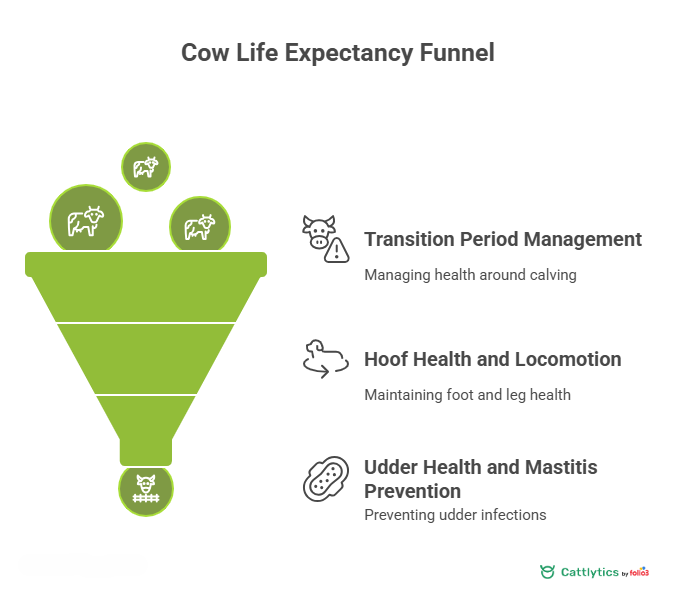
Transition Period Management
If you want to protect the life expectancy of a cow, start in the transition period. Metabolic stress around calving is strongly associated with downstream health problems, and those problems show up later as poorer reproduction, more udder infections, and higher exit risk.
Keep it practical: focus on consistent intake, clean and comfortable fresh pens, and early identification of off-feed or “not quite right” cows. Thorough calving season preparation, including facility setup, nutrition planning, and staff protocols, reduces the metabolic stress that creates downstream fertility and health problems. The goal is simple: reduce the cascade that turns one rough freshening into a season of fertility, hoof, and mastitis trouble.
Hoof Health And Locomotion
Lameness is not just a foot problem; it’s a longevity problem. Feet and leg disorders repeatedly appear among the major reasons cows exit, and lameness is also linked to poorer reproductive performance, which compounds cull risk. Understanding the full scope of lameness in cattle, from early detection to treatment protocols, helps you build prevention systems that protect both milk output and cow lifespan.
At the SOP level, tighten the basics you can control: routine locomotion scoring, a consistent trim cadence, dry and well-bedded stalls, and flooring that reduces slips and excessive wear. When you measure lameness early and respond fast, you protect both milk and cow lifespan.
Udder Health And Mastitis Prevention
Mastitis is one of the most common pathways to involuntary culling, especially when cases recur. Along with mastitis, recognizing symptoms and treatments for common cow diseases early helps prevent minor health issues from escalating into chronic conditions that force involuntary exits. Evidence shows recurrence increases culling risk, and mastitis is frequently cited alongside infertility and lameness as a leading cull reason.
Your decision thresholds matter. If a cow repeatedly relapses, spends extended time out of the tank, or becomes a chronic high-SCC liability, the “keep treating” path can quietly become more expensive than replacement. Use clear rules based on your records so you’re not making high-cost decisions on a bad day.
How To Extend Dairy Cow Lifespan Without Sacrificing Production
Improving dairy cow lifespan is not about keeping every cow forever; it’s about reducing preventable, involuntary exits while keeping your herd productive. A comprehensive approach to cattle care covering nutrition, housing, health protocols, and welfare creates the foundation for longevity improvements.
The best herds treat longevity like a system: they measure why cows leave, tighten transition/hoof/udder fundamentals, and make replacement decisions with consistent rules instead of emotion.
A 90-Day Longevity Audit
- Pull your last 12–24 months of exits and sort them into a short list of reasons.
- Then do a quick Pareto: what 2–3 reasons account for most culls?
- Next, segment by parity; first-lactation vs mature cows, because the “why” often differs by age group.
- Finally, split each exit into involuntary vs elective as that one split usually reveals whether management issues or replacement pressure is driving your dairy cow’s life expectancy.
A dedicated cattle management system streamlines this entire audit process by automatically categorizing exits, calculating parity distributions, and generating reports that show exactly where your longevity losses are occurring.
The Longevity Levers Checklist
Use this checklist to target the biggest controllable drivers of dairy cow lifespan:
- Transition cow SOP: consistent fresh-cow checks; reduce metabolic stress and support energy balance
- Lameness prevention: locomotion scoring, trim cadence, stall comfort, and footbath, where relevant
- Mastitis control plan: focus on recurrence prevention and chronic-case management
- Repro KPIs: conception/pregnancy rates, plus a deliberate voluntary wait strategy
- Heifer pipeline control: reduce “forced replacement” dynamics when cows are still viable
Culling Decisions From Gut-Feel To Decision Support
Longevity improves when your culling rules are consistent. Therefore, replacement decisions are driven by how a cow ranks on production, reproduction, and health relative to herd mates and the availability of replacements. Digital record systems for cow-calf operations provide the historical production, health, and reproductive data you need to make objective replacement decisions rather than relying on gut feel or incomplete memory.
A practical decision-support mindset is: keep the cow if her expected value exceeds the value of replacing her right now. A recent open-access economic framework describes a straightforward rule built around comparing cow value to replacement value, which helps remove bias from stressful decisions.
It is how some herds improve cow lifespan without an economic penalty: they don’t “save” problem cows. However, they avoid premature exits for cows that are still net-profitable, while culling chronic-risk cows earlier and more deliberately.
Breed and System Differences That Change Cow Life Expectancy
Genetics set potential, but housing, nutrition, and production pressure determine reality. Comparing systems explains why some cows live decades while dairy herds see much shorter working lives.
How Long Do Highland Cows Live?
Highland cattle are known for longevity compared with many commercial breeds. Breed materials describe cows commonly living around 18–20 years, with 20 years “not uncommon,” and note that females may continue breeding beyond 18 years, some producing up to about 15 calves across an 18–20 year productive window when managed well.
Meanwhile, longevity is most often discussed in beef or conservation herds, where cows are not pushed for maximum milk output. So, they can be kept for maternal performance and temperament as long as they stay sound and their body condition is protected.
Why “Breed Lifespan” Rarely Equals “Dairy Herd Lifespan”
Breed potential is only one input to cow life expectancy. In a dairy herd, the system sets the outcome: high milk demand increases metabolic load, and housing, hoof health, udder health, and reproduction performance drive involuntary culling. On many operations, cows average about 2.8 lactations, so “cow lifespan” is often more about management and replacement strategy than breed genetics. If you have surplus heifers, voluntary culls rise, and older cows exit sooner.
KPIs to Measure Cow Lifespan the Right Way
Track cow life span with a small monthly dashboard:
- Average lactations (herd average)
- Age at culling (months/years)
- % of cows reaching 3rd lactation
- Cull rate (total and involuntary)
- Lameness prevalence and locomotion-score distribution
- Mastitis indicators: bulk tank SCC trend and clinical case rate
These six metrics translate “cow lifespan” into numbers you can review in herd meetings and tie directly to the main exit drivers without waiting for annual reports or end-of-year summaries alone. Automated cattle health monitoring systems can track many of these indicators continuously, flagging trends before they show up as culling events.
Conclusion
Cow life span is not a fixed breed number; it is a management outcome you can influence. When average lactations hover around 2.8, many cows exit before mature, efficient parities, which drives replacement demand and cost. That also improves sustainability by reducing youngstock rearing pressure. Your best leverage is simple: measure why cows leave, tighten transition, hoof, and udder SOPs, and align heifer supply with stall capacity. If you want, we can help you with a longevity Audit template plus a KPI dashboard you can use in herd reviews. Let’s connect with our experts at Cattlytics to see how it works.
FAQs
What Is The Life Expectancy Of A Cow In Ideal Conditions?
In ideal conditions, the life expectancy of a cow is often cited as around 20 years. Getting close requires steady nutrition, low disease pressure, and safe facilities; biology sets the potential, but your management keeps cows sound and comfortable long enough.
How Long Do Dairy Cows Live On Average?
In high-producing systems, dairy cow lifespan is often 3–4 productive years after first calving, with total life commonly near 5–6 years. A dataset reported an average cull age of 5.87 years, so use it as a reference, not a rule.
What Shortens Dairy Cow Lifespan The Most?
Most early exits trace back to three repeat offenders: reproduction failure (open cows), mastitis, and lameness. These issues reduce performance and increase treatment time, so they quickly become involuntary culls. Track them monthly before you chase genetics or milk targets.
How Long Do Highland Cows Live Compared To Most Breeds?
Highland cows are often described as living up to about 20 years, and cows may keep breeding beyond 18 years in well-managed herds. That’s generally longer than many commercial cattle types. Remember, those numbers reflect low-intensity systems, not high-output dairy conditions.
What’s The Difference Between Cow Lifespan And Productive Life?
Cow lifespan (longevity) is the full time from birth until culling or death. Productive life is the working window from first calving to exit, when she repays rearing costs. For herd decisions, productive life is usually the more actionable metric.