

Buying a bull can feel like drinking from a firehose: catalogs packed with numbers, a pen full of bulls, and one decision that shapes your next calf crop. The stakes are high because a single bull can sire dozens of calves in a season, as one survey-based paper summarizes that bulls can sire about 25–60 calves per year in extensive systems.
Fertility risk is also more common than most people think. In one field testing program, about 20% of bulls initially failed to meet minimum breeding soundness standards, and roughly 17% were ultimately deemed unsatisfactory after retesting.
This buyer’s guide turns “Bull Selection Criteria” into a step-by-step workflow. Follow this structure, and you’ll walk into a sale with a short list you trust and walk out with a bull that fits your ranch, not just the catalog.
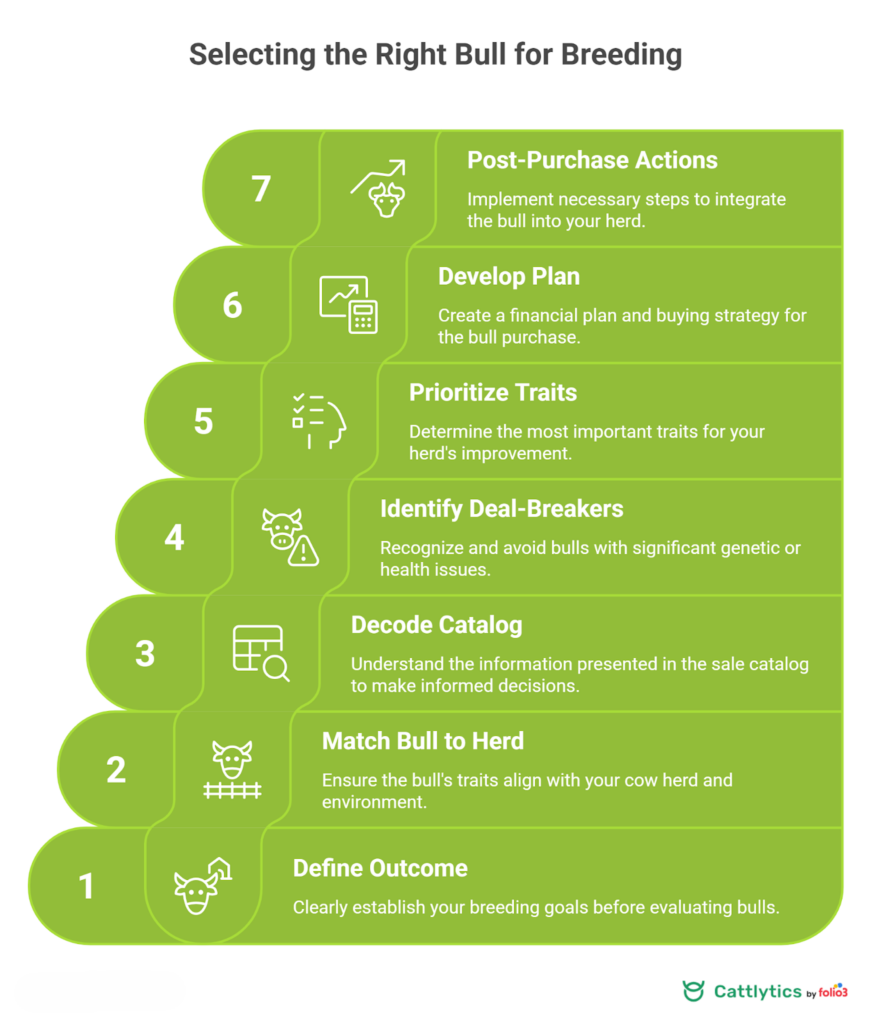
Step 1 — Define Your Outcome Before You Look at Bulls
Start with your market goal and herd direction before reviewing any bulls. Clear outcomes make your bull selection criteria focused and profit-driven.
What Are You Selling, and When?
Start with your marketing endpoint, because that’s what turns genetics into cash. If you sell calves at weaning, you’re usually paid for pounds and uniformity, so you want sensible growth without creating calving headaches. If you retain ownership or sell on a grid, carcass value and efficiency matter more, only if you actually capture those premiums. If you keep replacement females, maternal function becomes the long game: fertility, udder quality, and cows that stay moderate and productive year after year.
Will You Keep Replacement Heifers?
This is the fork in the road. If you keep replacements, you’re buying a bull that will shape your cow herd for years, so maternal focus and cow efficiency deserve priority. If you don’t keep replacements, you can lean more toward terminal and emphasize sale-weight or carcass traits. Either way, be honest about your reality: pasture, winter feed, labor, and how tight your calving window needs to be, and your market signals.
Pick Only 3 “Money Traits”
Discipline makes bull buying easier: pick three “money traits,” then protect yourself with two guardrails. Your three are usually some mix of calving ease, growth, and maternal/cow efficiency based on your endpoint. Your guardrails are always for the sake of fertility and structural soundness. If a bull fails a guardrail, he’s out, no matter how impressive the catalog numbers look. That mindset is the backbone of bull selection criteria in real life.
Step 2 — Match the Bull to Your Cow Herd and Your Environment
Choose a bull that fits your cows, feed resources, and labor reality. Herd match prevents costly genetic mismatches and long-term management stress.
Use Your Herd as the Baseline
Before you shop, use your herd as the baseline. Where are you leaking profit like dystocia, open cows, poor udders, weak calves, inconsistent weaning weights, bad feet, or wild attitudes? Then look at your best cows and ask what they have in common. That becomes your “fix-it” map. Clean records make this faster, especially when breeding history and fertility notes stay connected. If heifers are the pain point, calving ease moves to the top.
Fit to Resources and Labor
Your environment sets the guardrails. In a low-input pasture, a bull that pushes bigger, higher-maintenance cows can raise your feed bill. If labor is tight, temperament and calving ease become more valuable because they prevent wrecks and save time.
Also, think about breeding season pressure: a short season demands bulls with stamina and mobility; a longer season gives more time, but it doesn’t excuse poor fertility management or thin bull power.
Decide the Breeding Strategy
Now choose the breeding strategy you’re actually running. A maternal strategy builds cows as fertile, functional females that stay moderate and wean a good calf every year. A terminal strategy builds calves to maximize sale weight or carcass value, often with no replacements kept. Crossbreeding can add heterosis, but only if you’re clear on roles. Once you pick the strategy, your Bull Selection Criteria stops feeling fuzzy fast.
Step 3 — Decode the Sale Catalog
Learn how to quickly interpret EPDs, indexes, and accuracy values. A simple catalog reading method helps you shortlist bulls with confidence.
EPDs Importance in Bull Selection
In Bull Selection Criteria, EPDs (Expected Progeny Differences) aren’t a “good bull / bad bull” score. They estimate how a bull’s calves are expected to differ from another bull’s calves for a specific trait, assuming similar management. That’s why EPDs are useful for traits you can’t see in the pen, such as calving ease, maternal function, carcass merit, and more.
Two rules keep you out of trouble. First, compare EPDs within the same breed evaluation unless you’re using an across-breed tool. Second, use EPDs to sort and rank, not to chase extremes.
An EPD is a genetic forecast, not a report card for looks today. For a deeper dive, see our complete guide to EPDs in cattle.
Accuracy (ACC) and What It Changes
Accuracy is the confidence behind an EPD. Young bulls often carry lower accuracy because they don’t have many recorded progeny yet, so their numbers can move as more data comes in. Genomic testing can improve reliability, but it doesn’t eliminate risk. Practically, accuracy tells you how hard to lean on small differences between bulls.
Selection Indexes = “EPDs for Profit”
Selection indexes combine multiple traits into one number tied to a specific production goal.
- Used correctly, they keep you balanced because you’re selecting for an outcome, not a single headline trait.
- Pick the index that matches your system: maternal-focused if you keep replacements; terminal-focused if you don’t.
- Then rank your short list by that index, and only after that, check a few individual EPDs that matter most to you.
Indexes still need guardrails for fertility and structural soundness, so you don’t buy trouble. If marketing changes, update the index choice before you change bulls.
Your Paper Shortlisting Workflow
Here’s a paper workflow for sale day: set non-negotiable minimums first, rank bulls by the right index, then check only 2–3 EPDs tied to your three money traits. Build a “top 10” list before you arrive, and let pen appraisal confirm, not replace your shortlist.
| Goal | Start with | Then check | Trade-off | Red flags |
| Heifers | calving-ease | CED + BW | too low BW | no BSE |
| Wean & sell | weaning/terminal | WW + balance | higher BW | extremes |
| Keep heifers | maternal | milk moderate | feed needs | poor udders |
| Grid/retain | terminal | carcass + eff. | cow cost | wild bull |
| Harsh range | fit/eff. | moderate size | slower growth | bad feet |
Step 4 — The Deal-Breakers You Should Never Ignore
Never compromise on breeding soundness, mobility, or health records. These non-negotiables protect pregnancy rates and prevent expensive breeding-season failures.
Breeding Soundness Exam (BSE)
A breeding soundness exam (BSE) is your best pre-purchase risk reducer, because it screens fertility before turnout. A practical timing target is 30–45 days before breeding, so you have room to retest or replace a bull.
A routine BSE typically includes a physical exam plus semen evaluation. Common minimum standards referenced in the veterinary literature include at least 30% progressively motile sperm and 70% normal sperm morphology, with scrotal circumference minimums that vary by age.
As a buyer, ask for the most recent BSE paperwork, and don’t be shocked if a young bull needs a retest, as some deferred bulls can pass after 30–60 days. Also, remember a BSE doesn’t measure libido or serving capacity, so observe bulls during the season and keep breeding notes tied to each sire.
Structural Soundness and Mobility
A bull can have great semen and still fail you if he can’t travel, mount, and breed comfortably. Start simple: watch him walk on level ground. You want a free, long stride with no stiffness, no short stepping, and no obvious lameness. Then study the feet, heel depth, claw shape, symmetry, and the leg set.
Finally, check body condition: overly thin bulls may lack stamina, and excessively fat bulls can tire quickly and risk injury. Mobility is fertility in pasture systems. If you run rough country, put extra weight on soundness, because breakdowns get very expensive fast.
Health, Biosecurity, and Temperament
You’re not just buying genetics, you’re importing health risk. A commonly recommended quarantine window for purchased cattle is about 21–30 days, especially if you’re waiting on test results or watching for incubating disease.
Also, ask for health and cattle vaccination documentation, and avoid sharing fencelines with new arrivals. Temperament belongs on your checklist, too, as a quiet bull is safer, easier on fences, and easier on cows under breeding pressure in the pasture.
Step 5 — Choose the Right Trait Priorities for Your Herd
Prioritize traits based on whether you sell calves or keep replacements. Focused trait selection improves herd performance without creating new problems.
Calving Ease Without Wrecking Growth
If you breed heifers, calving ease is often your first money trait because the downside of a hard pull is real: dead calves, injured heifers, and delayed rebreeding. Use calving-ease tools for heifer matings, but don’t over-correct so hard that you end up with calves that don’t perform in your market.
A practical approach is to choose a dedicated heifer bull, record birth weights and calving outcomes, and then use balanced bulls on mature cows. Proper calving season preparation ensures you’re ready to capture those outcomes.
When consequences are high, prioritize higher reliability so you get fewer surprises. Remember, calving ease is still a system: heifer development, nutrition, and timely calving checks do as much as genetics often.
Growth and Efficiency
Growth pays when you’re selling pounds, but efficiency is what keeps pounds profitable. Tie growth to your resources: if your calves sell at weaning, you want gain that fits your cow size and forage base.
If you retain ownership, growth needs to pair with feed efficiency and carcass value; you’re just buying a bigger feed bill. Consistent weights, ADG, and cost-per-pound-gain tracking help you select what works on your place. Avoid chasing the bull if the grass can’t support him.
Maternal Traits
Maternal traits are where many ranches accidentally buy themselves into trouble, one of the common cattle farming mistakes we often make. More milk can mean heavier calves, but it also raises nutrient demand and can hurt rebreeding if feed is limited.
Keep it practical: aim for milk your forage can support, value fertility and sound udders, and watch mature size so cows don’t outgrow your pasture. If you keep replacements, remember you’re selecting the cows you’ll be feeding for years, not just the next calf crop through drought and winters.
Carcass & Convenience Traits
Carcass traits matter most when you’re paid for them through retained ownership, grid marketing, or a branded program. If you don’t capture carcass premiums, don’t let carcass numbers hijack your whole decision.
Convenience traits pay almost everywhere: docility makes handling safer, feet and legs protect longevity, and maternal function reduces headaches if you keep heifers. Track pedigree and outcomes so the next purchase gets easier. Even if you’re not a seedstock operation, a sire scorecard plus consistent weaning records will reveal which lines really work best. A cattle lifecycle records system keeps this data connected across generations.
Step 6 — Economics & Buying Plan
Evaluate bulls using cost-per-calf and realistic service capacity. A numbers-based buying plan keeps your investment disciplined and financially sound.
The “Cost Per Calf” Break-Even
A clean way to compare bulls in your Bull Selection Criteria is “cost per calf weaned.” Estimate what the bull costs you each year, then spread that across the calves he sires.
One method is:
(purchase price − salvage value) ÷ years of use = annual ownership cost
Then add annual feed, health, and maintenance.
Finally, divide the annual bull cost by the expected calves weaned from that bull. Decision tools exist that calculate annual bull cost and prorate it per cow or per calf, which makes it easier to compare different price tags without emotion. You’re looking for payback, not bragging rights.
How Many Cows Can One Bull Breed?
Bull power is a budget decision and a pregnancy-rate decision. A cited starting point is one bull for 20–30 females, with mature bulls closer to 1:30 and yearling bulls closer to 1:20, then adjusted for terrain, breeding season length, and management intensity. If you tighten the breeding window or use synchronization, pressure rises, so plan bull power and rest.
Budgeting & Evaluating the Breeder
Set your budget before the sale and decide what you’ll pay for reliability and fit. Evaluate the breeder like a long-term partner: clear health protocols, consistent performance records, and transparency when questions come up. After purchase, track results like pregnancy rate, calving ease, and weaning weights, so you can prove value. Keeping cow-calf records in one system makes that review fast every season.
Step 7 — To-Do’s After Buying a Bull
Manage quarantine, nutrition, and pre-breeding checks immediately after purchase. Early care protects bull fertility and secures your breeding season results.
Quarantine Check
The fastest way to waste a good bull is a sloppy first month. If you can, run a 21–30 day separation period for new arrivals, especially if you’re waiting on test results or watching for incubating disease.
Acclimation Check
During acclimation, bring him onto your ration and minerals gradually, monitor feet and attitude, and aim for workable body condition before turnout.
Pre-Breeding Check
Schedule a pre-breeding check early enough to retest if needed, and log breeding activity so problems show up fast. That’s how you protect the pregnancy rate and keep the investment working.
Conclusion
Buying a bull doesn’t have to feel like gambling. If you start with your marketing goal, use EPDs and indexes to shortlist, and then refuse to compromise on fertility and soundness, you’ll stack the odds in your favor. To keep improving each season, capture BSE results, breeding dates, and calf performance in one place. With Cattlytics’ cattle breeding records management, you can assess bulls with real data, not memory. So, get in touch with our cattle experts or book a demo to see how it works for your cattle operations.
FAQs
When Should You Schedule a Breeding Soundness Exam Before Turnout?
Plan a BSE early enough to fix surprises. Many extension programs recommend evaluating bulls about 30–60 days before turnout so you can treat, retest, or replace without stretching your calving season.
What Paperwork Should You Ask for Beyond the Sale Catalog?
Ask for a recent BSE report (date + pass), herd health/vaccination history, and how the bull was developed (ration, exercise, minerals). Confirm the breeding guarantee and what happens if he’s injured or fails early.
How Do You Compare Bulls From Different Breeds in a Crossbreeding Program?
Within-breed EPDs aren’t directly comparable across breeds. If you’re shopping multi-breed, use across-breed adjustment factors (AB-EPDs) to put traits on a common scale, then re-check fit, calving risk, and soundness.
How Can You Evaluate Libido and Serving Ability, Not Just Semen Quality?
Even a bull that passes a BSE can underperform if he won’t work. Watch him around cycling cows: interest, mounting, ability to achieve service, and whether he moves freely. If anything looks off, pull him early and investigate.
What’s the Smartest Way to Bring a New Bull Home Without Spreading Disease?
Isolate new bulls before mixing with your herd, especially if health history is limited. A common recommendation is a 21–30 day quarantine while you observe, vaccinate/test as advised by your vet, and prevent nose-to-nose contact.
What In-Season Signs Tell You a Bull Might Be Failing?
Too many cows coming back in heat, a lame bull, sudden weight loss, or sheath/penis issues are early warnings. Don’t wait it out, swap bulls if possible, then schedule a vet exam and review pregnancy results by pasture.