

EPD in cattle is the most practical way to compare bulls and replacement females on the genetics they pass on, not just how they looked or weighed on one good day. In plain terms, Expected Progeny Differences (EPDs) estimate an animal’s average genetic “transmitting ability,” meaning how its future calves are expected to differ from another animal’s calves for a specific trait.
If you’ve ever been burned by picking sires off raw weights, ratios, or show-ring style, this guide is for you. EPDs combine pedigree, an animal’s own records, and progeny information to separate genetics from environment, so your decisions hold up across years and farms, every time.
EPD Meaning in Cattle (In One Minute)
What does EPD stand for in cattle? EPD = Expected Progeny Difference. It’s a genetic prediction that tells you how a bull’s (or cow’s) calves are expected to perform, on average, compared with calves from another animal in the same evaluation.
The key word is “difference.” An EPD is not a guarantee that every calf will hit a specific weight or carcass grade. Instead, it’s a comparison tool: if two sires are bred to similar cows and managed in similar conditions, the difference between their EPDs predicts the average difference you should see in their calves for that trait.
One more practical note: EPDs are typically reported in the same units as the trait , and they’re meant for comparing animals within the same breed evaluation. That’s the whole point, really.
Why EPDs Matter in Cattle
EPDs help you make profitable breeding decisions by reducing calving risk, predicting performance differences, and aligning genetics with your environment, labor, and marketing goals.
- Sire selection moves your herd faster than almost anything else. Most of the genetic change in commercial herds comes through bull selection, because one bull influences a large set of calves each year.
- EPDs help you buy genetics, not feed or management. Actual weights and “best-looking” cattle can be heavily influenced by environment; EPDs are designed to isolate genetic merit so you don’t accidentally select for conditions you can’t repeat.
- They reduce costly surprises at calving and weaning. Using EPDs lets you forecast relative risk (e.g., calving difficulty) and relative payback (e.g., weaning weight) before you spend money on semen or bulls.
- They make comparisons fair across herds. EPDs use multiple data sources (pedigree, individual records, progeny data) so you can compare animals more reliably than raw weights or simple ratios.
- “Genetic change” is not always “genetic progress.” You only win when the traits you improve match your forage base, labor at calving, replacement strategy, and how you get paid.
- They support repeatable, low-drama decisions. Once you set a few priority traits, EPD in cattle gives you a consistent way to shortlist sires season after season, across changing markets and weather, and keep your selection focused on profitable traits.
How EPDs Are Calculated
If you’ve ever wondered how to calculate epd in cattle, here’s the honest answer: you compare, not compute at home.
What Goes Into an EPD
Breed associations generate EPDs by blending multiple data streams so the “genetics signal” isn’t confused with feed, weather, or management. The core inputs typically include:
- Pedigree: Family relationships let the evaluation “borrow strength” from proven bloodlines, even before an animal has many calves on the ground.
- Performance records: Think birth weight, weaning weight, yearling weight, ultrasound, and calving difficulty scores, captured and organized systematically so data flows cleanly into breed association evaluations without errors that distort genetic predictions.
- Progeny information: As more progeny records come in, the prediction becomes more reliable and is less likely to swing.
- Contemporary groups: A contemporary group is cattle of the same sex and similar age managed together and measured under the same conditions. This adjustment helps separate genetics from environment, so a calf raised on better pasture isn’t automatically “better genetics.”
If contemporary groups are formed incorrectly, animals can look genetically better or worse than they are. That’s why maintaining consistent, well-organized contemporary group records across breeding seasons matters for reliable genetic evaluations and accurate EPD predictions.
In practice, you don’t need to build these models, you need to supply clean records and interpret the outputs confidently.
The Part You Can Calculate: Expected Difference Between Two Bulls
Here’s the practical part you can calculate in a sale catalog: the expected average difference between two sires’ future calves for one trait, assuming both sires are bred to comparable cows and managed similarly.
- Pick the same trait EPD for both bulls.
- Subtract: Bull A WW EPD − Bull B WW EPD.
- Interpret the result as the expected average difference in their calves.
Example: Bull A WW EPD = 60 and Bull B WW EPD = 40. The difference is 20, so Bull A’s calves are expected to average about 20 lb heavier at weaning than Bull B’s calves, all else equal.
Remember: that 20 lb is an average across a group of calves, not a promise for every single calf. It’s also intended for within-breed comparisons in the same evaluation.
What you can’t do on-farm is recreate the official EPD itself. Those values come from national genetic evaluations that solve large, population-wide statistical models using massive datasets across herds and years.
Your takeaway: use the published EPDs, then do the “difference” math to make decisions quickly and consistently.
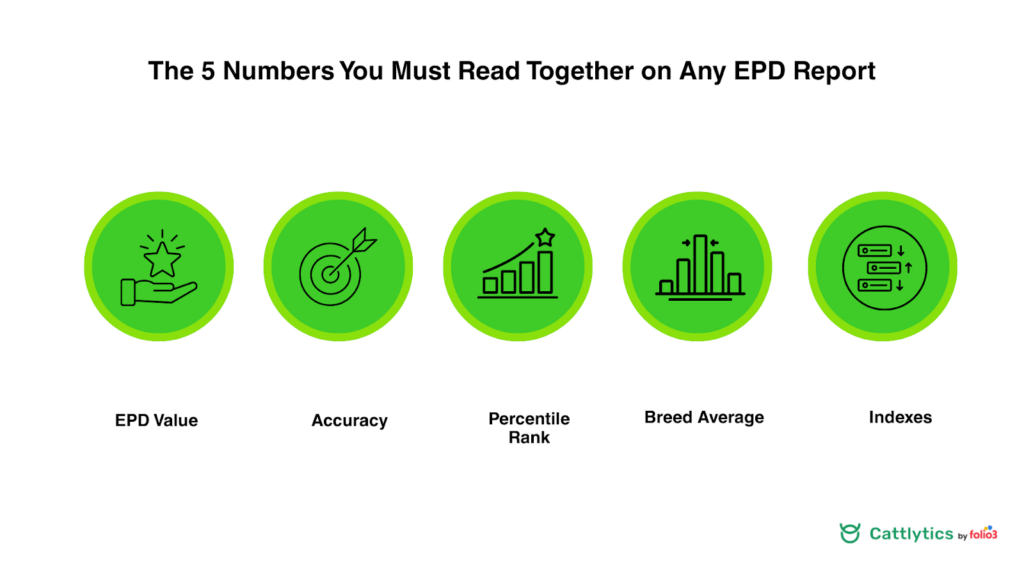
The 5 Numbers You Must Read Together on Any EPD Report
Learn how EPD value, accuracy, percentiles, breed average, and indexes work together so you can turn confusing numbers into confident, repeatable selection decisions.
EPD Value
The EPD value is the main prediction on the page. It estimates how a bull’s or female’s calves should differ, on average, for one trait when you compare two animals in the same evaluation.
Units match the trait: pounds for Birth Weight or Weaning Weight, a percent for some fertility/survival traits, or a score where the breed uses scoring. “Better” depends on your system. Lower BW can reduce calving risk; higher WW can add sale pounds. Use epd in cattle to match your goal, not chase the biggest number.
Accuracy (ACC)
Accuracy (ACC) is your confidence meter for an EPD. Most reports show ACC on a 0 to 1 scale, and values closer to 1.0 indicate higher reliability in practice. ACC generally increases as more information enters the evaluation, especially progeny records and ancestral data, so the EPD is less likely to change over time.
A simple way to use it:
- For high-risk outcomes (heifer calving, harsh winters), lean toward higher ACC.
- If you can tolerate variation (terminal sires on mature cows), lower ACC may be acceptable if the EPD fits your target range.
Yearling bulls often start with lower ACC because they have little or no progeny data, and DNA information can increase accuracy earlier when available.
Percentile Rank
Percentile rank tells you where an animal stands within the breed and often within a class . The 50th percentile is the breed average, and percentile tables can change as new animals and records are added. Use the percentile chart your breed publishes to set targets.
This is how you make epd in cattle examples practical: instead of chasing “top 1%” for every trait, choose a band that your feed, labor, and market can support. Extremes like very high Milk can backfire if your environment can’t carry the extra nutrient demand.
Breed Average
Breed average is the reference point that prevents the “zero trap.” For many traits, the breed average EPD is not zero, and it can shift over time as the evaluation base changes.
So, an EPD above 0 doesn’t automatically mean “above average.” Always compare the animal’s EPD to the published breed average or percentile chart for that trait and class. This quick check saves you from buying a bull that looks positive on paper but is actually middle-of-the-pack for the breed you run and helps you set clean cutoffs.
Indexes / $Values
Indexes, often shown as $Values combine multiple traits into one number tied to a breeding objective, helping you select for profit without juggling ten separate EPDs. Use them to shortlist faster, stay objective, in one quick glance, then confirm the key single-trait EPDs that matter most in your operation.
EPD Trait Cheat Sheet
When you’re staring at a sale catalog, it’s easy to get lost in a wall of numbers. This cheat sheet turns common EPD in cattle traits into “what it means for your herd” so you can make faster, cleaner decisions. Remember: EPDs are designed for comparing animals within the same breed evaluation, and they’re expressed in the units of the trait.
| EPD Trait | Units | When it matters most | Direction |
| CED (Calving Ease Direct) | % | Heifers, tight calving labor | Higher |
| BW (Birth Weight) | lb | Heifers, dystocia risk control | Lower |
| WW (Weaning Weight) | lb | Selling at weaning | Higher |
| YW (Yearling Weight) | lb | Backgrounding/retained ownership | Higher |
| Milk (Maternal Milk) | lb | Keeping replacements | Fit your forage |
| MW (Mature Weight) | lb | Cow cost control | Lower–moderate |
| SC (Scrotal Circumference) | cm | Reproduction, puberty signal | Higher |
| Marb (Marbling) | score | Grid/quality premiums | Higher |
| REA (Ribeye Area) | in² | Yield, muscle | Higher |
| Fat (Backfat) | in | Yield management | Lower |
Use this table to shortlist, then confirm the “5 numbers” before you buy. For epd in cattle examples, compare two bulls on the same trait and interpret the difference as the expected average difference in their calves under comparable cows and management.
Birth Weight EPD in Cattle Explained for Reducing Calving Risk Without Hurting Growth
Explore how to correctly use birth weight and calving ease EPDs to reduce heifer losses without sacrificing growth or creating long-term herd problems.
Birth Weight EPD vs Calving Ease
Birth weight EPD in cattle is useful, but it’s not the cleanest “easy-calving” decision by itself. Calving difficulty is influenced by more than weight, so think calf shape, dam pelvic area, and how much variation you’ll tolerate at calving. That’s why many breed evaluations provide a Calving Ease Direct (CED) EPD that predicts the expected difference in unassisted births when bred to first-calf heifers.
Here’s the trap we see in the field: producers try to stack every indicator at once, actual birth weight from the bull’s own record, BW EPD, and even “body shape” or “looks small-fronted.” Experts warn that piling those signals together does not improve your ability to identify a calving-ease sire; it can actually reduce selection accuracy compared to using the right EPD on its own.
Also, birth weight is typically already accounted for in calving-ease genetic evaluations, so over-emphasizing BW can lead you to give the same risk factor multiple votes. Use BW as context, but let CED drive heifer decisions.
A Practical Heifer-Bull Targeting Approach
Start by deciding what “safe” means in your calving setup, because your labor reality matters as much as your genetics. Practical selection guidance recommends setting calving-ease expectations based on management level, whether you can monitor heifers closely or you’re checking them around another job. If you can’t watch heifers closely, you need a higher margin of calving ease than someone who can intervene quickly.
Use this simple targeting workflow:
- Step 1: Lead with CED, then check BW EPD. Use CED as your primary screen for heifers, and use BW EPD as a supporting check so you don’t create growth problems by chasing only “tiny calves.”
- Step 2: Set an accuracy threshold for heifer sires. Accuracy increases as more records flow into the evaluation, so very young bulls often carry more uncertainty. For heifers, avoid very low-accuracy calving traits unless you’re comfortable with risk.
- Step 3: Use genomics to reduce early-life uncertainty when available. Genomic information is incorporated into national evaluations and can improve the accuracy of EPDs earlier in an animal’s life.
- Step 4: Keep it within-breed and use percentiles to set “good enough.” Your goal is repeatable, low-assistance calving, not chasing extremes that don’t fit your cows. Finally, sanity-check the bull: feet/legs, structure, and disposition still matter. EPDs guide genetics; you still need a bull that works in your facilities today, safely.
PD in Cattle Examples: 4 Real-World Scenarios
See practical EPD examples for heifer bulls, terminal sires, replacement females, and carcass-focused programs so you can apply genetics to real buying decisions.
Scenario 1: Buying a Heifer Bull (CED + BW focus)
When your priority is getting heifers calved with minimal pulls, start with Calving Ease Direct (CED). CED is designed to reflect expected differences in unassisted births when bulls are used on heifers, so higher is safer for first-calf females. It won’t eliminate all pulls, but it shifts the odds consistently.
Next, use Birth Weight (BW) EPD as a supporting check, not the main driver. A very low BW can come with trade-offs, while a moderate BW paired with strong CED often fits real-world herds better.
Finally, apply an accuracy “filter.” Young bulls commonly have lower accuracy because they have fewer (or no) progeny records. If you can’t monitor heifers closely, bias toward higher-accuracy calving traits to reduce surprises; if you can supervise intensively, you can tolerate a bit more uncertainty. Also confirm structural soundness, EPDs don’t replace a physical evaluation this season.
Scenario 2: Terminal Sire for Weaned-Calf Sales (WW/YW focus)
If you sell calves at weaning, pick the growth trait closest to that endpoint; Weaning Weight (WW) EPD, then use simple “difference math” to compare bulls.
Example: Bull A WW EPD = 60 and Bull B WW EPD = 40. The 20-point gap means Bull A’s calves are expected to average about 20 lb heavier at weaning, assuming comparable cows and management.
If you background calves or retain ownership longer, Yearling Weight (YW) becomes more relevant. Keep one eye on calving ease and mature size as you push growth, because growth traits can be genetically correlated with higher birth weights and larger cows.
Keep comparisons within the same breed evaluation for fairness. Then check accuracy so the growth edge is more dependable.
Scenario 3: Retaining Replacement Heifers (Milk + Mature Size trade-offs)
When you’re keeping daughters, you’re not just buying a calf, you’re buying a cow that will eat for years. That’s why Maternal Milk (Milk) and Mature Weight (MW) deserve a “paired” decision.
Milk EPD can help you improve weaning performance through maternal ability, but higher isn’t always better. In environments with limited nutrient availability, too much milk and too much cow can pressure body condition, reproduction, and longevity. If cows lose condition, milk may be too high for forage.
A practical approach is to set a percentile target range for Milk that matches your forage and supplement budget, then screen MW to avoid inflating cow size. If you’re in a tougher environment, aim for “functional” milk and moderate mature size. Tracking female performance data—body condition, calving intervals, and progeny outcomes across multiple generations helps you validate whether your EPD targets are working in your specific environment. If you’re in high-input conditions, you can afford to push a bit higher without chasing extremes year after year.
Scenario 4: Grid/Carcass Marketing (Marbling/REA)
If you’re getting paid on a carcass grid, prioritize the traits that drive premiums in your specific marketing program. It typically includes marbling and muscling indicators like Ribeye Area (REA), along with your targeted carcass weight endpoint. Confirm grid pays for these traits.
Use percentile charts to understand where a bull ranks within the breed, then confirm accuracy, so you’re not betting premiums on shaky predictions. If you’re not selling on a grid, don’t overpay for carcass numbers you can’t monetize.
The rule is simple: select hardest for the traits you get paid for, and keep the rest within acceptable ranges at your endpoint so you don’t create problems in calving, cow cost, or fertility.
Genomic-Enhanced EPDs When DNA Testing Actually Helps
Genomic-enhanced EPDs, often shown as GE-EPDs are still EPDs. You read them the same way but they’re built with an extra layer of information: DNA test results that identify specific genetic markers associated with performance traits, increasing prediction accuracy before an animal has progeny records.
The main benefit for you is simple: better accuracy earlier, especially on young bulls that don’t have many calves on the ground yet. Higher accuracy means the EPD is less likely to swing as more data comes in, which reduces “buyer’s remorse” risk.
Here’s what DNA can do in practical terms. Adding a genomic profile can be equivalent to multiple progeny records, and genomically enhanced Calving Ease Direct EPDs can reach accuracy levels normally seen only after dozens of progeny are recorded.
Genomics is most helpful when you’re making a high-impact decision with limited history, such as buying a yearling bull, using AI sires, or selecting calving-ease genetics for heifers. It tightens prediction accuracy before you have multiple calf crops worth of performance data.
How to use genomics without getting fooled by it:
- Use GE-EPDs to reduce risk on traits where mistakes are expensive.
- Treat genomics as a confidence boost, not a reason to chase extreme EPD values.
- Still compare within the same breed evaluation and confirm the “big picture”.
If you’re paying a premium for DNA, make sure it’s buying you lower uncertainty. It pays when higher accuracy changes which bull you buy today.
Across-Breed Comparisons When You Can Compare EPDs
EPDs are built to compare animals within a breed, because each breed runs its own genetic evaluation and uses its own base point. That’s why a straight “Bull A in Breed X vs Bull B in Breed Y” comparison is usually wrong even if the trait names look identical.
So how do you define epd in cattle when you’re shopping multiple breeds for a crossbreeding program? You have two safe options:
- Stay within-breed. Shortlist bulls inside each breed by understanding breed-specific characteristics, from growth patterns and mature size to environmental adaptability using percentiles and accuracy, then choose the breed(s) that best fit your environment and market.
- Use across-breed adjustment factors (AB-EPDs) for specific traits. Across-breed factors are published for a defined set of traits and let you put bulls from different breeds on a comparable scale by adjusting their within-breed EPDs.
A practical rule: across-breed adjustment factors are meant to compare individual bulls across breeds, not to “rank breeds.” Don’t confuse adjustment factors with breed differences; they’re different concepts and are presented separately in published materials.
If you use AB-EPDs, follow the current table for the traits it covers and the birth-year group it targets, then apply the adjustment exactly as described in the publication.
They’re most useful for commercial herds buying multiple breeds for terminal crossbreeding, and the scale is set to a chosen base.
Step-by-Step Workflow to Use EPDs for Choosing a Bull This Season 
A clear, repeatable workflow showing how to set goals, choose traits, manage risk, and combine EPDs with visual appraisal to select the right bull.
Step 1: Define Your Breeding Objective
Before you look at a single EPD in cattle, decide what “winning” looks like for your operation. Your breeding objective is the roadmap that keeps you from buying a bull because he is popular instead of profitable.
Write one sentence that includes: your marketing endpoint, your cowherd constraints, and your calving-risk tolerance. Example: “Sell heavy, uniform weaned calves with minimal heifer pulls on moderate forage.”
Then answer:
- Heifers, mature cows, or both?
- Sell at weaning, retain ownership, or replacements?
- What limits you first feed, labor at calving, or weather?
Those answers tell you which traits to emphasize and what level is “enough,” so you stay focused consistently.
Step 2: Pick 3–5 Economically Relevant Traits
Next, pick 3–5 Economically Relevant Traits (ERTs), the traits tied directly to revenue or cost in your production and marketing system. Everything else is either an indicator trait or “nice-to-know.”
This is how you prevent information overload in sale catalogs. If you sell calves at weaning, WW is usually more “economically relevant” than marbling. If you retain ownership to harvest, carcass traits become more relevant.
Make a short list, then ignore the rest unless a number is extreme. Your EPD in cattle decisions become faster, more consistent, and easier to explain to your partners and banker. Re-check your ERT list each year as markets and forage conditions change locally.
Step 3: Set Acceptable Ranges Using Percentiles
Now set “acceptable ranges” instead of chasing the single highest EPD. Percentile tables show where an animal ranks within its breed; the 50th percentile is the breed average, and tables update as new data is added.
Use percentiles to create a target band for each priority trait, then pressure-test that band against your environment.
Avoid extremes that don’t fit your system. A sire can rank in the top 1% for milk, yet still be too extreme for your forage or management level, increasing cow requirements and risk. Your goal is a bull whose EPDs sit in ranges you can actually support year after year without costly surprises.
Step 4: Apply Accuracy Rules
Use accuracy (ACC) as your risk-control dial. Published accuracy runs from 0 to 1; higher values indicate the EPD is less likely to change as more information is added.
Low accuracy is acceptable when you can absorb variation: mature-cow matings, limited use, or when you can cull after the first calf crop. Guidance recommends using low-accuracy bulls more cautiously and high-accuracy bulls more extensively.
For heifers or limited labor, bias toward higher-accuracy calving traits. If genomics are available, they can lift accuracy and reduce the “young sire” gamble.
Step 5: Make Final Decision Using Structure
Once you have a shortlist, do a final “works in my pasture and pens” check. Some traits don’t have EPDs, so visual appraisal and measurements still matter, especially structural correctness.
Look for:
- Feet and leg soundness (mobility matters for breeding and grazing)
- Body condition and capacity for your environment
- For females: udder quality and teat size
- Disposition that fits your handling setup
If a bull’s numbers look strong but he can’t travel, breed, or stay healthy, the EPD advantage won’t show up in your calf crop.
Common EPD Mistakes and How to Avoid Them
Most producers don’t struggle with the math, they struggle with interpretation. These are the mistakes that cost you money, and the fixes that keep selection decisions consistent.
Comparing across breeds as-is:
EPDs are intended for within-breed comparison. If you’re shopping multiple breeds, use published across-breed adjustment factors (AB-EPDs) for traits where they exist; otherwise, shortlist within each breed and decide based on your crossbreeding plan.
Treating an EPD like a guarantee:
An EPD predicts average differences in progeny, not a promised calf weight, calving outcome, or carcass grade. Environment, health, nutrition, and the dam still create variation, so manage EPDs like probabilities, not promises.
Chasing a single-trait extreme:
Selecting only for high growth, very high milk, or ultra-low birth weight can push cow size, feed requirements, and management risk beyond what your forage base can support. Set “good enough” target ranges using percentiles and stay balanced.
Ignoring accuracy (ACC):
Accuracy increases as more records and progeny data are added, so young sires often carry more uncertainty. Use higher ACC for high-risk matings (heifers, limited calving labor) and accept lower ACC only when you can absorb variation.
Messy contemporary groups:
Contemporary groups are the foundation of fair comparisons because they help separate genetics from management. If groups are inconsistent, the evaluation can’t correct for environment, and EPDs become less reliable across herds.
A quick rule: use EPDs to compare genetics, then use your management plan to handle the rest.
Conclusion
EPDs are one of the best tools you have for making genetic decisions, but they are not a promise of what every calf will do. Maintaining complete lifecycle records from birth through breeding and culling lets you verify whether the EPDs you selected are delivering the performance and profit you expected in your actual conditions. Use them the way they were designed: compare animals by the differences between their EPDs, confirm where they sit in breed percentiles, and control risk with accuracy. After that, make sure the numbers fit your forage, labor, and marketing endpoint.
That’s how you turn “genetics talk” into predictable calving seasons, sale-ready calves, and cows that stay in the herd without chasing extremes you can’t feed year after year. If you share your herd goals, we can build a simple EPD target profile and bull-shortlisting scorecard for your operation. So, book your free consultation with our experts at Cattlytics.
FAQs
What Is A “Good” EPD In Cattle For My Herd?
A good EPD is one that fits your forage, labor, and marketing plan. It’s about functional ranges, not chasing the highest number in the breed.
Can EPDs Help Improve Herd Fertility And Longevity?
EPDs influence fertility indirectly by managing calving ease, mature size, and cow efficiency. Balanced genetics help cows breed back, stay productive longer, and reduce replacement pressure.
How Often Do EPDs Change, And Should That Worry Me?
EPDs update as new data and progeny records are added. Small changes are normal and usually reflect improved accuracy, not unreliable genetics.
Are EPDs Useful For Small Or Low-Input Cattle Operations?
Yes, EPDs are especially useful in low-input systems because they help avoid genetic extremes. This keeps cow costs, feed demand, and calving risk manageable.
Do EPDs Account For Nutrition, Health, And Management Differences?
No, EPDs estimate genetic potential only. Nutrition, health, and management determine how much of that potential your cattle actually express.
Should I Use EPDs When Buying Replacement Females, Not Just Bulls?
Yes, using EPDs on females helps control cow size, milk level, and calving ease. These traits strongly affect lifetime cost, fertility, and herd consistency.
How Many Years Does It Take To See Results From Using EPDs Correctly?
You’ll see differences in the first calf crop, especially in calving ease and growth. Meaningful herd-level improvement usually appears after two to three generations.
Can EPDs Help Manage Risk During Volatile Cattle Markets?
Yes, EPDs support predictable performance and cost control. That stability helps protect margins when feed prices rise or cattle markets tighten.