

If heavier calves at weaning, longer-lived cows, and a better bottom line matter to your operation, crossbreeding is worth your full attention. This guide walks you through everything, from the basic genetics behind hybrid vigor to picking the right crossbreeding system for your herd size, climate, and market goals.
Crossbreeding in cattle is the intentional mating of animals from two or more distinct breeds to produce offspring that outperform either parent breed in key production traits, particularly those linked to fertility, survival, and growth.
Done right, crossbreeding is one of the most cost-effective tools available to cow-calf producers and feedlot operators. It does not require expensive technology. It requires a clear plan and consistent execution. Whether you run 50 cows or 500, the principles work the same way, and the returns compound over every breeding season you stay consistent.
What is Cross Breeding in Cattle? (And Why It Matters)
Cross-breeding in cattle is a management strategy used to capture the strengths of multiple breeds in a single calf crop. It matters because no single purebred is perfect. Some breeds excel in maternal traits like milking ability and fertility. Others deliver superior growth rates and carcass quality. Crossbreeding lets you combine both.
It is not a new concept, ranchers have practiced crossbreeding cattle for over a century. What has changed is how well we now understand the science behind it, and how precisely we can apply it using modern genetic tools like EPDs.
Understanding the cattle breeding cycle is the foundation you need before putting any crossbreeding plan into action.
The Science: Heterosis (Hybrid Vigor) Explained
Heterosis, often called hybrid vigor, is the performance boost crossbred offspring show compared to the average of their parent breeds. It happens because crossbred animals carry a wider mix of gene pairs, which tends to suppress the expression of unfavorable recessive traits.
There are three types:
- Individual heterosis: The performance advantage in the crossbred calf itself, primarily seen in growth, survival, and health.
- Maternal heterosis: The performance advantage in the crossbred dam, particularly in fertility, milk production, and longevity.
- Paternal heterosis: A smaller effect in crossbred sires, mainly improving libido and semen quality.
Here is the key insight: traits with low heritability, like fertility, calving ease, and cow longevity, respond the most to heterosis. You cannot breed your way to better fertility as easily as you can breed for better ribeye area. Crossbreeding fills that gap. Cattle genetic testing can help you identify which animals are already carrying the genetic potential to respond best to a crossbreeding program.
Breed Complementarity: The Best of Both Worlds
Heterosis is only part of the story. Breed complementarity is the other half. It is the practice of pairing breeds with different strengths so the resulting calf inherits the best traits from each side.
A classic example: mate a Hereford cow with strong maternal instincts to an Angus bull with superior marbling genetics. The calf inherits a nurturing mother’s disposition, and the carcass traits buyers pay a premium for. Neither parent breed alone would have produced that combination as reliably.
Popular Crossbred Cattle Breeds and Examples
Knowing your options makes choosing a cross much easier. Here is a practical breakdown of the most proven crossbred cattle examples used across U.S. operations. For a broader look at breed traits, the top beef cattle breeds guide is a good starting point.
Traditional Beef Crosses
Black Baldy (Hereford x Angus)
The Black Baldy is widely regarded as the gold standard for maternal crossbred cattle. Combining the Hereford’s hardiness, docility, and milking ability with the Angus breed’s marbling genetics and black hide, the result is a cow that works hard, raises a heavy calf, and holds up well across multiple breeding seasons. Black Baldy females are known for exceptional udder quality and strong mothering instincts. Their calves consistently perform well in both the stocker and feedlot phases, making them popular with buyers at every level of the supply chain.
Brahman Crosses (Tiger Stripes)
For producers in the Gulf Coast, Southeast, and Southwest, Brahman-influenced cattle are not optional. They are essential. Brahman crosses carry the Bos indicus genetics needed for heat tolerance, parasite resistance, and the ability to thrive on lower-quality forage. The distinctive “tiger stripe” dappling pattern is a common marker in F1 Brahman-British crosses. When crossed with Angus, Hereford, or Simmental, Brahman genetics produce cattle well suited to challenging southern environments where straightbred British or Continental breeds would struggle to maintain body condition and reproductive performance.
Composite Breeds
A composite breed is a stabilized crossbred. Breeders select animals from a multi-breed cross over several generations until the population breeds relatively true. The practical advantage is that you get a predictable level of retained heterosis without managing multiple purebred herds.
Well-known U.S. composites include:
- Brangus (Brahman x Angus): Combines heat tolerance with Angus carcass quality. Popular across the South.
- Beefmaster (Hereford x Shorthorn x Brahman): Bred for adaptation, milk, and growth. Developed specifically for the South Texas environment.
- SimAngus (Simmental x Angus): Widely used in commercial cow-calf operations for its growth and maternal balance. One of the fastest-growing composite breeds in the U.S.
Composites work well for smaller operations where managing two or three distinct breeding pastures is not practical.
The Modern Edge: The Rise of Beef-on-Dairy Crossbreeding
One of the most significant economic shifts in U.S. beef production over the past decade has been the surge in beef-on-dairy crossbreeding. This is where beef semen, most commonly Angus or Simmental, is used on lower-producing or surplus dairy cows rather than dairy semen.
The economics work for both sides of the equation.
For dairy producers: Calves from beef-sired matings command substantially higher premiums at sale compared to straight Holstein or Jersey bull calves. Lower-producing cows that would otherwise generate little calf value become a more meaningful revenue source.
For feedlot operators: Beef-cross dairy calves offer improved carcass characteristics, including better dressing percentages and marbling potential, compared to straight dairy steers. They grade out more consistently and return better value on the rail.
According to USDA data, the share of beef semen used in U.S. dairy operations has grown considerably in recent years, reflecting just how mainstream this practice has become. Understanding dairy cow milk production benchmarks helps dairy producers identify which cows are candidates for beef matings versus those that should be bred back to dairy semen for replacement purposes.
Choosing the Best Crossbreeding System for Your Operation
Picking the right system depends on your herd size, your labor situation, and what you are trying to sell. Here is a breakdown of the main options.
Two-Breed and Three-Breed Rotations
A rotational system cycles two or more breeds through a breeding herd, alternating sire breeds each generation.
- A two-breed rotation (e.g., Angus x Hereford) retains approximately 67% of maximum heterosis at steady state. It is simpler to manage but captures less hybrid vigor than a three-breed rotation.
- A three-breed rotation retains approximately 86% of maximum heterosis. The trade-off is complexity: you need at least three separate breeding pastures and rigorous identification records to avoid accidentally breeding related animals.
Good pasture rotation management becomes especially important in rotational crossbreeding systems where multiple sire groups must be kept separate.
Terminal Sire System
In a terminal system, all calves are marketed. Replacement heifers are purchased externally rather than raised from within the herd.
The approach is straightforward: mate older cows or crossbred females to a terminal sire breed, typically a heavily muscled Continental breed like Charolais, Limousin, or Simmental. Every calf produced goes to the feedlot or sale barn. Growth rate, feed efficiency, and carcass yield are maximized because no compromises are made for maternal trait selection.
This system suits producers who are retaining ownership through the feedlot phase or who have a reliable source of replacement females nearby.
Roto-Terminal System
The roto-terminal system is the practical middle ground. A portion of the cow herd is designated for rotational breeding to produce replacement heifers. The remaining cows, typically older or proven females, are bred to a terminal sire to maximize market calf value.
This approach keeps your replacement pipeline functioning without sacrificing the carcass and growth advantages of terminal breeding on your commercial cow herd.
Crossbreeding Systems Comparison
| System Type | Retained Heterosis | Min. Herd Size Recommended | Pros | Cons |
| Two-Breed Rotation | ~67% | 30–50 cows | Simple to manage, low cost | Less heterosis than 3-breed |
| Three-Breed Rotation | ~86% | 80–100 cows | High heterosis retention | Requires multiple pastures, strict records |
| Terminal Sire | Up to 100% in calves | Any size | Maximum growth, carcass yield | Requires purchased replacements |
| Roto-Terminal | 67–86% | 60–80 cows | Balanced approach | Requires careful herd splitting |
| Composite Breed | 50–75% (stabilized) | Any size | Low management complexity | Less heterosis than active rotation |
How to Start Cross Breeding Cattle: A Step-by-Step Guide
Getting into crossbreeding is not complicated, but a clear starting point prevents costly mistakes. Here is a practical approach for cow-calf and seedstock producers.
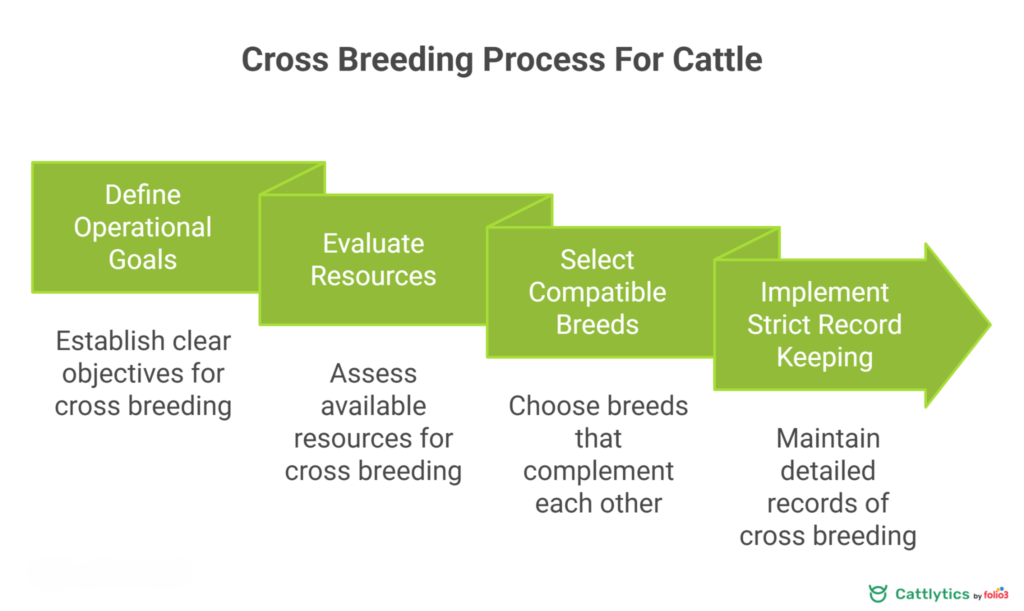
Step 1: Define Your Operational Goals
Start by deciding where your calves exit the system. Are you weaning and selling? Retaining the feedlot? Marketing replacement heifers to other producers? Your answer determines which traits matter most and which system fits your situation. Terminal producers need to prioritize growth and carcass; replacement heifer sellers need to lead with maternal traits.
Step 2: Evaluate Your Resources
Be honest about what you have to work with. Assess your climate, forage base, herd size, available pastures, and labor. A three-breed rotation sounds great on paper but requires separate breeding pastures and consistent record-keeping discipline. If your operation cannot support that, start with a two-breed rotation or a composite.
Step 3: Select Compatible Breeds
Focus on breed complementarity, not just popularity. Match a breed strong in maternal traits to one strong in carcass or growth traits. Use EPDs to make data-driven sire selections, and pay attention to birth weight EPDs to avoid calving difficulty. Proper bull selection is one of the highest-leverage decisions you will make in any crossbreeding program. A breeding soundness exam on every bull before the season is non-negotiable.
Step 4: Implement Strict Record Keeping
This is where most rotational programs eventually break down. Without accurate sire and dam records, you risk inbreeding in rotation systems, which erases the heterosis benefit you were trying to capture. Digital cattle record management tools make tracking breed composition and parentage far more reliable than paper logs, especially as your herd scales up. Record keeping also pays dividends when selling replacement females, since documented breed history adds credibility and market value to your animals.
Challenges and Considerations
Crossbreeding is not a silver bullet. Knowing the drawbacks helps you plan around them rather than getting caught off guard.
Management complexity: Multi-breed rotations require multiple breeding pastures, individual animal identification, and often artificial insemination. The more breeds you rotate, the more moving parts you manage.
Replacement costs: Terminal systems eliminate the option of keeping replacements from within your own herd. You will need a reliable and cost-effective source for replacement females, which can put pressure on margins during tight cattle markets.
Inbreeding risk: In rotational systems, replacement heifers kept from within the herd can eventually trace back to the same sire lines. Without disciplined cow-calf operation records, this risk goes undetected until it shows up as reduced performance.
Market preferences: Some buyers apply discounts to certain color patterns or frame sizes that fall outside their preferred specification. Before committing to a cross, know your target market and confirm your crossbred calves fit the buyer’s grid.
Genetic quality still matters: Heterosis does not rescue poor genetics. Crossbreeding amplifies what is already there. If you are crossing two low-quality purebreds, you will get a more vigorous version of mediocre. Always start with high-quality purebred stock.
The Economic Impact: Does Crossbreeding Pay?
The short answer is yes, consistently and meaningfully. Crossbred cows have longer productive lives and generate more weaning weight per cow exposed over their lifetime. Crossbred cows produce approximately 20–25% more lifetime weaning weight compared to straightbred contemporaries, in part because they wean an average of one extra calf over their productive life due to improved fertility and survival.
A longer productive life also means lower annual replacement costs. A crossbred cow that stays in the herd one or two years longer than her straightbred counterpart spreads your heifer development investment across more productive seasons. Understanding average cow lifespan benchmarks helps you measure just how much that longevity advantage translates into real dollars per cow.
When you pair that with better feed efficiency in crossbred feeder calves and higher carcass premiums from well-planned crosses, the economic argument becomes hard to ignore. The upfront planning cost is real, but the per-cow return over a cow’s working life consistently justifies it.
FAQs
What Is the Best Cross for Beef Cattle?
There is no universal answer, but the Black Baldy (Hereford x Angus) is the most widely used and proven maternal cross in the U.S. For southern operations, Brahman-based crosses like Brangus offer superior heat tolerance. The best cross for your operation depends on your climate, market, and production goals.
How Much Does Heterosis Improve Weaning Weight?
Individual heterosis typically adds 5–8% to weaning weight in crossbred calves compared to the average of their parent breeds. Maternal heterosis in the crossbred dam can add another 15–25 lbs of weaning weight through improved milking ability and fertility.
Can Small Herds Benefit From Crossbreeding?
Yes. Composite breeds like SimAngus or Brangus are designed specifically for smaller operations. They provide a stable level of heterosis without requiring separate breeding pastures or complex sire rotation schedules. A two-breed rotation also works well for herds of 30 or more cows.
When Does Terminal Crossbreeding Make the Most Sense?
Terminal systems make the most sense when you are retaining ownership through the feedlot phase, selling on a grade-and-yield basis, or when affordable replacement heifers are easy to source locally. They are not ideal if you are trying to maintain a closed herd or build your own replacement inventory.
How Long Does It Take to See Results From a Crossbreeding Program?
You will see the first measurable results within one calf crop. Weaning weights, calf survival rates, and cow rebreeding rates from crossbred females typically improve noticeably by the second generation, especially when maternal heterosis is captured through crossbred dams entering the cow herd.