
Meet Cattlytics at NCBA’s CattleCon 2026 , Booth 944. Book Now

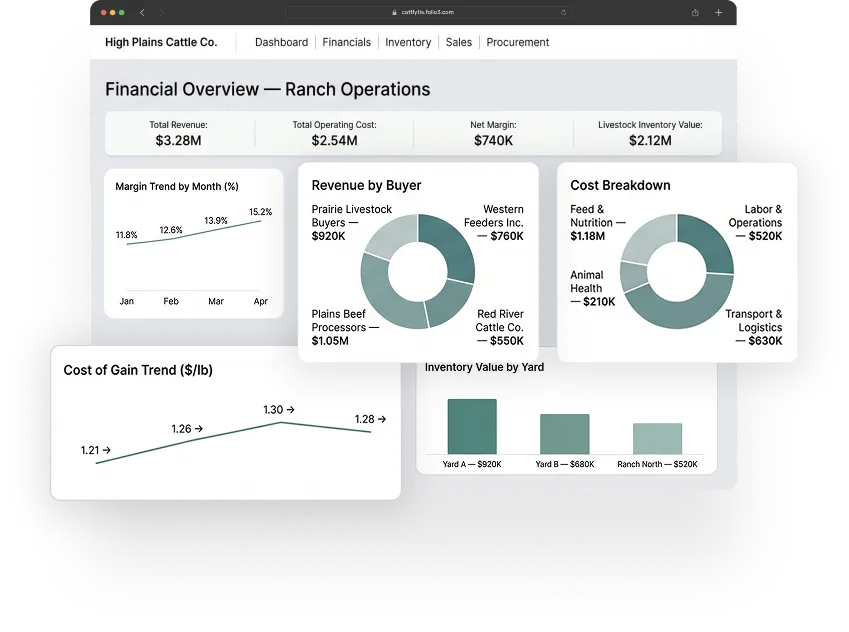






Most large cattle operations aren’t short on data; they’re short on data that stays connected. When cattle records, feed, inventory, and financials live in separate systems, the cost of gain, lot performance, and margins fall out of sync, making it harder to track performance and trust the numbers behind key decisions.
QuickBooks breaks when managing multiple yards, entities, and shared costs, making consolidated reporting and lot-level profitability difficult to maintain accurately.
Feed logs, cattle movements, invoices, and inventory are recorded in separate systems, requiring repeated entry and time-consuming reconciliation to align operational and financial data.
Feed, lot performance, and financial data exist but aren’t connected, making it slow to calculate the cost of gain and assess profitability accurately.
Cattle movements and feed usage are tracked operationally, but financial systems update separately, causing gaps between performance data and actual recorded costs.
Cost of gain is calculated after the fact using delayed data, limiting the ability to adjust feed strategies and protect margins in time.
Financial reports rely on period-end processes and reconciliations, delaying visibility into inventory, lot performance, and profitability across the operation.

Manage every purchase your cattle operation makes, from feed contracts to veterinary supplies, in the ranch ERP, without losing track of what was ordered, received, or still outstanding.

Track feed, cattle, and operational inventory movements in real time, ensuring accurate valuation, lot-level visibility, and alignment between physical and financial records.

Consolidate financials across every entity, location, and cost center your cattle operation runs, giving your finance team one accurate picture instead of several incomplete ones.

Handle cattle sales, direct marketing, and production sale transactions inside the same system, managing your costs, so revenue and margin are always tracked against the same records.

Turn operational and financial data into reports your team can act on, without spending three days pulling numbers from systems that were never designed to share information.

Maintain complete traceability of cattle, feed, and transactions while ensuring compliance with regulatory requirements and supporting audit-ready financial and operational records.


Keep your existing cattle system and connect it to ERP for financials, or move to a more integrated setup. Choose the approach that fits how your cattle operation runs today.
Already using a cattle management platform your team knows? We build the connection to your new ERP, real-time data sync, no rip-and-replace required. Your operational data flows into your financial system without manual export.
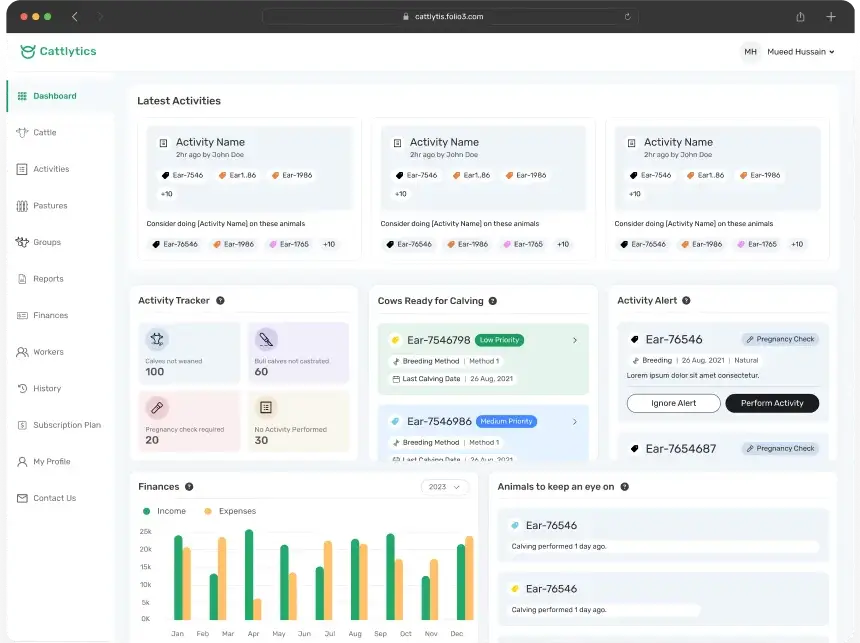
Switch to Cattlytics, an AI-powered system for running cattle operations. Capture feed, movements, weights, and herd data in one place, and send cost of gain, inventory, and animal records directly into Dynamics 365 and NetSuite for financials.


Automatically count, identify, and track cattle movement across pens, yards, and processing areas using AI vision systems.

Detect health risks early by analyzing intake, behavior, weight trends, and operational performance patterns across the herd.

Analyze feed intake, ration performance, and operational costs to improve efficiency and reduce unnecessary feed spend.

Generate instant summaries of treatments, movements, weights, and performance records for faster operational and financial decisions.

Identify elevated calving risk using breeding history, animal condition, and behavioral signals to support proactive intervention.

Monitor intake behavior trends and forecast feed demand to improve planning, inventory management, and yard efficiency.

Predict environmental stress risks using weather conditions, intake fluctuations, and cattle performance pattern monitoring.

Scan and convert handwritten records, feed tickets, invoices, and ranch paperwork into structured digital data automatically.

Retrieve operational, financial, and livestock data instantly using conversational AI assistants trained on ranch workflows.


20+ years of solving real livestock challenges.

Ranch-specific automations, reporting, and ERP workflow configurations.

Connect cattle systems, operational data, & ERP financials seamlessly.

Industry-certified team ensuring seamless software performance.

Trusted by many clients with successful ERP implementations.

Continuous training & support to optimize your ERP investment


Operational Discovery
Process Mapping
Financial Assessment
Integration Planning
Weeks 1–2
ERP Configuration
Workflow Design
System Integration
Reporting Structure
Weeks 3-8
Data Migration
User Acceptance Testing
Team Training
Validation Cycles
Weeks 9–12
Go-Live Support
System Monitoring
Workflow Optimization
Post-Go-Live Assistance
Weeks 13–16
Years ERP Experience

Microsoft Gold Partner

NetSuite Alliance Partner

Multi-System Integrations


Read what our clients say about their experiences and the difference our solutions have made for them.
Used CattleMax for a couple of years, and the biggest thing that got old was not having a real mobile app. Felt like I always had to wait til I got back to the computer to check records or update stuff. Switching over to Cattlytics and being able to pull up health records, breeding logs, and treatments, all from my phone out in the pasture, has made day-to-day work way easier. Would still like a few more sorting options on the inventory side, but overall pretty dang happy I switched.
The offline sync on this app is lowkey a next level. I can log weights and treatments way out in the back pasture where there's basically zero service, and it syncs everything once I'm back near town. Before this, I'd forget half the stuff by the time I got home lol.
Not gonna lie, I was skeptical at first cause Ive tried a few livestock apps before, and most of them looked nice but turned into a headache once you actually started using them every day. Cattlytics has been a lot simpler. Logging treatments from the pens takes maybe 30 sec, and pulling reports at the end of the month doesn't make me wanna throw my laptop anymore, haha. My foreman figured it out pretty quickly, too, which says a lot. A few more report filters would be nice, but nothing major.
Was comparing a few different cattle software options and kept coming back to Cattlytics. The mobile side actually works well and doesn't feel like some stripped-down version of the desktop. Pasture management and pedigree tracking being built in was what sold me, honestly. Probably one of the better things I've added to the operation this year.
The offline sync on this app is low key a next level. I can log weights and treatments way out in the back pasture where theres basically zero service and it syncs everything once I'm back near town. Before this I'd forget half the stuff by the time I got home lol.
Used Cattle Max for a couple yrs and the biggest thing that got old was not having a real mobile app. Felt like I always had to wait til I got back to the computer to check records or update stuff. Switched over to Cattlytics and being able to pull up health records, breeding logs, treatments, all from my phone out in the pasture has made day to day work way easier. Would still like a few more sorting options on the inventory side but overall pretty dang happy I switched.
Cattlytics app runs smooth and keeps all my cattle records in one place. Pulled up the full treatment history on a heifer right from my phone at the auction barn lol, that's pretty much when I knew I was gonna keep using it. Saved me a lot of digging through old notes already.
A livestock ERP system brings financials, inventory, procurement, and sales into one structured system, while most ranch software focuses only on operational tracking, like herd, feed, or breeding. ERP connects those activities directly to financial outcomes, so costs, inventory, and margins reflect what’s actually happening across the operation.
A cattle ERP for large ranches is designed to manage multiple yards, ranches, and entities within one system. It consolidates financials, tracks inventory by location, and allows you to report performance across the entire operation without manually combining data from different systems.
Yes, livestock ERP integration allows your existing cattle system to remain in place while connecting operational data to financials. Activities like feed usage, cattle movements, and weights can flow into ERP, eliminating duplicate entry and keeping financial records aligned.
No. Many operations start by integrating their current systems with a ranch ERP. Over time, you can decide whether to keep your existing tools or move to a fully connected livestock operations ERP stack.
A livestock ERP system captures operational data and posts it into financials as it happens. This allows cost of gain, cost per head, and margins to be calculated continuously rather than after the fact, giving you timely visibility into profitability.
It provides real-time access to income statements, cost breakdowns, inventory valuation, and receivables. Instead of waiting for period-end reporting, you can see financial performance as operations happen across your ranch.
Ranch ERP software records transactions once and uses that data across the system. Feed usage, cattle transfers, and purchases automatically update inventory and financial records, reducing the need for duplicate entry and manual reconciliation.
Yes. Livestock ERP systems are built to handle complex ownership structures, including multiple entities, partnerships, and divisions. They allow you to maintain separate records while also providing consolidated financial reporting.
It tracks livestock as inventory by lot, group, or individual, assigning costs over time. As cattle move, grow, or are sold, the system updates their value and reflects it in financial reporting automatically.
You can generate financial reports like income statements and balance sheets, along with operational reports such as lot profitability, cost of gain, inventory valuation, and receivables aging, all within one system.
Implementation timelines depend on the size and complexity of your operation, but enterprise livestock ERP deployments typically range from a few weeks for integration to several months for full system rollout and adoption.
Yes, but it is particularly valuable for growing and large-scale operations where multiple systems, locations, and financial complexities make it difficult to maintain accurate and timely reporting.
Enterprise livestock ERP systems are built on secure platforms with role-based access, audit trails, and compliance standards such as ISO and GDPR, ensuring your operational and financial data is protected.
The biggest returns come from reduced manual work, better cost control, improved margin visibility, and faster financial reporting. Over time, this leads to better decision-making and more predictable profitability.
By connecting operational activity with financial outcomes, livestock ERP provides a clear view of performance across the business. Leaders can evaluate costs, margins, and trends without waiting for delayed reports or manual analysis.
50% Off During CattleCon Week. Save Before CattleCon Ends. Valid until February 5