

If you run a commercial beef operation, you already know that not every cow or bull pulling its weight today was built that way by accident. According to the USDA’s National Institute of Food and Agriculture, genetic improvement through selective breeding is one of the most cost-effective tools available to beef producers aiming to increase profitability over the long term. The cattle you breed today will define the productivity of your herd for the next decade.
The challenge is knowing which cattle breeding traits actually matter, and which ones you can afford to ignore without hurting your bottom line.
This blog covers the core biological and genetic criteria that determine breeding potential in beef cattle. You will learn about reproductive traits, growth traits, maternal traits, carcass traits, structural soundness, and the role genetics and EPDs play in making smarter selection decisions. Whether you are selecting your next herd bull or culling replacement heifers, this is a practical reference you can come back to.
Why Cattle Breeding Traits Matter More Than You Think
The animals you keep and mate today define what your calf crop looks like three, five, and ten years from now. Every selection decision either moves your herd forward or holds it back.
Most commercial farmers understand this at a surface level. But the problem is that many still rely on visual appraisal alone. A bull can look structurally sound and carry impressive frame scores, and still pass on poor fertility or low milk production to his daughters. That is a costly mistake.
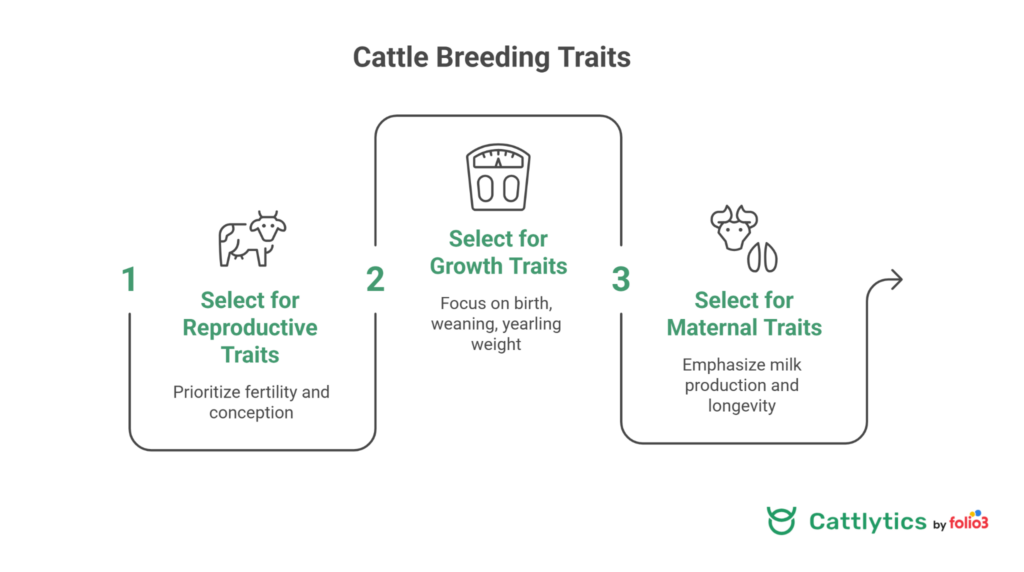
The cattle breeding traits that matter are not always visible. Some are measured. Some are estimated through genetic tools. And some require performance records going back multiple generations.
Understanding the criteria that define breeding potential gives you a structured way to evaluate animals rather than relying on gut feel alone.
Reproductive Traits: The Foundation of Breeding Potential
No cattle breeding trait matters more than reproduction. A cow that does not get pregnant, stay pregnant, and calve regularly is not productive, no matter how good her growth numbers are.
Fertility and Conception Rates
Reproductive efficiency is the single biggest driver of profitability in a cow-calf operation. A cow that calves every 365 days produces more calves over her lifetime than one with longer calving intervals. That difference compounds year over year.
Key reproductive cattle breeding traits to evaluate include:
- Age at first calving: Heifers that reach puberty earlier and calve for the first time around 24 months are considered reproductively efficient. Late-maturing females cost you in feed, time, and lost calf production.
- Calving interval: The target for commercial operations is 365 days or less. Cows that consistently calve outside this window reduce the economic output of your herd.
- Pregnancy rate: This reflects the percentage of cows that become pregnant within a defined breeding season. It is one of the clearest indicators of reproductive fitness across your herd.
Scrotal Circumference in Bulls
For bulls, scrotal circumference is one of the most reliable cattle breeding traits to assess. It is directly linked to sperm production, semen quality, and the age at which daughters reach puberty. A bull with larger scrotal circumference tends to sire daughters that reach puberty earlier, which improves the reproductive cycle of your cow herd over time.
This is not just a visual observation. A proper breeding soundness exam in bulls evaluates scrotal circumference alongside semen motility and morphology to confirm a bull is fit for service before the breeding season starts.
Growth Traits: Translating Genetics Into Pounds
Growth performance is one of the most economically relevant groups of cattle breeding traits for commercial producers who sell calves at weaning or retain ownership through the feedlot.
Birth Weight
Birth weight is a double-edged sword. Heavier calves at birth generally have more growth potential, but excessive birth weights increase the risk of calving difficulty, especially in heifers. Selecting for moderate birth weight while maintaining good growth potential is the balance most commercial operations aim for.
If you are breeding heifers, calving ease should be your first filter. Difficult calvings cost you in labor, calf losses, and cow health.
Weaning Weight
Weaning weight is one of the most commercially important cattle breeding traits because it represents the primary revenue point for most cow-calf producers. Heavier calves at weaning mean more money per head sold.
Weaning weight is influenced by both the direct genetics of the calf (growth potential) and the maternal genetics of the cow (milk production and mothering ability). This is why evaluating growth traits in isolation misses part of the picture.
Yearling Weight and Average Daily Gain
Yearling weight and average daily gain (ADG) matter most for producers who retain ownership or sell feeder calves. These traits reflect post-weaning growth efficiency and are among the more moderately heritable cattle breeding traits, meaning consistent selection pressure will produce measurable improvement over time.
Understanding how feed efficiency in cattle connects to growth rate is critical here. An animal that gains weight efficiently on less feed delivers better margins than one that grows fast but eats proportionally more.
Maternal Traits: Building the Next Generation
If you are retaining replacement heifers, maternal cattle breeding traits deserve as much attention as growth and carcass traits. These are the traits that determine how productive your cows are across their lifetime, not just in any single year.
Milk Production
Milk production directly influences weaning weight. Cows that produce more milk raise heavier calves. But there is a ceiling. Extremely high milk production increases the nutritional demands on the cow, which can reduce body condition and hurt reproduction if she cannot maintain adequate energy intake.
The goal is to select for milk production appropriate to your environment and forage base. A cow that produces more milk than your pasture can support will cycle poorly and wean a lighter calf the following year.
Mothering Ability and Temperament
Mothering ability covers how quickly a cow claims her calf after calving, how aggressively she protects it, and how effectively she allows the calf to nurse. This trait is difficult to quantify but has a measurable impact on calf survival and early growth.
Temperament is a related cattle breeding trait that commercial producers often undervalue. Nervous or aggressive cattle are harder to handle, more likely to injure farm staff, and pass those behavioral tendencies on to their offspring. Selecting for calm temperament is both a safety and a productivity decision.
Cow Longevity and Stayability
Longevity is one of the most underrated cattle breeding traits in commercial herds. A cow that remains productive for eight or more years generates far more return on investment than one that leaves the herd at four or five years due to structural breakdown, reproductive failure, or health issues.
Replacement costs are significant. Every time you buy or develop a replacement heifer, you absorb a cost that is only recovered if that animal goes on to be productive for multiple years. The average cow lifespan in commercial herds varies, but producers who select for longevity consistently see lower replacement costs and higher lifetime productivity per cow.
Carcass Traits: Matching Your Market
If you sell into a grid-based or value-added market, carcass cattle breeding traits become financially important. Even if you sell calves at weaning, building a reputation for producing high-grading calves can command a premium from buyers.
Marbling and Quality Grade
Marbling, or intramuscular fat, is one of the most heritable cattle breeding traits. This means selection for marbling produces results faster and more predictably than selection for low-heritability traits like reproduction. Animals with higher marbling scores grade Choice or Prime, which translates directly to higher carcass value.
Ribeye Area and Yield Grade
The ribeye area reflects muscling and is closely tied to cutability. A larger ribeye generally means more saleable beef per carcass. Yield grade estimates the percentage of retail cuts relative to carcass weight. Selecting for a favorable yield grade alongside marbling gives you cattle that produce both volume and quality.
If your end-market rewards carcass merit, these cattle breeding traits should be factored into your bull selection decisions alongside growth and reproductive criteria.
Structural Soundness: The Physical Foundation
An animal can have outstanding EPD values and still fail to perform if it cannot move comfortably, breed effectively, or hold up under the physical demands of commercial production. Structural soundness is one of the most practically important cattle breeding traits to evaluate on sight.
Feet and Leg Structure
Poor foot and leg structure leads to lameness, reduced mobility, and decreased grazing efficiency. A cow that cannot travel effectively cannot maintain body condition on the range. A bull with compromised leg structure will struggle to breed a full complement of cows. Understanding lameness in cattle and what early signs look like can help you catch structural problems before they cost you.
Body Condition Score
Body condition score (BCS) at key production points, including at breeding, at calving, and at weaning, reflects how well an animal maintains condition relative to its nutritional environment. Animals that consistently maintain good BCS under your management conditions are inherently better suited to your operation than those that require excessive supplementation to stay productive.
Genetic Tools: EPDs and Genomic Testing
The biological traits described above are what you are trying to improve. Genetic tools are how you improve them with precision.
Expected Progeny Differences (EPDs)
EPDs are the most widely used genetic tool in beef cattle selection. An EPD is a numerical estimate of how an animal’s offspring are likely to perform for a specific trait compared to the offspring of other animals in the same breed evaluation.
A bull with a weaning weight EPD of +50 is expected to sire calves that wean 25 lbs heavier (on average) than a bull with a weaning weight EPD of 0, when compared within the same breed. EPDs exist for most major cattle breeding traits, including birth weight, weaning weight, yearling weight, milk, carcass traits, calving ease, and more.
Understanding EPDs in cattle is one of the most valuable investments you can make in your breeding program. They allow you to make selection decisions based on genetic merit rather than visual assessment alone, which removes a significant source of error from your herd improvement plan.
One important note: EPDs are breed-specific. You can only compare EPDs between animals evaluated within the same breed population. Comparing an Angus EPD directly to a Hereford EPD is not valid.
Genomic Testing
Cattle genetic testing through genomic panels has become increasingly accessible and affordable. Genomic data can improve the accuracy of EPD predictions, particularly for young animals that do not yet have progeny performance records.
For replacement heifers, genomic testing can help identify which animals carry the genetic potential for superior fertility, growth, and carcass merit before you invest in developing them. This is especially useful for operations trying to accelerate genetic progress without waiting multiple generations.
How Crossbreeding Affects Cattle Breeding Traits
Crossbreeding is a practical strategy that commercial producers use to capture heterosis, also known as hybrid vigor. When you cross two unrelated breeds, the offspring typically outperform the average of both parents for traits like fertility, survival, growth, and longevity.
The gain in performance from heterosis is most pronounced for low-heritability traits like reproduction and longevity, which are the hardest to improve through straight breeding. This is why many commercial operations use a structured crossbreeding system as a core part of their breeding strategy.
Understanding crossbreeding in cattle and which breed combinations suit your environment and market is essential before implementing a crossbreeding program. Complementarity, or selecting breeds that offset each other’s weaknesses, is as important as heterosis in building a productive commercial cowherd.
Balancing Multiple Cattle Breeding Traits
One of the most common mistakes in selection programs is focusing too heavily on a single cattle breeding trait. Selecting only for rapid growth, for example, can inadvertently increase mature cow size, calving difficulty, and feed requirements. Selecting only for docility might mean you overlook poor reproductive performance.
The practical approach is to identify your top three to four priority cattle breeding traits based on your market, your environment, and your current herd’s strengths and weaknesses. Then use EPDs, genomic data, and visual appraisal together to select animals that rank well across that group of priorities.
Economic selection indexes offered by most breed associations combine multiple cattle breeding traits into a single dollar value that reflects profitability for a specific production scenario. For example, a terminal index weights growth and carcass traits heavily, while a maternal index prioritizes reproduction and milk. These indexes are a useful starting point for commercial producers who want a practical way to rank animals without evaluating each EPD individually.
Recording and tracking these decisions over time is where many operations fall short. Keeping digital cattle records that link breeding decisions to actual calf performance is what allows you to measure whether your selection strategy is working and adjust it when it is not. Platforms like cattle breeding software are built to help commercial producers do exactly that, keeping breeding records, EPD data, and performance history in one place so your decisions are based on data rather than memory.
Conclusion
Breeding potential in cattle is not determined by one trait in isolation. It is the result of how well an animal combines reproductive efficiency, growth capacity, maternal ability, structural soundness, and genetic merit.
The cattle breeding traits covered in this blog, from fertility and calving ease to EPDs and genomic testing, give you a framework for evaluating animals more precisely and building a herd that improves year over year.
The decisions you make today in the breeding pen will show up in your calf weights, pregnancy rates, and cull cow costs for the next decade. A structured approach to evaluating cattle breeding traits is not just good animal science. It is a sound business.
FAQs
What Are The Most Important Cattle Breeding Traits For Commercial Beef Producers?
For commercial producers, reproductive traits come first. A cow that calves every year is more valuable than one with impressive growth numbers but poor fertility. Beyond reproduction, weaning weight, structural soundness, and maternal traits like milk production and longevity are the cattle breeding traits that have the most direct impact on profitability.
How Do EPDs Help In Selecting For Cattle Breeding Traits?
EPDs estimate how an animal’s offspring will perform for specific traits compared to other animals in the same breed evaluation. They let you compare bulls and cows on genetic merit rather than appearance alone, which makes selection decisions more accurate and consistent over time.
What Is Heritability And Why Does It Matter For Cattle Breeding Traits?
Heritability measures how much of the variation in a trait is caused by genetics versus environment. High-heritability traits like marbling and ribeye area respond faster to selection pressure. Low-heritability traits like reproductive efficiency are harder to improve through genetics alone but benefit significantly from crossbreeding and good management.
How Does Crossbreeding Improve Cattle Breeding Traits?
Crossbreeding captures heterosis, which boosts performance in traits that are hardest to improve through straight breeding. Fertility, calf survival, and cow longevity tend to show the greatest improvement from heterosis. Crossbreeding also allows producers to combine the strengths of different breeds in the same animal.
What Is The Role Of Genomic Testing In Evaluating Cattle Breeding Traits?
Genomic testing provides DNA-based data that improves the accuracy of EPD predictions, especially for young animals without progeny records. It helps producers identify genetically superior replacement heifers and bulls earlier, which accelerates genetic progress and reduces the risk of investing in animals that do not perform as expected.
At What Age Should Cattle Breeding Traits Be Evaluated In Heifers?
Most cattle breeding traits can begin to be evaluated in heifers from around weaning age onward. Puberty onset, body condition, structural soundness, and genomic scores can all be assessed before first breeding. Reproductive performance, milk production, and calving ease are then confirmed through actual production records across the first two to three calvings.