

Your herd sire shapes everything from calf genetics to long-term profitability. But keeping the wrong bull costs you more than you think.
Every year, producers lose money holding onto bulls that should have been culled last season. Between winter feed bills, missed pregnancies, and declining genetics, an unproductive bull quietly drains your bottom line. Smart culling is one of the highest-ROI decisions you can make for your operation.
This guide walks you through when, why, and how to cull a bull for maximum salvage value and herd improvement.
What Is a Cull Bull? (Meaning & Importance)
Understanding cull bull basics helps you make faster, more confident decisions. Here is what the term means and why it matters.
A cull bull is a male bovine removed from the breeding herd and sold for slaughter or at auction. The most common reasons for culling include:
- Age: Bulls past their productive breeding years
- Injury: Structural damage that limits breeding ability
- Infertility: Failed breeding soundness exams
- Poor genetics: Calves that fall short of herd goals
- Disease: Venereal or chronic health issues
Why does this matter to your wallet? Salvage value from selling a cull bull offsets the cost of purchasing a younger, genetically superior replacement. In 2026, yield grade 1 cull bulls broke the $200 per cwt barrier at multiple auctions across the Southeast. That is real money you can reinvest into your next herd sire.
When you pair timely culling with strong bull selection criteria for breeding, you keep your genetics moving forward instead of standing still.
Top 5 Reasons to Cull a Bull (The “Why”)
Culling is not a one-size-fits-all decision. These five reasons cover the most common scenarios that signal it is time to let a bull go.
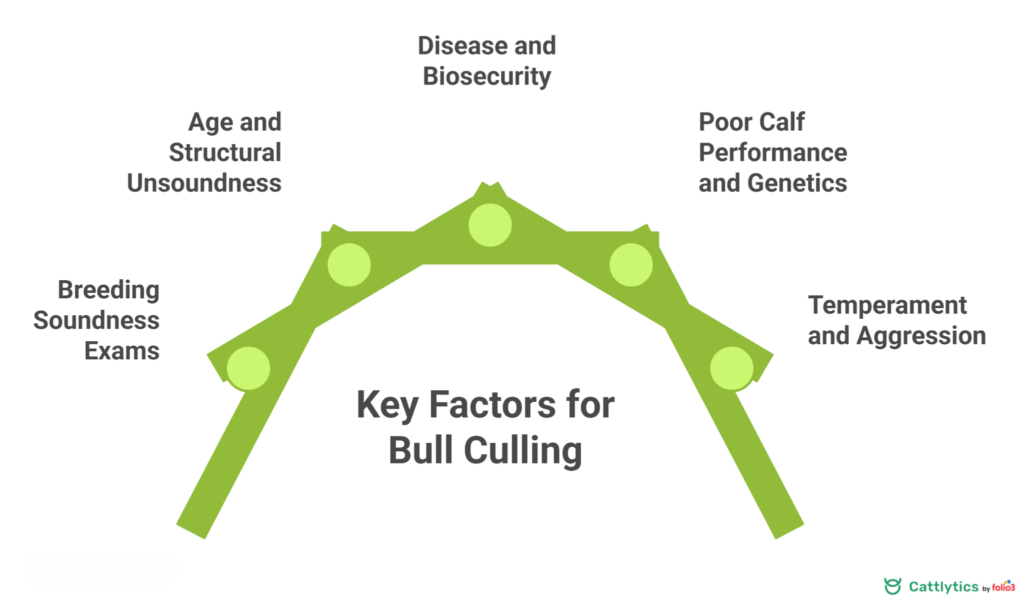
1. Failed Breeding Soundness Exams (BSE)
A breeding soundness exam is the most reliable way to evaluate a bull’s fertility before turnout. A bull must meet three minimum thresholds to pass:
- At least 30% progressive sperm motility
- A minimum of 70% normal sperm morphology
- Scrotal circumference of at least 30 cm (under 15 months) up to 34 cm (over 24 months)
If a bull fails his BSE, a “deferred” classification means you can retest in 60 days. But a clear fail on morphology or motility is a strong signal to cull.
2. Age and Structural Unsoundness
Bulls over 6 to 8 years old naturally decline in breeding ability. But age alone is not the whole story. Feet, legs, and joints take a beating in rough pastures. A bull with bad feet cannot cover cows, no matter how good his semen looks.
Watch for these red flags:
- Lameness or swollen joints that slow movement
- Cancer eye (ocular squamous cell carcinoma), especially in breeds with less pigmentation around the eyes
- Worn or broken teeth that reduce feed intake and body condition
- Chronic injuries to the sheath or penis from prior breeding seasons
Structural soundness is non-negotiable. A bull that cannot walk, mount, and breed with ease is costing you open cows every cycle he misses.
3. Disease and Biosecurity
Trichomoniasis, commonly called “trich,” is a venereal disease caused by the protozoan Tritrichomonas foetus. It spreads through natural breeding and can devastate a herd’s pregnancy rates.
Trich causes early embryonic death or abortions up to day 240 of gestation. Research from the University of Nebraska shows that trich can reduce calf crops by 50 to 70% in infected herds.
The critical detail: there is no effective treatment for infected bulls. Bulls over 4 years old are especially vulnerable because the infection becomes permanent in older animals. If a bull tests positive, the only responsible action is immediate culling.
Strong cattle breeding records management helps you track which bulls have been tested and when, so nothing slips through the cracks.
4. Poor Calf Performance and Genetics
Your bull is responsible for half the genetics in every calf he sires. If weaning weights are consistently below herd averages or calves are not meeting your target EPDs (Expected Progeny Differences), it is time to question the sire.
Look at the data:
- Weaning weight ratios compared to contemporary groups
- Birth weight trends creating calving difficulty
- Growth and carcass EPDs below breed benchmarks
If you are tracking cattle breeding traits and a bull’s calves consistently underperform, replacing him with a proven sire is a straightforward path to better returns.
5. Temperament and Aggression
Safety comes first. An aggressive bull is a liability to you, your family, and your hired help. Bulls that charge, bluff, or become unpredictable during handling should be culled regardless of genetic merit or fertility.
Temperament is moderately heritable, meaning aggressive bulls can pass that trait to offspring. Removing them protects both the people working your operation and the long-term disposition of your herd.
The Economics: Navigating the Culling Season
Timing your cull bull sales can mean the difference between average and premium salvage value. Here is how to work the market.
Timing the Market for Maximum Salvage Value
Cull prices follow predictable seasonal patterns. Prices are typically lowest from November through early January, then improve through spring and plateau from June through September. Prices drop steeply in October when the fall glut hits.
The price gap is significant. The difference between selling a canner-cutter animal in November versus a utility-grade animal in February represents roughly a 20 to 25% increase in price per hundredweight.
Winter Feed Costs vs. Replacement Costs
Before deciding to overwinter a cull bull, run the numbers. Estimated annual bull feed costs run approximately $650 per head, and over a five-month winter, that translates to roughly $270 to $325 in feed alone.
If the seasonal price improvement does not outweigh feed costs plus risk of injury or death loss, selling in the fall makes more sense.
Cull Bull Decision Matrix
| Condition | Recommended Action | Best Market Timing |
| Injured | Cull immediately | Sell now at the current market |
| Old but healthy | Feed to add weight, then sell | Target February to May |
| Failed BSE | Cull immediately | Sell now at current market |
| Trich-positive | Cull immediately | Sell now at current market |
| Poor calf performance | Replace before next season | Target spring sale |
| Aggressive temperament | Cull immediately | Sell now at current market |
Cull Bulls vs. Cull Cows: Key Management Differences
Bulls and cows leave the herd for different reasons. Understanding the differences helps you manage each class more effectively.
Cull cow decisions typically center on pregnancy status and udder health. Cull bull decisions are driven by BSE results, structural soundness, and the physical ability to mount and breed.
At the packer, the two classes also differ. Cull cows typically dress at 1.5 to 2 percentage points lower than steers at similar fat levels, while bulls can dress slightly higher due to heavier muscling. However, bull meat is often discounted for being darker and tougher.
For your marketing strategy, cull bulls and cull cows should be evaluated and sold separately.
Step-by-Step Strategy to Cull a Bull
Here is a practical, repeatable process for making cull decisions. Follow these steps every year.
Step 1: Schedule Pre-Breeding and Post-Breeding BSEs: Work with your veterinarian to test every bull at least 30 to 60 days before turnout. Run a post-breeding exam after the season ends to catch any bulls that broke down during service. This is especially important for older bulls.
Step 2: Monitor Body Condition Scores (BCS) Throughout the Season: A bull that drops below a BCS of 5 during the breeding season may not be covering cows effectively. Track condition at turnout, mid-season, and at pull. Using cattle management software simplifies this by keeping all your records in one place.
Step 3: Analyze Market Reports to Time Your Sale: Check USDA AMS market reports weekly to compare current cull bull prices against seasonal trends. If prices are strong and your bull needs to go, do not wait for a better number that may never come.
Step 4: Practice Biosecurity When Rotating in Replacement Bulls: Every replacement bull should have a current negative trich test and a passed BSE. Quarantine new bulls for at least 30 days before introducing them to the cow herd.
Making the Tough Call for Herd Health
Letting go of a trusted herd sire is one of the hardest decisions in cattle production. But holding onto a bull past his prime is an economic liability that compounds every season. An infertile, injured, or genetically declining bull costs you open cows, lighter calves, and wasted feed dollars. Start by scheduling your BSEs, reviewing calf performance data, and running the numbers on salvage value versus feed costs. Use Cattlytics’ breeding and herd management tools to track every bull’s performance and make data-backed culling decisions with confidence.
FAQs
How Often Should You Perform a Breeding Soundness Exam on Your Bulls?
Test every bull at least once a year, ideally 30 to 60 days before turnout. If a bull is over 5 years old or shows signs of injury during the last breeding season, consider testing him twice, both pre-breeding and post-breeding.
What Is the Average Salvage Value of a Cull Bull in 2026?
Salvage value depends on weight, condition, and market timing. In early 2026, yield grade 1 cull bulls sold above $200 per cwt at several auctions. A 1,800-pound bull at that price returns over $3,600 in salvage value.
Can a Bull That Failed His BSE Be Retested and Used?
It depends on the classification. A “deferred” result means the bull can be retested in 60 days. However, a clear fail on motility or morphology, especially in an older bull, rarely reverses. Most veterinarians recommend culling rather than waiting.
What Is the Ideal Bull-to-Cow Ratio for Breeding Season?
The standard recommendation is one mature bull per 25 to 30 cows. For yearling bulls, use one female per month of age. So a 15-month-old bull should be turned out with no more than 15 females.
How Does Crossbreeding Impact Your Bull Culling Decisions?
Crossbreeding programs require tighter culling standards because breed complementarity depends on specific trait combinations. If a bull is not delivering the heterosis or terminal traits you targeted, replacing him quickly protects your crossbreeding strategy and keeps your program on track.