
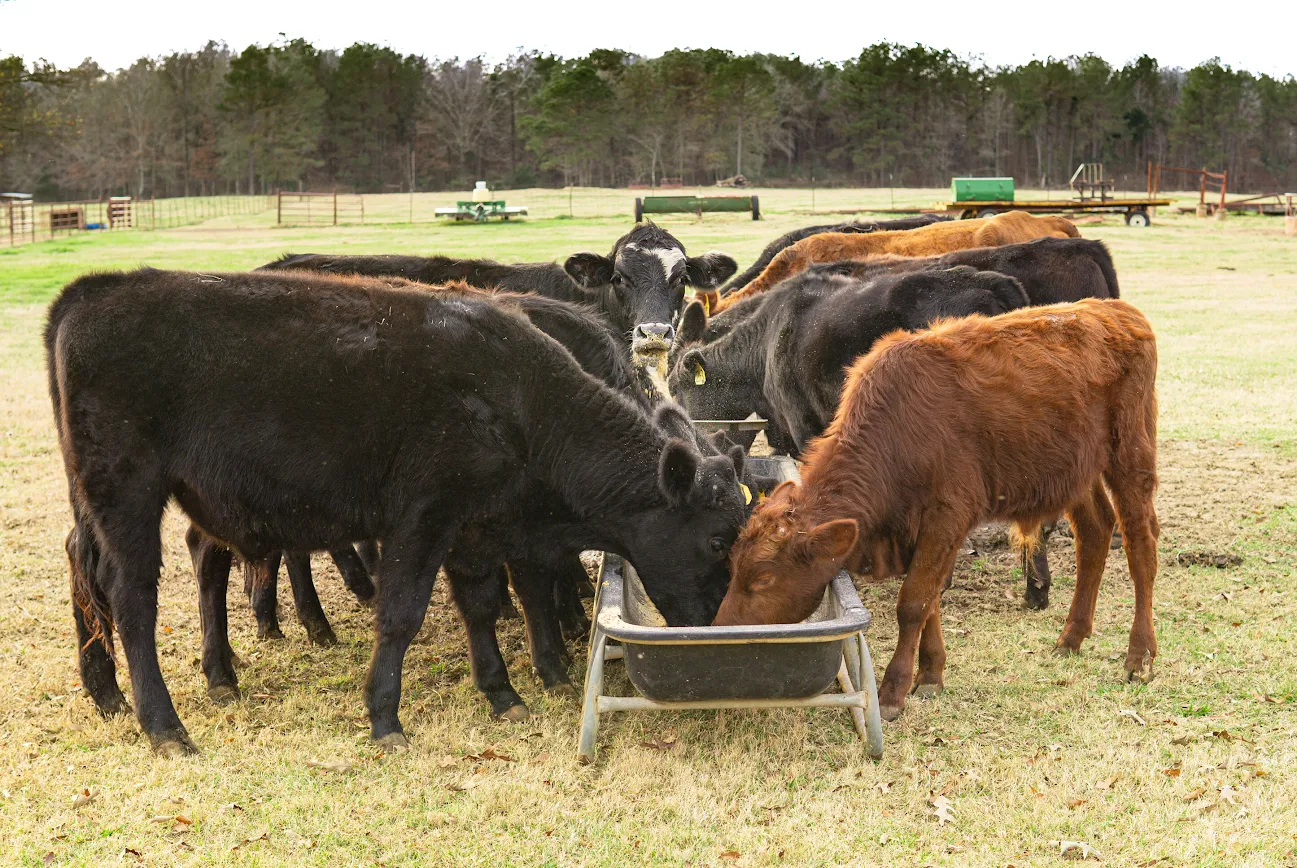

Cattle markets are unpredictable. One month you’re riding high; the next, prices tank and your margins disappear. That’s where backgrounding cattle comes in. It’s a strategic transition phase between weaning and the feedlot that gives you control over your calves’ health, growth, and your bottom line.
Instead of dumping freshly weaned calves into a volatile fall market, backgrounding lets you add value. You build frame, immunity, and profit. This guide breaks down exactly how to run a successful beef background program, from finances to feed to risk management.
What Is Backgrounding Cattle? (Meaning & Core Basics)
Backgrounding cattle is a specialized management and feeding phase that occurs after calves are weaned and before they enter a finishing feedlot. During this 45- to 120-day period, calves transition from a forage-based diet to eating from a bunk, develop their immune systems through vaccination protocols, and gain frame and muscle on a high-roughage ration, typically reaching 700 to 800 lbs.
Think of it this way: you’re preparing calves for the next stage of their life. A freshly weaned, 450 lb calf straight off its mother isn’t ready for a high-concentrate feedlot diet. Backgrounding bridges that gap. You teach them to eat from a bunk, drink from a waterer, and fight off disease before they ever step foot in a feedlot pen. The result? A healthier, heavier, more valuable animal.
Backgrounding vs. Stocker vs. Feedlot: What’s the Difference?
These three terms get mixed up constantly, even by experienced producers. Here’s a quick breakdown:
| Phase | Primary Diet | Goal | Duration / Weight |
| Backgrounding | Forage-based (hay, silage, co-products) | Frame/muscle growth, health, bunk adaptation | 45-120 days (up to 800 lbs) |
| Stocker | Grazing / Pasture | Cheap weight gain on grass | Seasonal (Spring/Summer) |
| Feedlot | High-concentrate grain | Fattening / Marbling | Until market weight (1,300+ lbs) |
The key difference? Backgrounding focuses on health and adaptation. Stocker programs focus on cheap gain through grazing. Feedlots focus on finishing and marbling. A well-run cattle backgrounding program sets calves up to perform better in both stocker and feedlot operations.
Why Background Calves? The Strategic Advantages for Producers
Backgrounding calves isn’t just about adding weight. It’s a calculated business decision with health, growth, and market advantages that pay off.
Too many producers sell calves the week they wean them. Here’s why backgrounding calves gives you a real edge.
Health, Immunity, and Preconditioning Benefits
Weaning is the single most stressful event in a calf’s life. They lose their mother, their food source changes, and they’re often hauled to a sale barn full of unfamiliar animals. That stress hammers their immune system, and bovine respiratory disease (BRD) thrives on it. BRD is responsible for roughly 75% of all feedlot morbidity and 50 to 70% of all finishing mortality, making it a significant feedlot health risk. The U.S. loses an estimated $1 billion annually in treatment costs and production losses from BRD alone.
Backgrounding gives you 45 to 90 days to vaccinate your herd properly, allow boosters to take effect, and let calves recover from weaning stress before they face another round of it at the feedlot. That window is the difference between a healthy calf and a $230/head loss from repeated BRD treatments.
Bunk Adaptation and Rumen Development
A calf that’s been on milk and grass its whole life doesn’t know what a feed bunk is. It doesn’t know how to drink from an automatic waterer. Plus, its rumen isn’t developed enough to handle a concentrated diet.
Backgrounding solves all three problems. You gradually introduce long-stem hay, then transition to a backgrounding ration. The rumen’s microbial population adapts. The calf learns to eat and drink from the equipment it will use for the rest of its life. Feedlots pay more for calves that are already bunk-broke and eating well, because those calves gain faster and get sick less.
Strategic Market Timing
Here’s where backgrounding becomes a financial tool. Fall is when most cow-calf producers wean and sell. That supply flood pushes prices down. Seasonal price data shows fall feeder cattle prices consistently drop below the annual average, while spring prices rise above it.
By holding calves for 45 to 90+ days through a backgrounding program, you can sell into a stronger winter or spring market when supply is lower and demand from feedlots ramps up. You’re not just selling a heavier calf. You’re selling it at a better price per hundredweight.
How to Make Money Backgrounding Cattle: A Financial Blueprint
The money in backgrounding cattle lives in the math. Understanding your numbers is the difference between profit and an expensive lesson.
Let’s be honest: backgrounding isn’t free. You’re carrying calves, feeding them, and tying up capital. The only way to make money backgrounding cattle is to know your numbers.
Calculating Your True Breakeven Cost of Gain (COG)
Most producers underestimate their cost of gain because they only think about feed. A cattle breakeven calculator can help account for the full range of costs involved:
- Feed costs: Your daily ration expense is the biggest variable. Price your ration on a per-head, per-day basis.
- Yardage: This covers equipment wear, fuel, and labor. At current diesel prices around $4/gallon, plan for a minimum of $0.65 to $0.80 per calf per day. Some operations run higher.
- Interest on capital: This is the cost most people forget. If you’re holding a $1,200 calf on borrowed operating capital at 8%+ interest rates, that’s roughly $0.26/day per calf in interest alone. Over 90 days, that’s $23.40 per head before you’ve even fed it.
- Health and processing: Vaccines, dewormers, and processing supplies run $15 to $25 per head at intake.
- Death loss: Budget 1 to 2% for death loss. One dead calf erases the profit from several good ones.
Add it all up, divide by your expected gain, and that’s your true cost of gain. If the market pays more than your COG, you’re in business.
Evaluating Price Margins: Winter Feeding vs. Summer Grazing
Summer grazing programs offer the cheapest cost of gain. Grass is inexpensive compared to harvested feed. But winter backgrounding has its own advantage: you can capture higher spring market premiums when fewer calves are available.
The decision comes down to your operation. If you have cheap pasture, summer grazing can deliver gains at $0.40 to $0.60/lb. Winter backgrounding in a drylot with harvested forages and supplements might run $0.80 to $1.20/lb, but you’re selling into a stronger market. Run the numbers for your specific situation.
Steers vs. Heifers: Finding the Profit Margin
Steers bring higher gross revenue, but that doesn’t mean they always deliver a better margin.
Lightweight heifers are often undervalued at fall weaning sales. Buyers discount them because of lower expected gain and the perception of more health issues. That discount creates an opportunity. If you can buy heifers cheap, background them through winter, and sell them as 700 to 800 lb yearlings in the spring, your margin per head can actually beat steers.
The key is the purchase price. A $15 to $20/cwt discount on 450 lb heifers translates to $67 to $90 per head in savings upfront. If you can match the steer’s cost of gain, that purchase advantage drops straight to your bottom line. Tracking each animal’s performance helps you measure which groups deliver.
Designing a Successful Beef Background Production System
A profitable beef background system starts with the right calves, the right nutrition, and the right facilities. Here’s how to set up your program from the ground up.
Selecting the Right Calves for the Program
Not every calf is a good backgrounding candidate. Your ideal target is a 400 to 600 lb calf in thin-to-moderate body condition. These calves have the most room for compensatory gain on a high-roughage diet.
Avoid over-conditioned calves. A fleshy, 600 lb calf that’s been creep-fed heavily will often lose weight in the first two weeks on a forage-based ration. Very young calves under 350 lbs are risky too, with immature immune systems that struggle in new environments.
Look for calves with a good frame, a healthy appearance, and a known vaccination history. Source matters. Commingled auction calves from multiple origins carry significantly higher disease risk than single-source calves.
Advanced Nutrition
Your base ration will be hay and/or silage. However, smart backgrounders lower feed costs by integrating agricultural co-products that deliver excellent nutritional value at a fraction of traditional ingredient costs.
Co-products worth evaluating include:
- Wet/Dried Distillers Grains (DDGS): A byproduct of ethanol production, DDGS contain 27 to 30% crude protein and about 10% fat. Research shows modified wet distillers’ grains can save over $7/ton compared to corn on a dry matter basis.
- Beet pulp and tailings: High in digestible fiber, low in starch. Great for rumen health during the transition period.
- Corn gluten feed: Another ethanol byproduct that’s high in protein and fiber. Works well blended into a backgrounding ration.
The goal is to keep your cost of gain low while still pushing 1.5 to 2.5 lbs of daily gain. Price your co-products on a cost-per-unit-of-energy basis, not just cost per ton.
Facility Requirements and Environmental Stress
Your facilities don’t need to be fancy, but they need to be functional.
Dry, comfortable loafing areas are non-negotiable. Calves standing in mud burn extra calories just to maintain body temperature. That’s weight gain you’re paying for but not getting. Proper ventilation prevents ammonia and moisture buildup that triggers respiratory problems.
Clean, accessible water is critical. A 500 lb calf drinks 6 to 12 gallons per day. Waterers need to be clean, working, and positioned so timid calves aren’t blocked by dominant pen mates. Monitoring your herd’s health during this period helps you catch problems early.
The Backgrounder’s Edge With Advanced Risk Management
Smart backgrounders protect their margins the same way they protect their calves. Price volatility can erase your profit faster than a BRD outbreak.
Most backgrounding guides stop at grass and vaccines. That’s a mistake. Cattle markets can swing 10 to 15% in weeks. If you’re carrying $1,200 calves for 90 days, treat them like the financial investment they are.
Here are the tools serious backgrounders use:
- Livestock Risk Protection (LRP) Insurance: The most accessible price risk tool for small to mid-size producers. LRP insures against declining prices without requiring a brokerage account or margin calls. You can insure as few as one head.
- Forward Contracting: Lock in a sale price with a feedlot buyer before your calves are finished. You give up some upside, but eliminate downside risk. Especially valuable when prices are above your breakeven.
- Hedging with CME Feeder Cattle Futures: More complex, but powerful. A short hedge on feeder cattle futures offsets losses if the cash market drops. Requires a brokerage account and understanding of margin requirements.
A backgrounded calf is a financial asset sitting in your pen. Protect it the same way you’d protect any other investment.
Step-by-Step Preconditioning Checklist for Background Cattle
A structured preconditioning protocol makes or breaks your background cattle program. Follow this 45-day checklist to set your calves up for success.
Day 1 to 14: Arrival and Low-Stress Transition
- Use fenceline weaning where possible. Calves that can see their mothers across a fence settle faster and eat sooner.
- Practice low-stress cattle handling at every interaction. Calm calves eat more and get sick less.
- Offer long-stem grass hay free choice. This is familiar and encourages early bunk visits.
- Provide fresh, clean water from day one. Check waterers twice daily.
- Process on arrival: ear tag, initial vaccinations (modified-live viral respiratory + clostridial), and record weights.
Day 15 to 30: Health Protocol and Booster Vaccinations
- Administer booster vaccines for clostridial diseases and viral respiratory pathogens.
- Deworm and treat for external parasites.
- Perform castration and dehorning if not done prior to arrival. Allow adequate recovery time.
- Begin introducing the backgrounding ration gradually alongside hay.
Day 30 to 45: Full Ration Transition and Sorting
- Complete the transition to your full backgrounding ration.
- Sort calves into uniform groups by weight and sex. Uniform lots command a premium at sale time because feedlot buyers can manage them more efficiently.
- Record updated weights and track daily gains to evaluate your program’s performance.
- Identify and pull any chronic poor-doers for individual attention or early marketing.
Conclusion: Is Backgrounding Right for Your Cattle Operation?
Backgrounding cattle isn’t for every producer, but for those with the right setup, it’s one of the most reliable ways to add value to a calf crop. The question isn’t whether backgrounding works. It does. The question is whether your operation has what it takes.
You need operational capacity: pens, equipment, feed storage, and labor to manage calves daily. You need feed security: reliable access to affordable forage and co-products. And you need financial liquidity to carry calves until the sale day. If you check all three boxes, backgrounding cattle can turn a volatile fall market into a controlled, profitable program. Run your numbers, protect your price risk, and manage your calves like the investment they are. That’s how you build a consistent profit center for your cattle operation.
FAQs
How Much Weight Should Cattle Gain During Backgrounding?
Most backgrounding programs target 1.5 to 2.5 lbs of average daily gain, depending on the ration and genetics. Over a 90-day program, that translates to roughly 135 to 225 lbs of total gain per calf, taking them from around 500 lbs to 625 to 725 lbs.
What Is the Best Time of Year to Start a Backgrounding Program?
Fall is the most common starting point because that’s when spring-born calves are weaned. Starting in October or November lets you background through winter and sell into the stronger spring market when feeder cattle demand typically increases.
Can Small-Scale Producers Make Money Backgrounding Cattle?
Yes, but your per-head costs will be higher without economies of scale. Tools like LRP insurance make price risk management accessible even if you’re backgrounding 20 to 50 head. The key is keeping your cost of gain below what the added weight and market timing are worth.
How Does Backgrounding Differ From Preconditioning?
Preconditioning is a component of backgrounding, not a separate program. Preconditioning refers specifically to the health protocols (vaccines, deworming, bunk training) performed in the first 30 to 45 days. Backgrounding is the full management and feeding phase that includes preconditioning plus continued growth.
What Records Should You Keep During a Backgrounding Program?
Track individual animal weights at arrival and sale, vaccination dates and products used, feed costs per head per day, treatment records for any sick animals, and death loss. These records let you calculate the true cost of gain, evaluate program performance, and build a health history that adds value at sale. Digital record-keeping tools make this process faster and more accurate.