
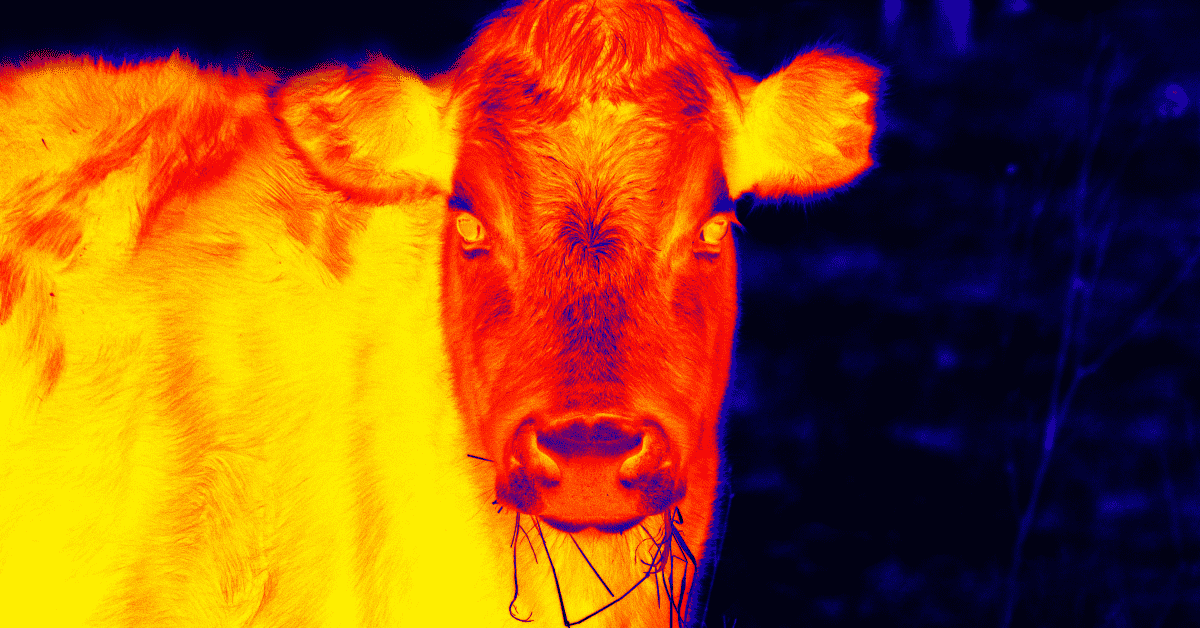

Heat detection in dairy cows is the process of identifying which cows are in estrus accurately and early enough to breed them within the fertile window. Three numbers determine whether your heat detection in dairy cows program is working: detection rate, detection accuracy, and timing of insemination relative to ovulation. If any of the three is off, your pregnancy rate suffers, your days open climb, and your reproductive losses compound quietly across every cycle.
This guide covers how each technology option for heat detection in dairy cows actually performs, what the metrics on your reports mean, and where the common interpretation errors occur.
What Is Dairy Cow Heat Detection?
Dairy cow heat detection is the identification of cows in estrus, the roughly 6 to 18-hour window when a cow will stand to be mounted and when ovulation is approaching. The primary and most reliable sign of standing heat is a cow remaining still while another animal mounts her. Secondary signs include restlessness, chin-resting on other cows, a clear mucus discharge, reduced milk yield at the peak of estrus, and elevated activity levels.
The challenge for high-producing dairy herds is that modern Holstein cows express estrus far more briefly and with less intensity than lower-producing animals. Research cited by the University of Florida Veterinary Extension found that cows producing over 100 lbs of milk per day had an average estrus duration of 6.2 hours compared to 10.9 hours for low producers, with correspondingly fewer mounting events. A 6-hour window overnight in a 2,000-cow herd is nearly invisible to visual observation programs, which is why technology has replaced human observation on most large dairies.
On a 21-day cattle breeding cycle, a single missed heat means a cow goes another three weeks before the next opportunity, and during peak lactation that delay has a measurable cost on days open and calving interval.
Heat Detection Rate in Dairy Cows: What the Numbers Actually Show
Heat detection rate in dairy cows is the percentage of eligible cows detected in estrus over a defined observation period, typically 21 days. It answers one question: of all the cows that cycled this period, how many did your program actually catch?
According to DRMS Dairy Metrics data analyzed by Kansas State University, the average heat detection rate across more than 6,800 U.S. Holstein herds is only 51%. That means nearly half of cycling cows are missed, adding a full 21-day cycle to their days open.
A well-managed heat detection in dairy cows program using automated monitoring should hit 70% or higher. Top-performing herds using automated activity monitoring consistently report heat detection in dairy cows rates above 80%.
The most important thing to understand about heat detection in dairy cows is that detection rate and detection accuracy are not the same. These two metrics are often conflated, and confusing them leads to the wrong diagnostic conclusion when reproductive performance drops.
Detection rate (efficiency): The percentage of cows that were actually in estrus and were detected. Missing cows hurts this number. Improving heat detection dairy cows operations struggle with most is this one.
Detection accuracy (specificity): Of the cows you flagged as in estrus, what percentage actually were? False positives hurt this number.
You can have high accuracy and still miss most of your heats. A program that flags only 30% of cycling cows but correctly identifies all 30% has excellent accuracy and terrible detection rate. The detection rate is almost always the limiting factor in dairy reproductive programs.
Pregnancy rate connects the two: Pregnancy Rate = Detection Rate × Conception Rate. A herd with 55% heat detection in dairy cows rate and 30% conception rate runs at a 16.5% pregnancy rate. Push detection rate to 75% at the same conception rate and pregnancy rate climbs to 22.5%. That difference compounds significantly over a 12-month calving calendar.
Heat detection rate in dairy cows is a core metric in any dairy benchmarking program alongside conception rate, days to first service, and pregnancy rate per 21-day period.
Why Heat Detection in Dairy Cows Is Getting Harder
Three factors are working against visual heat detection in dairy herds simultaneously.
Higher milk production shortens estrus. The relationship between milk yield and estrus duration is well documented. High-producing cows have lower estradiol concentrations at estrus despite larger dominant follicles. That suppresses behavioral expression. A heat that would have lasted 12 hours in a 70-lb-per-day cow lasts 6 hours in a 100-lb cow. Most of that window falls outside observation hours.
Housing conditions suppress mounting. Concrete floors, overcrowding, and pen lameness all reduce mounting behavior. A cow in estrus on a slippery concrete floor is less likely to mount or stand to be mounted, and lameness in cattle compounds this further by suppressing the physical activity and social movement that makes heat visible to both observers and sensors.
Herd size outpaces observation capacity. Visual observation is a labor-intensive task that requires trained staff watching specific groups at specific times. As dairies scale past 500, 1,000, and 2,000 cows, the number of estrus events per day rises while the labor available to observe them stays flat or declines.
Collar-based systems that track both activity and cow rumination use the characteristic drop in rumination time around estrus as a second signal, which reduces false positives from lameness or illness events that also raise activity counts.
The Economic Cost of Poor Heat Detection in Dairy Cows
New Mexico State University Extension reports that excessive days open cost $2 to $5 per cow per day beyond 90 days. A single missed heat adds 21 days to a cow’s open period. At $2 per day, that is $42 per missed heat. At $5 per day, it is $105.
In a 500-cow herd with a 51% detection rate, roughly 245 estrus events per cycle go undetected. Even at the conservative end, that represents thousands of dollars per 21-day period in added days open costs, before accounting for increased culling rates and replacement costs in cows that fail to conceive within the target calving interval.
The goal for dairy cow heat detection is to reduce the number of cows that cycle past their voluntary waiting period without being detected and bred. Every undetected heat that pushes a cow’s days open beyond 150 days increases the probability she enters the culling list rather than the breeding list. With a cattle gestation period of 283 days, a cow that is not confirmed pregnant by 120 days open has almost no path to maintaining a 365-day calving interval.
Technology Options for Heat Detection in Dairy Cows
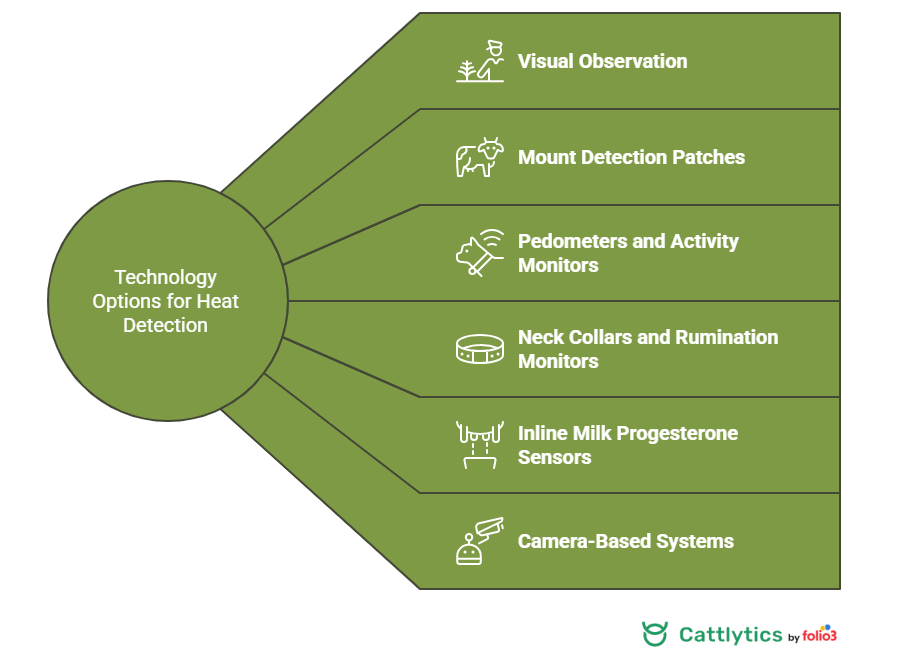
Visual Observation
Visual observation is the baseline method for heat detection in dairy cows. Trained staff observe cattle for 20 to 30 minutes per session, two to four times per day, focusing on the standing-to-be-mounted behavior. When done well, accuracy is high because trained observers correctly identify cows in standing heat. Efficiency is the problem. Two observation sessions per day cover less than 5% of the 24-hour period. A cow in heat for 6 hours overnight is invisible to this heat detection in dairy cows approach.
Visual observation works best as a supplement to automated systems, not as a standalone heat detection in dairy cows program for herds above 200 cows.
Mount Detection Patches
Pressure-sensitive patches applied to the tailhead (Estrotect, KAMAR) are activated when a cow is mounted repeatedly. The patch scratches off or changes color with sufficient mounting pressure. They are inexpensive, require no infrastructure, and work 24 hours per day. Accuracy on cows that fully activate a patch is high. Detection rate is limited to cows that receive sufficient mounting activity, which on slick floors or in overcrowded pens may be lower than expected.
Mount patches work best paired with a twice-daily visual check.
Pedometers and Leg-Mounted Activity Monitors
Pedometers count steps and flag cows with elevated step counts. Cows in estrus typically show 2 to 5 times their baseline walking activity. These systems perform well in free-stall dairies where walking patterns are measurable. Detection rate on commercial systems ranges from 70% to 90% for cows showing strong estrus behavior.
The limitation is false positives from health events. A cow with a fresh lameness event may show abnormal activity patterns that resemble estrus. Sorting health alerts from heat alerts requires cross-referencing health records.
Neck Collars and Rumination-Activity Monitors
Neck-collar systems (SCR by Allflex, Nedap, Lely Qwes) measure both activity and rumination. During estrus, activity rises and rumination drops. The combination of both signals reduces false positive rates compared to activity-only systems. A recent study published in PubMed on a neck-mounted accelerometer system found sensitivity of 90.9%, specificity of 100%, and overall accuracy of 93.6% for heat detection in dairy cows, with the optimal insemination window identified as 11.4 to 15.5 hours after heat onset detection.
These systems integrate directly with herd management software and generate timestamped alerts rather than requiring manual observation. They are the current standard for large confinement dairies.
Inline Milk Progesterone Sensors
Inline progesterone sensors (integrated into robotic milking systems like DeLaval and Lely) measure progesterone concentration at every milking. Progesterone drops sharply at the onset of estrus and rises again after ovulation. These sensors predict estrus 2 to 4 days in advance and can also flag early pregnancy loss when progesterone fails to rise post-breeding. They require a robotic milking setup, which limits their use to herds with automated milking infrastructure.
Camera-Based Systems
Machine vision systems using overhead cameras are an emerging option, particularly in large tie-stall and free-stall operations. Computer vision algorithms identify mounting events and flag animals involved. Detection accuracy on current commercial systems is still maturing but improving rapidly. These systems require camera infrastructure and robust data connectivity.
Camera-based systems require camera infrastructure and robust data connectivity, though costs have dropped significantly as part of the broader adoption of precision sensing in dairy trends across both large and mid-size operations.
What the Data Actually Means: Interpreting Heat Detection Reports
Most automated systems generate daily or weekly heat detection in dairy cows reports. Here is what to actually look at.
Detection rate: Pull the 21-day heat detection in dairy cows rate, not the daily alert count. A busy alert day does not mean a high detection rate if the same cows keep appearing on the list and new cows are being missed.
Alert precision: What percentage of alerts resulted in an insemination? If your system generates 100 alerts per week and your team breeds 40 cows, the other 60 were either false positives or missed by the breeding team. Both are problems but different ones.
Inter-estrus interval: Check the average number of days between detected heats for cows that have been flagged multiple times. The correct interval is 18 to 24 days. Intervals consistently shorter than 18 days suggest false positives or short luteal phases. Intervals longer than 24 days suggest missed cycles in between.
Alert fatigue: This is the most underappreciated problem in heat detection in dairy cows programs using automated technology. When a system generates too many alerts, breeding staff become selective about which ones to act on. The high-alert weeks with the most misses are often the weeks where alert fatigue sets in, not equipment failure.
A good question to ask of your system monthly: what percentage of cows that were bred last month were bred within 24 hours of the first alert? If that number is dropping, the problem is usually workflow, not technology.
Breeding records are only as reliable as the underlying cattle inventory tracking that keeps individual animal histories intact through pen moves, fresh cow events, and sales.
Heat Detection Strategies for Dairy Cattle: Combining Visual and Automated Methods
The strongest heat detection strategies for dairy cattle are hybrid programs, not pure technology or pure visual observation. University of Georgia Cooperative Extension notes that effective heat detection requires both catching the cows in estrus and breeding at the right time, and that combining detection aids with consistent observation scheduling produces better outcomes than either approach alone.
A practical hybrid approach for a 500-cow dairy:
- Neck collar or activity monitoring system as the primary detection layer, running 24 hours per day
- Mount detection patches on fresh cows and repeat breeders as a secondary check
- Twice-daily visual walks by a trained employee cross-referencing the system’s alert list
- Timed AI protocol for cows that pass 60 days in milk without a detected heat
Cows that cycle quietly or sit in deep negative energy balance are better managed on an estrus synchronization protocol that removes dependence on behavioral detection entirely, guaranteeing a timed breeding opportunity regardless of whether estrus was expressed.
Successfully bred cows need preg checking at 28 to 35 days post-insemination to confirm conception and identify open cows before another 21 days slips past.
Interpreting Heat Detection Across Production Stages
Heat detection in dairy cows does not behave the same across all stages of lactation.
Early lactation (0 to 60 DIM): Most cows are in voluntary waiting period and should not be bred. Detecting early heats during this period is useful for identifying cows that have resumed cycling and estimating when they will be eligible for breeding. Heat detection in dairy cows during this phase is observational, not actionable for insemination.
Peak lactation breeders (60 to 120 DIM): This is the highest-priority group for heat detection in dairy cows. Cows in peak production have the weakest estrus expression but the greatest economic impact of a missed heat. Detection technology delivers the most value here.
Repeat breeders: Cows that have been bred two or more times without conceiving need extra scrutiny in heat detection in dairy cows programs. Review alert timing relative to ovulation, insemination timing, and inter-estrus intervals for these animals before concluding the problem is conception failure rather than heat detection in dairy cows accuracy or insemination timing.
Cows in negative energy balance, which is common in the first 60 days of peak dairy cow milk production, show delayed return to estrus and weaker expression when cycling does resume, which is precisely when early-lactation detection failures compound into long days-open numbers.
Connecting Heat Detection Data to Herd Management
Heat detection in dairy cows generates data. The value of that data depends entirely on how it connects to breeding records, health records, and production records in your management system.
Standalone heat detection in dairy cows alerts that are not linked to individual animal history miss most of their potential. A heat alert is most useful when the person acting on it can also see: how many days since the last heat, how many previous services, the cow’s current milk production, any health events in the last 30 days, and what protocol she is on.
Connecting heat detection in dairy cows alert data to breeding decisions, recording insemination outcomes, and tracking conception rates by detection method are the steps that turn a technology investment into a measurably better reproductive program.
Cattlytics cattle IVF and Embryo transfer software connects heat detection, breeding records, reproductive history, and animal health data in one place. This gives breeding teams better visibility into the ideal time for breeding, helps them plan IVF and embryo transfer activities more accurately, and keeps each cow’s reproductive history available when making breeding decisions.
FAQs
What is heat detection in dairy cows?
Heat detection in dairy cows is the process of identifying cows in estrus (standing heat) so they can be inseminated within the fertile window. Estrus lasts 6 to 18 hours in dairy cows, with high producers expressing shorter, less visible heats.
What is a good heat detection rate in dairy cows?
The national average heat detection in dairy cows rate across U.S. Holstein herds is 51%, according to DRMS data. A well-managed heat detection in dairy cows program using automated monitoring should achieve 70% or higher. Top herds regularly exceed 80%.
What is the difference between heat detection rate and accuracy?
Detection rate measures what percentage of cows in estrus were actually detected. Accuracy measures what percentage of detected cows were truly in estrus. Detection rate is almost always the binding constraint. A low detection rate, not low accuracy, is what drives poor pregnancy rates in most dairy herds.
How much does a missed heat cost?
Each missed heat adds 21 days to a cow’s open period. At $2 to $5 per day open beyond the target, that is $42 to $105 per missed heat per cow.
Do activity monitors replace visual observation for heat detection?
On large dairies, automated monitoring systems running 24 hours per day outperform visual observation as a primary detection method. The best programs combine automated monitoring with targeted visual checks and a timed AI protocol as a backstop for cows that are not detected by either method.
Which heat detection technology is most accurate?
Neck-collar systems that combine activity monitoring and rumination data currently show the strongest combination of sensitivity and specificity. A controlled study found sensitivity of 90.9% and specificity of 100% for a neck-mounted accelerometer system. Inline milk progesterone sensors are highly accurate but require robotic milking infrastructure.