

Feed is the single largest input cost in any cattle operation. According to the USDA Economic Research Service, feed costs typically account for 50 to 70 percent of total production costs in beef cow-calf systems, which means every decision you make about what and how you feed your herd hits your margins directly.
Liquid feed for cattle has been part of that conversation for decades, but it still creates more confusion than most other feed topics. Some producers swear by it. Others have had bad experiences and never went back. Most are somewhere in the middle, trying to figure out whether it actually makes sense for their operation.
This blog breaks down what liquid feed for cattle is, the main types available, how it is used in practice, the real advantages, the legitimate drawbacks, and what to know before adding it to your program.
What Is Liquid Feed for Cattle?
Liquid feed is exactly what it sounds like: a feed supplement delivered in liquid form rather than as dry pellets, cubes, or meal. But the category is broader than most people expect.
Liquid cow feed can be made from a wide range of byproducts and ingredients, including molasses, whey, corn steep liquor, condensed corn distillers solubles (CCDS), and tallow. These base ingredients are often blended together and fortified with protein sources, urea, vitamins, minerals, and feed additives to create a consistent, customized supplement.
What makes cattle liquid feed different from most other feed formats is its flexibility. It can be used as a TMR (totally mixed ration) ingredient, applied directly to dry forages at a feed mill, or placed in lick tanks and troughs for free-choice pasture feeding. The same base ingredients can be adjusted for different production goals, different seasons, and different herd classes.
The simplest way to think about liquid feed for cattle: if it has nutrition in it and it is in liquid form, it falls into this category. That includes everything from straight bulk molasses to complex suspension formulas that carry protein, energy, minerals, and growth additives in a single product.
Main Types of Liquid Feed for Cattle
Understanding the different types of cattle liquid feed helps you choose the right option for what your herd actually needs.
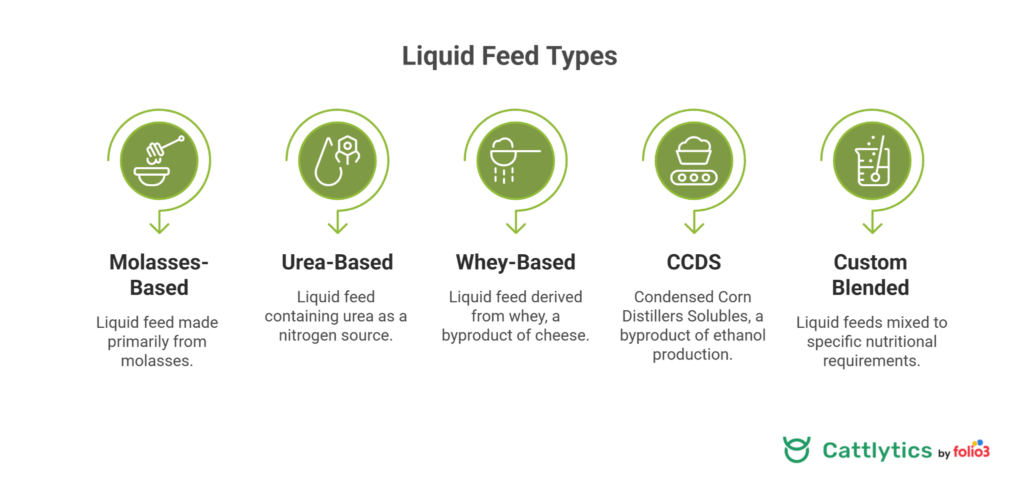
Molasses-Based Liquid Feed
Liquid molasses for cattle is the most widely recognized and historically established form of liquid feed. Both cane and beet molasses are used in beef and dairy operations. Both run around 65 percent sugar on a dry matter basis, making them a concentrated and rapidly fermentable energy source for the rumen.
Liquid molasses for cattle does more than just supply energy. The sugars in molasses stimulate fiber-digesting bacteria in the rumen, which improves the breakdown of forage. Research published in PMC supports this, showing that molasses-based liquid feed increases fiber digestibility, which matters when forage quality is inconsistent or low. Molasses also acts as a natural palatability enhancer, which is why it is commonly used as a carrier for ingredients like urea that cattle would otherwise resist.
Molasses can be added to mixed rations at the feed mill, applied directly to hay, or used as the primary base in a custom liquid feed blend. At inclusion rates up to around 10 percent of the total ration, it integrates well into most feeding programs without disrupting rumen balance.
Urea-Based Liquid Feed
Urea is a non-protein nitrogen (NPN) source that rumen bacteria convert into ammonia and then use to build microbial protein. It is included in liquid feed for cattle as a cost-effective way to meet crude protein requirements without relying entirely on plant-based protein sources like soybean meal.
When formulated correctly, urea in liquid feed is safe and effective. Modern formulations typically include urea at levels that represent 20 to 30 percent of the supplement’s crude protein, which is well within safe limits for ruminants. The combination of molasses and urea is particularly common because molasses provides the energy that rumen microbes need to use the nitrogen from urea efficiently.
Concerns about urea toxicity are real but are largely associated with older formulations or situations where cattle consumed large amounts after going without feed. Managed properly, with gradual introduction and consistent access, liquid feed containing urea is used safely across millions of head of cattle every year.
Whey-Based Liquid Feed
Whey is a byproduct of cheese manufacturing, rich in lactose (milk sugar). It is used as a liquid feed ingredient primarily in regions with significant cheese production. Standard whey runs 10 to 30 percent dry matter, making it less concentrated than molasses-based products. Fermented or ammoniated versions carry higher crude protein levels, and research indicates that fermented ammoniated condensed whey fed to transition cows can reduce subclinical acidosis. For operations near a cheese plant, whey can be a cost-effective liquid feed option. Consistent product analysis matters here because composition varies by source.
Condensed Corn Distillers Solubles (CCDS)
CCDS is a thick, syrup-like byproduct of the ethanol industry containing protein, energy, and phosphorus. It is often available at competitive prices in corn-producing regions and is most commonly used as a blended ingredient rather than fed straight. Its protein content adds value to supplement formulas that need to hit crude protein targets.
Custom Blended and Suspension Liquid Feeds
Many commercial liquid feed products are custom blends of the base ingredients above, formulated to specific nutritional targets and fortified with vitamins, minerals, ionophores, fly control additives, and other functional ingredients. Suspension technology keeps insoluble particles evenly distributed without settling, allowing a consistent dose of nutrients to be delivered through a lick tank or TMR addition. This is where the most targeted customization happens: a well-formulated blend can be designed around your specific forage base, herd class, and nutritional gaps.
How Liquid Feed for Cattle Is Used
There are three primary delivery methods for liquid cow feed, and the right one depends on your operation.
In a Total Mixed Ration (TMR)
For dairies and feedlots using a TMR, liquid feed is added directly into the mixer wagon. This is one of the most efficient ways to incorporate liquid feed for cattle because it distributes nutrients uniformly across the entire ration and allows for precise inclusion rates.
Molasses is the most common TMR addition at the mill level. It helps bind the ration, reduces sorting, improves palatability, and brings rapidly fermentable sugars to the rumen without spiking pH the way starch can. If you are managing TMR consistency as part of a broader herd health and production tracking system, logging feed composition alongside production data gives you a clearer picture of what is working. That kind of integration is covered in the dairy herd management guide.
Lick Tanks and Lick Wheels for Pasture Cattle
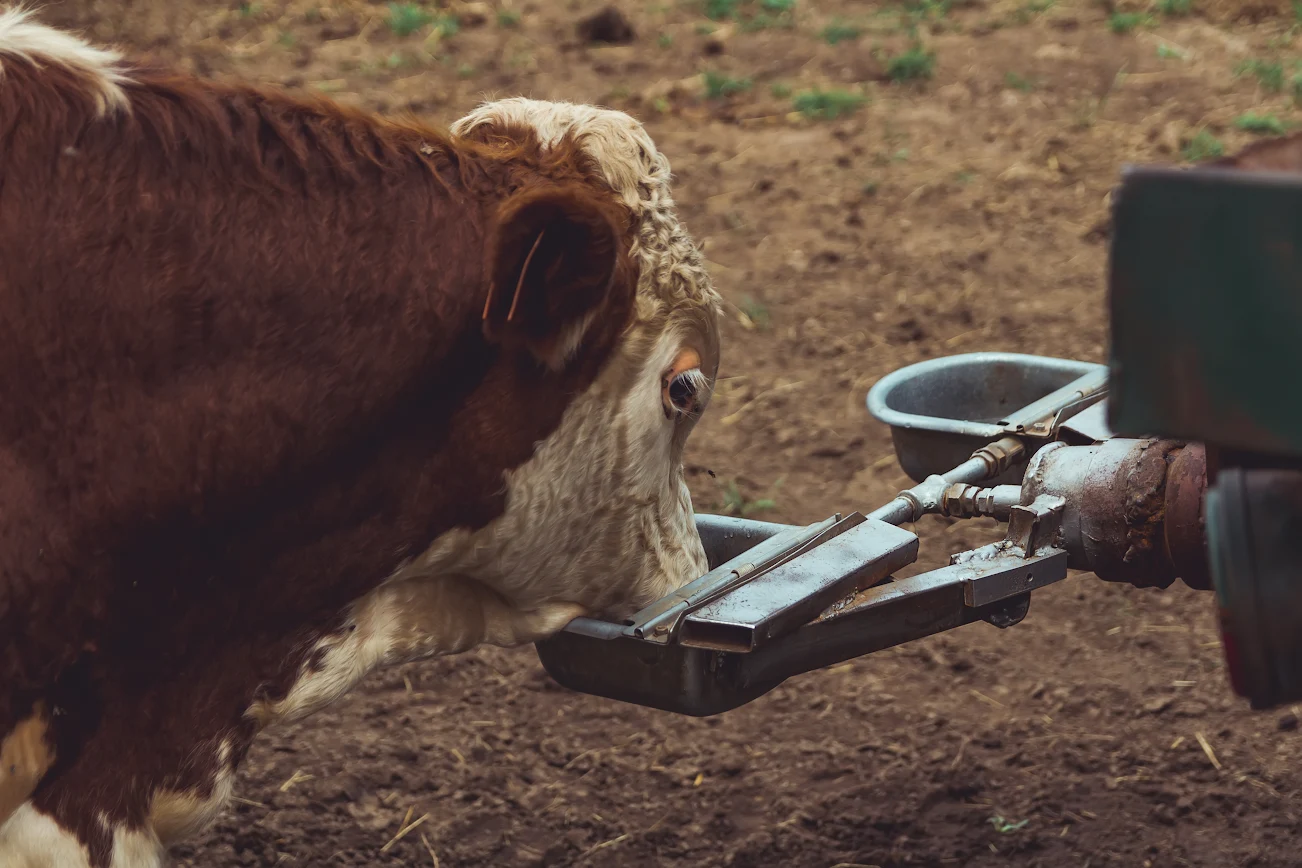
In range and pasture settings, lick tanks and lick wheels are the standard delivery method for liquid feed for cattle. A lick tank is a covered container with a wheel partially submerged in the liquid. When cattle lick the wheel, it turns and deposits a thin layer of feed on the surface. The design limits intake through the physical effort required, which serves as a natural consumption control.
Open troughs are also used with some formulas, particularly those that are self-limiting by design, meaning the formula is balanced with intake limiters that reduce palatability at higher consumption levels without reducing nutrition.
Pasture-based liquid cow feed programs are well suited to range cattle that are grazing lower-quality forage. Liquid feed supplements placed strategically across a pasture can also influence grazing distribution, encouraging cattle to use areas they might otherwise underutilize.
Applied to Hay or Low-Quality Forage
Liquid feed can be sprayed or poured directly onto hay or processed forage to boost palatability and nutritional value. This is a practical option during winter feeding or drought periods when forage quality drops. On smaller operations it is done at point of feeding; at the feed mill level, large-scale coating of hay and commodity feeds is done before delivery.
Advantages of Liquid Feed for Cattle
Liquid feed gives cattle a consistent, easy to consume source of nutrients that supports steady intake and better digestion. It also helps improve feed efficiency, making it a practical option for operations focused on performance and cost control.
Improves Forage Digestibility
One of the most consistent findings in liquid feed research is that molasses-based liquid feed for cattle increases fiber digestibility in the rumen. The sugars in molasses stimulate the growth of fiber-digesting bacteria, which allows cattle to extract more nutrition from the same amount of forage. This matters most when you are managing cattle on lower-quality hay or dormant pasture.
Better forage utilization reduces the gap between what cattle need and what their base diet provides. That translates to better body condition maintenance without adding expensive concentrates. For operations that track body condition scoring across the herd, you can see this effect reflected in BCS data over time, especially in late-gestation cows. The feed efficiency guide explains how to connect feed decisions to measurable performance outcomes.
Cost-Effective Protein Delivery
Liquid feed for cattle that contains urea delivers crude protein at a lower cost per unit than plant-based protein sources. Urea is priced well below soybean meal on a per-pound-of-nitrogen basis, and when included correctly in a molasses-based formula, it is used efficiently by rumen microbes.
The key is evaluating liquid feed on a cost-per-head-per-day basis rather than cost-per-ton. Products with higher moisture content will look expensive by the ton but may compare favorably per head once actual inclusion rates and nutrient density are factored in. This same principle applies to any feed decision in your operation. The livestock fattening guide covers how to think about feed costs relative to performance targets.
Labor and Handling Efficiency
Lick tanks and trough systems require only periodic filling, eliminating the daily handling and distribution of dry supplements. For range operations with cattle spread across large acreage, a well-placed lick tank system cuts time on supplement delivery significantly. On feedlot and dairy operations, liquid feed in the TMR system integrates into existing mixing workflows without extra handling steps beyond a storage tank and pump.
Consistent Nutrient Distribution and Year-Round Flexibility
When mixed into a TMR or applied uniformly to feed, liquid feed distributes nutrients more evenly than dry additives, reducing the risk of uneven intake across the herd. Quality molasses-based products with higher dry matter content (55 to 65 percent) also remain flowable in cold temperatures, making them usable year-round. Consistent access to liquid supplements year-round helps cows maintain body condition score through all production stages, which supports better rebreeding rates and a more uniform calf crop.
Pros and Cons of Liquid Feed for Cattle
| Category | Pros | Cons |
| Nutrition | Improves forage digestibility, flexible nutrient delivery | Moisture content means lower dry matter per gallon vs. dry feeds |
| Cost | Competitive cost per head for protein; urea is economical | Higher moisture = more weight shipped; requires per-head cost analysis |
| Labor | Lick tanks reduce daily supplement handling | Requires storage tanks, pumps, or delivery infrastructure |
| Intake control | Self-limiting formulas available; lick wheels restrict overconsumption | High-palatability products can be over-consumed without intake limiters |
| Consistency | Even nutrient distribution in TMR; no sorting | Byproduct-based types (whey, CCDS) vary in composition between loads |
| Seasonality | Molasses blends perform year-round | Pure byproducts (whey, steep) can freeze or separate in cold weather |
| Urea safety | Safe at modern inclusion rates | Requires acclimation; risk increases if cattle go hungry before access |
The pros and cons of liquid feed for cattle ultimately come down to how well it fits your feeding system. Operations with TMR equipment, on-farm storage capacity, and consistent forage programs will get more value from liquid feed than operations that cannot manage intake or monitor consumption.
What to Watch for When Using Liquid Feed
- Intake management is non-negotiable.
Highly palatable liquid feed for cattle, particularly molasses-based products, can be over-consumed if cattle are hungry or if the delivery system does not limit intake. Overconsumption leads to cost overruns and rumen disruption. Use lick wheels, troughs with built-in limiters, or self-limiting formulas.
- Acclimate cattle to urea-containing products gradually.
Introduce over one to two weeks and never let lick tanks run empty. Hungry cattle returning to a full tank will overconsume.
- Analyze your byproduct ingredients.
Products like whey, CCDS, and corn steep vary by batch. Request regular lab analysis for any byproduct-based liquid feed and factor moisture content into ration calculations.
- Store properly
Sealed tanks kept out of direct sunlight maintain product quality well. Rain contamination in open troughs or poor tank maintenance affects quality and cattle acceptance.
Managing these details is easier when you log feeding events, supplement changes, and animal performance in one system. The cattle management software from Cattlytics supports feed record tracking alongside health, breeding, and weight data in a single platform.
When Liquid Feed for Cattle Makes the Most Sense
Liquid feed for cattle is not the right fit for every operation, but it tends to deliver the most value in specific situations.
Pasture and range cattle on low-quality forage. When dormant grass or hay provides insufficient protein and energy, liquid molasses for cattle in lick tanks fills nutritional gaps without daily labor.
Drought or winter supplementation. When forage quality drops, liquid feed for cattle is a practical way to maintain cow body condition before late gestation. Cows that hold body condition score five or above rebreed more reliably, which directly affects calf crop consistency. You can read more about the link between cow nutrition and breeding in the cattle breeding cycle guide.
TMR-based dairies and feedlots. Adding liquid feed for cows into the mixer wagon delivers energy and palatability consistently. For how feed management connects to production tracking in dairy systems, see the dairy herd management guide.
Operations near local byproduct sources. If you are close to a cheese plant, ethanol facility, or sugar processor, liquid byproducts may be priced significantly below dry protein alternatives.
For producers building out their feeding fundamentals, the guide for raising cattle for beginners provides useful foundational context for decisions like whether liquid supplementation fits your program.
Using Records to Make Better Liquid Feed Decisions
Liquid feed for cattle programs work best when you can connect the feed input to observable outcomes. Are cows holding body condition through late gestation? Are weaning weights improving? Is feed cost per head tracking where you expected? These questions are hard to answer without records.
If you are changing your liquid feed program, log the change date, the product, the inclusion rate, and the cattle group affected. When that data sits alongside your health records, breeding dates, and weight history, patterns emerge that would otherwise be missed. The Cattlytics cow-calf management software is built to support exactly that kind of connected record-keeping.
Conclusion
Liquid feed for cattle is a versatile and often cost-effective supplement option, but it is not a one-size-fits-all solution. The right type of liquid cow feed depends on your forage base, your delivery infrastructure, your herd’s nutritional needs, and your production goals. Molasses-based liquid feed for cattle improves forage digestibility and delivers energy efficiently. Urea-containing formulas are economical for protein supplementation when managed correctly. Byproduct-based options like whey and CCDS can be highly competitive in regions where they are locally available.
The biggest mistake producers make with liquid feed is treating it as a set-and-forget program. Intake management, product analysis, and monitoring animal response are all part of making it work. When those pieces are in place, liquid feed for cattle earns its place in a feeding program that is built around actual herd performance and real production costs.
FAQs
What Is Liquid Feed For Cattle Made Of?
Liquid feed for cattle is made from byproduct and commodity ingredients including molasses (cane or beet), whey, corn steep liquor, condensed corn distillers solubles (CCDS), and tallow. These are blended and typically fortified with urea, vitamins, minerals, and feed additives. The exact formula depends on the intended use: TMR addition, pasture supplementation, or hay application.
Is Liquid Molasses For Cattle Safe To Feed?
Yes. Liquid molasses for cattle is one of the most widely used feed ingredients in beef and dairy production. At recommended inclusion rates it does not disrupt rumen pH the way starch can. At excessive levels, overconsumption can lead to acidosis, so intake management through lick wheels or formulated limiters is important.
How Do You Manage Intake When Mixing Liquid Feed For Cattle?
Intake is managed through the delivery system. Lick wheel tanks physically limit consumption. Self-limiting formula designs reduce palatability at higher intake levels. For TMR applications, inclusion rates are controlled at the mixer. Gradual introduction over one to two weeks is recommended for any new liquid feed program, especially those containing urea.
What Are The Main Pros And Cons Of Liquid Feed For Cattle?
Pros include improved forage digestibility, cost-effective protein delivery through urea, reduced supplement handling labor, and consistent nutrient distribution in TMR systems. Cons include the need for storage and delivery infrastructure, variability in byproduct-based ingredients, the risk of overconsumption without intake controls, and handling challenges for some products in cold weather.
When Should I Use Liquid Feed For Cows Instead Of Dry Supplements?
Liquid feed for cows makes the most sense in pasture and range settings where daily handling is impractical, during drought or winter when forage quality drops, in TMR systems where liquid addition is efficient, and when locally available byproducts offer a cost advantage over dry protein sources. If your operation cannot manage intake or lacks storage capacity, dry cubes or blocks may be more practical.
How Does Liquid Feed For Cattle Affect Rumen Health?
When properly formulated and fed at appropriate rates, liquid feed supports rumen health by stimulating fiber-digesting bacteria through molasses sugars, improving dry matter intake from lower-quality forage, and supplying consistent nitrogen for microbial protein synthesis via urea. Problems arise when overconsumption occurs, leading to rumen acidosis or urea toxicity. Gradual introduction and consistent, uninterrupted access are the two most important factors for maintaining rumen health on a liquid feed program.