
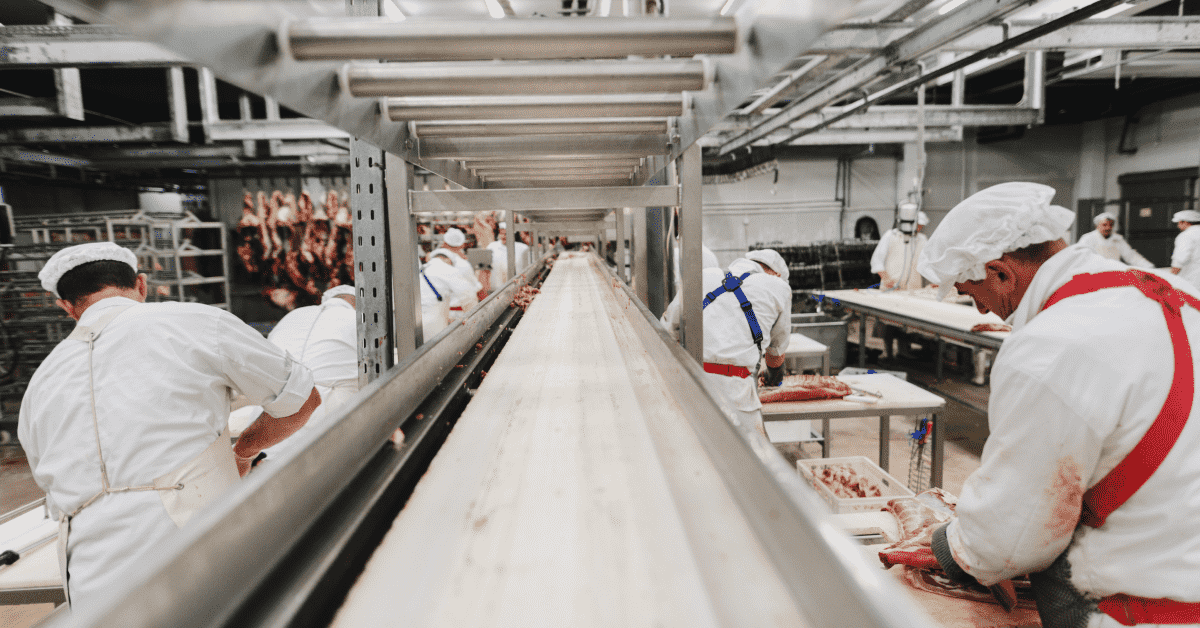

Meat processors today face operational challenges that compound across every department. You need more throughput from the same facility, but labor is harder to find, yield losses add up fast, packaging errors create rework, and manual recordkeeping slows every decision. Meat processing automation can help solve these problems, but only when you combine the right equipment with connected digital systems that let you actually measure and manage what is happening on your plant floor.
Operating costs keep climbing while margins stay tight. The processors who pull ahead are the ones who treat automation as a connected strategy, not a collection of standalone machines.
This guide breaks down where automation fits, what it costs, what it returns, and how to invest without disrupting what already works.
What Is Meat Processing Automation?
Automation in meat processing means different things depending on your plant. Here is how to think about it in plain terms.
Meat Processing Automation Explained in Practical Plant Terms
Meat processing automation is the use of machinery, robotics, sensors, controls, software, and connected data systems to perform or coordinate processing activities with less manual intervention. It covers everything from automated cutting and portioning equipment to production scheduling software, inventory tracking, quality management, and lot traceability systems that connect your plant floor to your business operations.
In practical terms, automation is what allows a plant to weigh, cut, package, label, and trace product with fewer manual steps, fewer errors, and more consistent output.
Automation Does Not Always Mean a Fully Automated Plant
Not every processor needs a fully automated meat processing plant. The reality is that most operations fall somewhere between manual and highly automated. You might run a semi-automated packaging line while still hand-trimming on a cutting floor. That is perfectly normal.
The most practical approach is to automate selected bottlenecks rather than rebuild everything at once. Current industry research supports this modular, gradual method, especially where biological variation in carcass size and shape makes full automation technically or economically difficult.
Why Is Automation Important in Meat Processing?
The importance of automation in meat processing goes beyond speed. It addresses labor, safety, yield, and visibility all at once.
Labor Availability, Safety, and Repetitive Work
Repetitive cutting, lifting, handling, and packaging are physically demanding. Workers performing these tasks face serious injury risks. Today, meat and poultry workers suffer serious injuries at more than double the rate of private industry overall. Carpal tunnel syndrome rates in this sector run more than seven times the national average.
Automation equipment can shift people away from the most repetitive and injury-prone tasks toward supervision, exception handling, maintenance, and quality control. That is better for workers and better for your plant’s retention.
Yield Consistency and Product Giveaway
Small variations in trimming, cutting, weighing, and portioning may look minor on a single piece. But yield and shrink loss compound fast when you multiply even a few grams of giveaway across thousands of pounds per shift. Automated portioning and weighing systems help control these variations and protect your margins on every production run.
Production Visibility and Faster Decisions
If your supervisors only see production numbers at the end of a shift, they cannot react to problems while those problems are happening. Automated meat processing systems that capture data in real time let you spot line slowdowns, yield drops, packaging errors, or inventory shortages while there is still time to fix them. Smarter real-time monitoring alerts make that response faster and more reliable. That visibility is what separates reactive management from proactive control.
Which Meat Processing Steps Can Be Automated?
From receiving to palletizing, there are automation opportunities at every stage. Here is what each one looks like in practice.
Receiving, Slaughter, and Primary Processing
Feedlot receiving and operations benefit most from early-stage automation. It covers receiving identification, automated weighing, carcass handling systems, hide removal equipment, splitting, and movement along the kill floor. Not every step here can or should be fully automated. But automated weighing, identification, and conveyor-driven movement reduce manual handling and improve consistency from the start.
Cutting, Deboning, Trimming, and Portioning
This is where robotic cutting, vision-guided systems, anatomical sensing, deboning assistance, portion control, automated weighing, and mixing come into play. Academic research consistently identifies biological variation in carcass shape and muscle structure as one of the central technical challenges in automating these tasks. Vision-guided and adaptive systems are closing that gap but have not eliminated it.
Inspection, Quality Control, and Foreign Material Detection
Machine vision, cameras, sensors, metal detectors, X-ray systems, and weight verification help automate quality checks that would otherwise depend on human spotting. Automated exception handling catches problems before they move downstream.
Packaging, Labeling, Case Packing, and Palletizing
Meat packaging automation covers portion placement, weighing, sealing, labeling, barcode creation, case packing, palletizing, and cold storage movement. Automated downstream workflows can link all of these steps together so that a finished, labeled case moves to storage with full traceability data attached.
Automation Opportunity Table
| Process Stage | Manual Pain Point | Possible Automation | Required Equipment | Required System | Main KPI Affected | Implementation Complexity |
| Receiving | Manual ID and weighing | Automated scales, RFID/barcode scanning | Scales, scanners, conveyors | Inventory system, lot tracking | Inventory accuracy | Low |
| Cutting/Portioning | Inconsistent cuts, giveaway | Vision-guided cutting, robotic portioning | Robotic cutters, vision systems | Production tracking, yield reporting | Yield %, giveaway | Medium-High |
| Quality/Inspection | Missed defects, slow checks | Machine vision, metal detection, X-ray | Cameras, detectors, sensors | QA system, exception alerts | Rework rate, compliance | Medium |
| Packaging | Label errors, slow throughput | Automated weighing, sealing, labeling | Sealers, labelers, case packers | Order/SKU management, label data | Packaging output, order accuracy | Medium |
| Palletizing/Storage | Manual stacking, tracking gaps | Robotic palletizing, automated movement | Palletizers, AGVs, conveyors | WMS, lot traceability | Throughput, traceability | Medium-High |
Automated Meat Processing Equipment vs. Meat Processing Systems
Most articles blur the line between machines and systems. Understanding the difference matters when you are evaluating automation investments.
What Counts as Automated Meat Processing Equipment?
Automated meat processing equipment includes any physical machinery that performs a processing task with reduced manual input. This covers conveyors, cutting systems, deboning equipment, weighing scales, vision systems, metal detectors, packaging lines, label printers, case packers, palletizers, barcode scanners, RFID readers, and robotics.
These are the tools that handle the physical work on your plant floor. Each one can improve speed or consistency at its specific station. But equipment alone does not tell you what happened, connect output to an order, or trace a lot from receiving to shipment.
What Makes Meat Processing Systems Different?
Meat processing systems are the digital coordination layer. They include production scheduling, work orders, lot and batch tracking, yield tracking, inventory management, quality management, traceability, packaging records, warehouse operations, ERP, MES, WMS, reporting, and integration with machines and scales.
Think of it this way: equipment handles the physical work, software manages the information, and integrated systems connect both. A scale can weigh a portion. A system records that weight, ties it to a lot number, compares it against an order spec, and flags an exception if it is out of range. That second layer is where operational control and business visibility come from.
How Does Meat Processing Automation Improve Efficiency and Reduce Costs?
Efficiency gains from automation are real, but they need to be measured and tracked by a meat processing software solution. Here is where plants see the biggest impact.
Six Areas Where Plants Can Measure Efficiency Gains
When you automate, track these metrics:
- Throughput per hour: Units or pounds processed per production hour. Automation typically reduces idle time between steps.
- Pounds processed per labor hour: This is your labor productivity number. It tells you whether automation is genuinely reducing the labor cost per unit.
- Yield percentage and product giveaway: The share of incoming raw material that becomes sellable product. Even a 1% yield improvement across a high-volume operation translates to significant annual savings.
- Downtime: Unplanned stops per shift or per week. Automated systems with sensors can catch problems earlier and reduce total lost time.
- Rework and error rates: How often product gets reprocessed, relabeled, or scrapped due to errors.
- Packaging output and order accuracy: Packages completed per hour and the rate of correct labels, weights, and case counts.
- Inventory accuracy: The gap between what your system shows and what is physically on hand. Automated scanning and tracking close this gap.
- Cost per pound: Your total processing cost divided by output. This is the number that tells you whether automation is actually improving your bottom line.
Where Cost Savings Actually Come From
Cost savings from automation are not abstract. They come from specific, measurable areas:
- Fewer labor hours per unit of output
- Reduced overtime from faster processing
- Lower yield loss and giveaway per shift
- Less rework from packaging and labeling errors
- Reduced waste from quality exceptions caught earlier
- Fewer inventory discrepancies from automated tracking
- Faster recall investigation through digital lot traceability
- Lower downtime through sensor-based maintenance alerts
A simple framework to evaluate:
Automation value = labor savings + yield gains + waste reduction + avoided errors + capacity gains – automation operating costs.
That gives you a real number to work with, not a vague promise.
How Does Meat Packaging Automation Improve Order Accuracy and Throughput?
Packaging is one of the highest-impact areas for automation. Here is why.
From Portioning to Final Pallet
Meat packaging automation covers the full sequence: weighing, portion control, tray loading, vacuum packaging, sealing, labeling, barcode generation, case packing, palletizing, and warehouse movement. Each step offers an opportunity to reduce manual handling, eliminate errors, and improve speed.
When these steps run as a connected workflow, you reduce the gaps where mistakes happen. A label that pulls weight and lot data automatically does not have the same error rate as one typed manually.
Connecting Packaging Data with Customer Orders
The real power of packaging automation shows up when production data, lot identification, weight, SKU, label information, and customer specifications stay connected from the production line to the shipping dock. When your packaging system talks to your order system, you fill orders faster, with fewer errors, and with complete traceability records attached to every case. That connection also simplifies audits and customer inquiries because every piece of data already exists in one place.
How Connected Automation Improves Traceability, Quality, and Compliance
Traceability is not just a regulatory requirement. It is an operational advantage when done right.
Build Digital Lot and Batch Genealogy
Every meat processor needs to trace product forward to customers and backward to source material. That means connecting incoming livestock identification, production batch, transformation steps, packaging, storage location, shipment, and final customer.
FSIS requires official establishments to maintain written recall plans, and recall releases reference lot codes, production dates, establishment numbers, and labels to identify affected products. Digital lot genealogy built through automated data capture makes this process faster and more reliable than pulling paper records from filing cabinets.
When your system can answer “which customers received product from lot X?” in minutes instead of hours, you reduce the scope and cost of any recall event.
Automate Records Without Treating Automation as Compliance
Moving from paper logs to digital recordkeeping can improve documentation, speed up record retrieval, and generate alerts for quality exceptions. But digital systems do not replace your HACCP plan, your sanitation controls, your verification procedures, or your regulatory obligations. FSIS requires official establishments to maintain written recall procedures and sanitation controls independent of the technology they use.
This distinction matters. Automation supports your compliance program. It does not become your compliance program.
What Should Meat Processors Consider Before Investing in Automation?
Before you spend on equipment or software, do the homework. Your investment decision should come from your own plant data.
Establish Your Current Performance Baseline
Before automating anything, document where you stand now:
- Labor hours per unit of output
- Throughput per shift
- Yield percentage
- Product giveaway weight
- Downtime hours per week
- Waste and rework rates
- Packaging accuracy
- Inventory accuracy
- Cost per pound processed
Without these numbers, you cannot prove whether automation delivered results. A baseline turns a gut feeling into a business case.
Calculate Automation ROI Using Plant Economics
The figures below are illustrative. Build your model using your own plant baseline.
| Cost Category | Example Estimate |
| Equipment cost | $180,000 |
| Software cost | $30,000 |
| Integration/customization | $20,000 |
| Plant modifications | $15,000 |
| Installation | $10,000 |
| Training | $8,000 |
| Annual maintenance | $12,000 |
| Total implementation investment | $275,000 |
| Expected annual labor savings | $95,000 |
| Expected annual yield gains | $40,000 |
| Additional capacity value | $20,000 |
| Annual net benefit | $155,000 – $12,000 = $143,000 |
| Estimated payback period | ~23 months |
Use this structure to compare projects against each other and against doing nothing. A project that delivers a payback period under 24 months is typically a strong candidate to prioritize.
Use an Automation Priority Scorecard
Score each potential automation project from 1 to 5 on these factors, then compare totals. The project with the highest combined score across your most important factors is where to start.
Scoring guide: 1 = low impact or difficulty; 5 = high impact or difficulty. For investment and integration complexity, a lower score is more favorable.
| Factor | Packaging Line Automation | Manual Trimming Automation |
| Labor intensity of the current process | $5 | 5 |
| Safety risk to workers | $3 | 5 |
| Production bottleneck severity | $4 | 3 |
| Impact on yield | $3 | 5 |
| Error frequency | $5 | 3 |
| Traceability importance | $5 | 3 |
| Available equipment maturity | $5 | 3 |
| Integration complexity (lower = easier) | $4 | 2 |
| Investment required (lower = less) | $3 | 2 |
| Expected payback speed | $4 | 3 |
| Total | $41 | 34 |
In this example, packaging line automation scores higher overall, driven by strong marks across error frequency, traceability, and equipment maturity. Manual trimming automation scores higher on safety and yield impact, which may push it higher in plants where injury rates or giveaway are the most urgent problems. Apply the same scoring to your own shortlist and let the numbers guide the conversation with your leadership team.
How to Implement Meat Processing Plant Automation Without Disrupting Production
Automation rollouts fail when plants try to do everything at once. A phased approach protects your production.
Follow a Phased Automation Roadmap
- Phase 1: Identify bottlenecks and establish KPIs for the areas you want to improve.
- Phase 2: Automate one high-value workflow. Measure results against your baseline.
- Phase 3: Connect equipment and data capture. Start building digital records alongside physical output.
- Phase 4: Integrate production, inventory, quality, and traceability into one system.
- Phase 5: Connect ERP, finance, warehouse, and reporting to plant floor data.
- Phase 6: Optimize continuously using the performance data your systems now generate.
Current industry research supports this gradual, flexible approach, especially in operations where full automation is not yet economically or technically practical.
Common Meat Processing Automation Mistakes
Avoid these pitfalls:
- Automating an inefficient process without fixing the process first
- Buying standalone equipment without planning how it integrates with existing systems
- Ignoring sanitation and washdown requirements for new equipment
- Failing to establish baseline KPIs before automating
- Underestimating training time for operators and maintenance staff
- Automating too many steps at once instead of proving value sequentially
- Choosing systems that cannot exchange data with each other
Meat Processing Automation Trends to Watch in 2026
The industry is moving fast. Here are the trends worth tracking this year.
Seven Automation Trends Shaping Modern Processing Plants
- AI-enabled machine vision: Cameras and AI working together to grade, inspect, and sort product faster and more consistently than manual inspection.
- Adaptive robotic cutting: Robots that adjust cuts based on real-time analysis of carcass shape and size, addressing the biological variation challenge.
- Human-robot collaboration and cobots: Collaborative robots designed to work alongside people rather than replace them. Research in 2026 emphasizes this human-centered approach.
- Connected sensors and edge computing: Sensors at every process point feeding data to local processors for real-time decision-making without cloud latency.
- Real-time quality sensing and predictive maintenance: Systems that detect quality issues and equipment wear before they cause downtime or defects.
- Greater ERP and plant floor integration: Tighter connections between what happens on the line and what shows up in financial, inventory, and compliance systems.
- Human-centered Industry 5.0 design: A design philosophy that puts worker experience, flexibility, and resilience at the center of automation planning rather than treating people as obstacles to full automation.
The global meat processing equipment market is valued at approximately $12 billion in 2026 and is projected to reach $18 billion by 2033 at a 5% CAGR, reflecting sustained investment in automation-driven capacity.
Why Smarter Meat Processing Systems Matter as Much as the Equipment
Equipment alone is only half the picture. The other half is the information layer.
Connect Plant Equipment, Data, and Business Operations
A machine can automate a task. But software is what lets management see what happened, connect it to inventory and orders, trace the output, measure the yield, and understand financial performance. Without that digital layer, your automated equipment is just faster manual work.
As a member of the American Association of Meat Processors, Cattlytics understands the real demands of plant operations firsthand. It supports meat processing workflows including production, work orders, inventory, lot and batch traceability, quality, yield tracking, packaging activities, industrial-scale integration, barcode and RFID systems, ERP connectivity, warehouse systems, and reporting. It connects the physical work on your floor to the business data your leadership team needs to make decisions.