


Sexed semen pays off when the value of a known-sex calf exceeds the fertility penalty you take on and the cost premium you pay per straw. That calculus looks different depending on whether you are using sexed semen in a conventional AI program or in an IVF program, and it changes considerably based on the type of animal you are breeding, the quality of your synchronization program, and what the resulting calf is worth to your operation.
Sexed semen does not work on every animal, and it does not pencil out in every program. This guide breaks down where it makes sense, where it does not, and what drives the line between the two.
What Is Sexed Semen and How Does Sexed Semen Work?
Sexed semen is bull semen that has been sorted by a flow cytometer to separate X-chromosome-bearing sperm from Y-chromosome-bearing sperm before being frozen into straws. The result is a straw that produces female calves (X) or male calves (Y) at a rate greater than 90%, compared to the roughly 50:50 ratio you get with conventional semen.
The sorting process works because bovine X-chromosome sperm carry approximately 4% more DNA than Y-chromosome sperm. A flow cytometer stains sperm cells with a fluorescent dye, then measures the light each cell emits as it passes through a laser beam. Cells with more DNA (X-bearing) fluoresce slightly brighter. The cytometer applies a tiny electrical charge to each droplet as it falls, directing X-sperm and Y-sperm into separate collection tubes.
Research published in Theriogenology and summarized in PubMed confirms that flow cytometry separates X-sperm from Y-sperm with an accuracy as high as 90% or more, and that in vitro fertilization offers a practical path to improving the efficiency of sexed semen in cattle.
The key tradeoff is sperm dose. A conventional semen straw contains 15 to 20 million motile sperm. A sexed semen straw typically contains 2 to 4 million. That lower dose is why sexed semen delivers lower pregnancy rates in AI programs. The cells are viable, but there are fewer of them competing to reach and fertilize the egg.
Sexed Semen Technology in Cattle Artificial Insemination: What the Numbers Show
Sexed semen technology in AI programs reduces pregnancy rates compared to conventional semen. Research from Ohio State University Extension summarizing field data and multiple studies found that pregnancy rates using sexed semen are generally 60 to 90% of those achieved with conventional semen. In practical terms, that usually means a 10 to 20 percentage point reduction in conception rate per breeding.
That reduction is not uniform. It depends on several factors:
Animal type matters most. Heifers consistently outperform cows when bred with sexed semen. Heifers have higher baseline fertility than postpartum cows, which is a meaningful advantage when you are already working with a reduced sperm dose. The fertility gap between sexed and conventional semen is smallest in high-fertility heifers in standing estrus.
Estrus expression at breeding matters. Animals showing strong, confirmed estrus at the time of insemination perform considerably better with sexed semen than animals bred at a fixed time without confirmed estrus. A quality estrus synchronization protocol that produces a high percentage of animals in standing heat at breeding is the single most important management factor for sexed semen performance in AI programs.
Bull selection matters. Not every bull’s semen sorts equally well or survives the sorting process with the same fertility intact. AI companies have identified which bulls are strong performers with sexed semen, and using those bulls versus poor candidates for sexed semen can shift results significantly.
Heat stress matters. Conception rates with sexed semen in summer months drop more than with conventional semen. Operations that breed during hot months should factor in additional fertility loss on top of the baseline sexed semen penalty.
The practical implication: sexed semen in AI is a program for well-managed, synchronized heifers bred at detected estrus. If your conventional AI conception rate on synchronized heifers is below 50%, sexed semen will likely underperform before you account for the cost premium. Build your conventional AI program first, then layer in sexed semen.
Sexed Bull Semen in IVF Programs: Where the Numbers Change
IVF changes the economics of sexed bull semen in a way that makes it far more attractive for high-value operations.
In a conventional AI program, the low sperm dose per straw is the primary fertility bottleneck. In IVF, the egg is fertilized in a laboratory dish, not in the reproductive tract. The sperm dose requirement is lower and the process is more controlled. The sorting-related damage to sperm cells is still present, but the IVF environment is designed to compensate for compromised sperm function in ways that the reproductive tract cannot.
The result is that sexed bull semen in IVF programs typically delivers a higher percentage of the baseline fertility compared to the same semen used in AI. A review published in Theriogenology on the application of sexed semen to in vitro embryo production found that IVF is a feasible and increasingly efficient means to increase the fertilization efficiency of sex-sorted sperm in cattle, with the controlled environment compensating for some of the sorting-related sperm damage.
Blastocyst production rates still decline compared to non-sexed semen, but the gap is smaller than what AI programs see. More importantly, when you are producing 10 to 20 embryos from a high-value donor per flush cycle, the sex-selection accuracy of greater than 90% has compounding value on every embryo transferred.
This is why sexed semen has been adopted most rapidly in elite genetics programs that combine IVF with donor cows. An operation flushing a high-EPD cow and producing 15 sexed embryos knows with high confidence that 13 or 14 of those embryos will produce heifers. That changes the economics of the entire program because heifer replacement value, donor calves for resale, or show-heifer programs all assign significantly more value to a female calf than a steer.
For a primer on how breeding cycle timing affects IVF and AI program planning, see our guide on the cattle breeding cycle.
When Does Sexed Semen Pay Off? The Decision Framework
The question is not whether sexed semen is technically useful. It is whether the value of the sex-biased outcome exceeds what you spend to achieve it, including the cost of the straw premium and the cost of the fertility penalty.
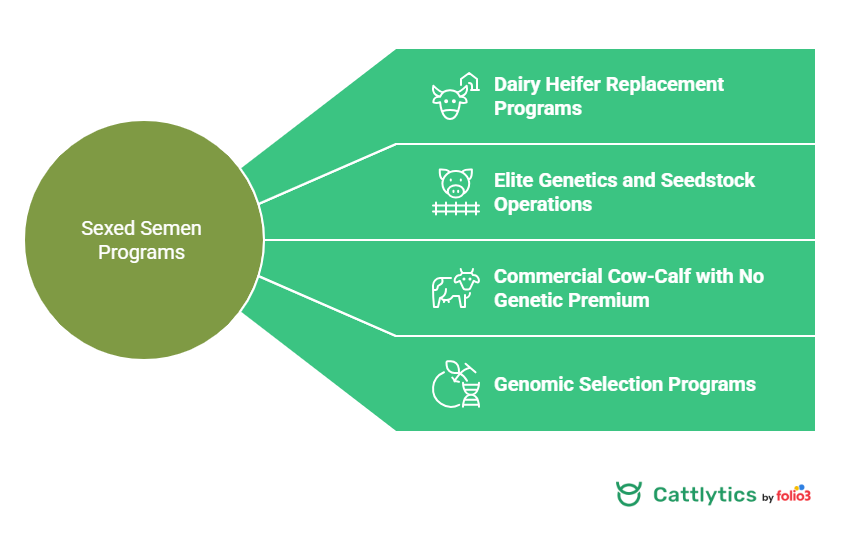
Dairy heifer replacement programs: This is the strongest case for sexed semen. Dairy farms that need heifer replacements assign a high dollar value to a female calf and a low or negative value to a bull calf from a dairy cow. Sexed semen in synchronized heifer AI programs converts a 50:50 calf sex outcome into an 85:15 or better outcome in favor of heifers. There is also a secondary benefit worth noting: female calves are typically smaller than male calves at birth, and operations using female-sorted sexed semen on first-calf heifers have reported fewer calving difficulty events as a result. Our dystocia in cattle guide covers the risk factors and management responses that matter most at calving. The overall math works when heifer replacement value is high enough to absorb both the straw premium and the lost pregnancies. In most dairy markets, it does.
Beef heifer replacement programs: The case is similar but narrower. Selecting replacement heifers for a cow-calf operation already involves tight selection criteria. If you are breeding replacement-candidate heifers with sexed semen and the remaining heifers with conventional semen or bulls, you are directing your breeding resources toward the animals most likely to benefit. The break-even depends on replacement heifer value in your market and what a steer calf of the same genetics would sell for.
Elite genetics and seedstock operations: Sexed semen combined with IVF produces the highest certainty per embryo. If you are producing embryos for sale, selling heifer embryos at a premium to steer embryos, or building a cow herd from a specific genetic line, the cost of sexed semen is quickly recovered across the embryo value. For operations running this at scale, IVF embryo transfer software makes it easier to track per-embryo value and recipient outcomes. Knowing which cattle breeding traits your target market values most helps you identify the right donors and bulls to prioritize in your sexed semen program.
Commercial cow-calf with no genetic premium: This is the weakest case. If your heifer and steer calves sell at similar weights for similar prices, and your only goal is pregnancy rate, conventional semen and natural service will almost always produce better reproductive outcomes for less money. The value difference between a heifer calf and a steer calf in a commodity program rarely justifies the sexed semen premium combined with the fertility penalty.
Genomic selection programs: Operations using genomic selection to identify high-merit donors get added benefit from sexed semen because they are already investing in embryos and genetic certainty. Adding sex certainty on top of genomic merit certainty increases the value of each resulting calf.
Artificial Insemination in Cattle with Sexed Semen: Management Requirements
Artificial insemination in cattle with sexed semen is less forgiving than conventional AI. The same errors that cost you 5 percentage points of conception rate with conventional semen can cost you 10 to 15 points with sexed semen.
The management requirements that matter most:
Synchronization protocol quality. Sexed semen is most forgiving when the maximum number of animals are in standing estrus at the time of insemination. A protocol that produces 70% estrus expression before breeding gives you a much stronger sexed semen result than a protocol that produces 40%.
Inseminator skill and timing. Sexed semen straws have a smaller margin for error in thawing and handling. Insemination technique, timing relative to estrus onset, and thaw protocol consistency all affect outcomes more than they do with conventional semen.
Heat stress management. During warm months, inseminate during cool hours of the day and minimize handling stress in the 12 to 24 hours before breeding. Heat stress compounds the existing fertility reduction from sexed semen.
Cooling bulls carefully. Not all bulls have semen that sorts well. An AI company’s rating of a bull as suitable for sexed semen is a meaningful signal. Using a bull with known poor sexed semen performance to try to save straw cost will cost more in lost pregnancies than you save. Our guide on bull selection criteria for breeding covers the broader evaluation factors that matter when choosing bulls for AI and IVF programs.
Cattle Artificial Insemination: Cost Breakeven for Sexed Semen
The cost arithmetic for cattle artificial insemination with sexed semen runs through three numbers: the straw premium, the cost of lost pregnancies, and the value difference between male and female calves.
As American Cattlemen reports from a beef cattle reproduction researcher with 13 years of sexed semen experience, seeing a decrease in pregnancy rates of 10 to 20% compared to conventional AI is common, and for sexed semen to be feasible, operations need to be performing well with conventional AI first. Sexed semen straws typically cost $20 to $30 more per straw than conventional semen from the same bull. That premium alone is manageable. The larger cost is the lost pregnancies. If your conventional AI conception rate is 60% and your sexed semen rate is 45%, you need more breedings per pregnancy. Each additional breeding adds straw cost, synchronization cost, and labor.
The straw cost and extra breedings must be offset by the value difference between the desired-sex calf and the alternative. In a dairy replacement heifer program where the female calf is worth $500 more than a bull calf, the math usually holds. In a beef operation where the premium for a heifer over a steer is $100 or less, it often does not unless the program is also capturing a genetic premium.
Run the numbers for your specific operation before committing. The combination of straw cost, estimated conception rate, and estimated calf sex value premium will tell you clearly whether the investment makes sense for your program. Once breeding is complete, confirming which animals conceived and planning rebreeds promptly is what keeps the reproductive calendar on track. Our guide on preg checking cows covers the methods and timing that matter after any AI program.
FAQs
How does sexed semen work?
Sexed semen is sorted using a flow cytometer that separates X-bearing sperm from Y-bearing sperm based on DNA content. X-sperm carry approximately 4% more DNA than Y-sperm. The cytometer reads the fluorescence of each stained sperm cell and sorts them into separate collection tubes, producing straws with greater than 90% sex accuracy.
What is the pregnancy rate with sexed semen compared to conventional AI?
Pregnancy rates with sexed semen are typically 60 to 90% of what you achieve with conventional semen, depending on animal type, management quality, and season. Well-managed, synchronized heifers in standing estrus show the smallest fertility gap. Cows and animals bred during summer heat show the largest gap.
When does sexed bull semen work better in IVF than in AI?
In IVF programs, the low sperm dose in a sexed semen straw is less of a limiting factor because fertilization happens in a controlled laboratory environment. Blastocyst rates still decline somewhat versus non-sexed semen, but the sex certainty on each resulting embryo adds significant value when embryos are produced from high-value donors.
Is sexed semen appropriate for use on cows or only on heifers?
Sexed semen is most effective on high-fertility heifers in detected estrus. Cows have lower baseline conception rates, which makes the fertility penalty from sexed semen more costly. Most programs restrict sexed semen to heifers or to IVF donors rather than using it broadly across a cow herd.
What is sexed semen technology accuracy?
Current flow cytometry-based sexed semen technology achieves greater than 90% sex accuracy. Calves resulting from sexed semen do not show elevated rates of genetic abnormalities compared to calves from conventional semen.
Can sexed semen be used with a fixed-time AI protocol?
Yes, but it requires a protocol that produces high estrus expression at breeding. Animals that are in confirmed standing estrus at fixed-time AI perform considerably better with sexed semen than those bred at a fixed time without confirmed estrus. Building a synchronization protocol that maximizes estrus expression is worth the extra management effort when using sexed semen.