

If you run cattle, you already know the stakes have never been higher. The U.S. beef cow herd just hit a 75-year low at 86.2 million head, and every replacement heifer you keep is a female you did not sell at record feeder prices.
That is the reality of replacement heifer selection in 2026. You are not just picking a pretty calf. You are making a 10-year financial commitment that will either pay you back through calves, longevity, and genetic gain or quietly bleed your operation through open seasons, calving problems, and early culls.
This guide breaks down the modern, data-driven approach to selecting, evaluating, and developing replacement cattle so every heifer you retain earns her spot in the herd.
What Is a Replacement Heifer? (And Why She Dictates Your Herd’s Future)
A replacement heifer is a young female bovine kept from the calf crop or purchased specifically to enter the breeding herd. She replaces older, less productive cows that are culled due to age, poor fertility, structural breakdown, or temperament issues. In simple terms, she is your herd’s next generation.
Every replacement heifer you retain or buy carries genetic potential that shapes your herd for the next decade. There are two categories you need to understand:
- Bred Replacement Heifers: Females already confirmed pregnant. They cost more upfront but remove the risk of open seasons. You know she is bred, and you can plan a calving window.
- Open Replacement Heifers: Unbred females selected for future breeding. They cost less but carry more risk. You are betting she will cycle, conceive, and calve on time. Without proper evaluation, an open heifer can burn through a full year of feed costs and still end up at the sale barn.
A bred heifer gives you a shorter path to your first calf. An open replacement heifer gives you more genetic control (you choose the bull or AI sire), but she needs to pass every physical and reproductive checkpoint before you invest a single breeding dollar. Either way, the replacement cattle you select today will define your herd’s productivity for the next 8 to 10 years.
The 2026 Replacement Heifer Market with High Stakes and Historic Lows
The numbers behind replacement heifer selection in 2026 tell a story of scarcity and opportunity cost. Here is what every producer needs to know before making a decision.
- Inventory is at near-historic lows. As of January 1, 2026, the national beef replacement heifer inventory sat at just 4.71 million head, the second-lowest count since the 1940s. Only 2025’s figure of 4.6 million was lower. The supply of quality replacement cattle is thin, and competition for proven females is fierce.
- The opportunity cost of retention is massive. With 550-pound weaned heifer calves selling for well over $2,000 per head, every heifer you hold back is a heifer you did not cash in at the feeder market. That is real money sitting in your pasture, eating your feed, and waiting 18 to 24 months before she generates her first dollar of revenue.
- Breakeven costs on purchased bred heifers are steep. A new analysis pegs the breakeven price at $5,018 per head for a bred heifer to still deliver an 8% return under current market conditions. At that price point, there is zero room for a wrong selection.
- Culling rates have slowed, but the herd is not growing. Beef cow slaughter dropped nearly 17% in the first half of 2026, following an 18% decline in 2025. Producers are holding cows longer, but the overall beef cow herd still contracted to 27.6 million head, down 1% year-over-year.
The takeaway is simple. When replacement cattle cost this much, and supply is this tight, your selection process cannot afford guesswork. Every heifer you keep must be structurally sound, reproductively ready, and genetically proven.
Step-by-Step Replacement Heifer Selection Criteria
Relying on eye appraisal alone leads to expensive mistakes. A heavy heifer with bad feet will break down by her third calf. A pretty-fronted female with a terrible udder will starve her calves. Modern selection breaks the process into distinct structural and genetic checkpoints.
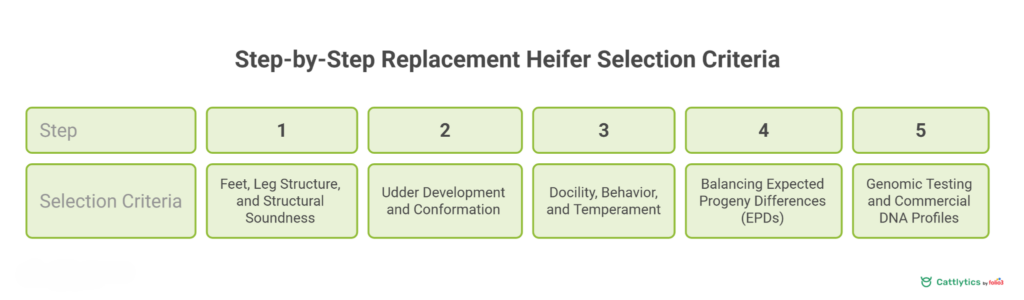
1. Feet, Leg Structure, and Structural Soundness
Feet and legs are the foundation. A structurally flawed heifer will not survive the demands of grazing rough pasture for a decade.
Look for a moderate foot angle (approximately 45 degrees), symmetrical claws with even wear, and adequate heel depth. The hocks should show a clean, moderate set without being too straight (post-legged) or too much angle (sickle-hocked). Pasterns should be strong and upright, not weak and sloping.
Structural problems compound with age and weight. A slight toe issue in a 600-pound heifer becomes a lameness problem in a 1,200-pound cow carrying a calf. If she cannot walk to water and graze comfortably, she will miss breeding windows and get culled years before she should.
2. Udder Development and Conformation
The udder determines whether a cow can raise a calf to weaning weight or leave you bottle-feeding.
In young heifers, look for uniform teat placement with four functional teats of moderate size. Teats should not be excessively large (balloon teats) or too small for a newborn calf to latch onto. The udder should show strong medial suspension, meaning it is held tight to the body rather than pendulous and swinging.
One critical warning: heifers that get too fat during development often deposit excess fat in the udder tissue. This is not the same as udder development. Fat replaces the milk-producing tissue and permanently reduces her ability to produce milk. You cannot feed it off later. It is gone.
3. Docility, Behavior, and Temperament
Temperament is not just a convenience trait. It is a safety and profitability factor.
Wild or high-strung heifers are dangerous to handle, slower to conceive, and produce calves with elevated stress responses. Research confirms that temperament in beef cattle is moderately heritable, meaning a nervous dam will likely produce nervous calves. That trait carries forward for generations.
The practical rule is straightforward: if a heifer consistently scores poorly on chute temperament or flees aggressively at handling, she is an easy cull. You will never train it out of her, and her calves will inherit the same disposition.
4. Balancing Expected Progeny Differences (EPDs)
EPDs are the baseline data strategy for any replacement cattle decision. If you are not using them, you are guessing.
Focus on maternal EPDs first. The three that matter most for replacement heifers are:
- Calving Ease Maternal (CEM): Predicts how easily her calves will be born. Low CEM values mean more calving difficulty, more vet bills, and more dead calves.
- Milk: Estimates her milking ability through her calf’s weaning weight. Too little milk starves calves. Too much milk can drive excessive cow size and higher maintenance costs.
- Stayability: Predicts the probability she will still be in the herd at age six. This is your longevity metric.
The biggest mistake producers make is single-trait selection. Chasing extreme growth or extreme milk creates large-framed, high-maintenance cows that eat you out of house and home. Balance maternal traits against terminal traits like carcass weight and growth. For a deep breakdown, review our guide on EPDs in cattle.
5. Genomic Testing and Commercial DNA Profiles
DNA testing has moved from seedstock luxury to commercial necessity. In 2026, tools like genomic-enhanced breeding values (GEBVs) and commercial DNA profile tests give producers the ability to see what visual appraisal cannot.
For open replacement heifers with no calf performance data, genomic selection fills the gap. A DNA test can predict a heifer’s genetic potential for fertility, feed efficiency, disease resilience, and carcass merit before she ever sees a bull.
The practical value is clear. Instead of waiting two to three years to find out if a heifer was a good pick, you can rank your heifer pen by genetic merit today. The heifers that do not make the cut can be marketed at premium feeder prices while they are still worth top dollar.
For operations already using cattle genetic testing, these tools also identify parentage, detect genetic defects, and confirm breed composition.
Pre-Breeding Exams Before Replacing Heifer: The Ultimate Tool for Culling
Your veterinarian physically evaluates the reproductive tract and pelvic structure to confirm each heifer is ready to breed. Heifers that fail should be marketed immediately while feeder prices remain strong. For the broader process, our guide on preg checking cows covers the fundamentals.
Reproductive Tract Scoring (RTS) and Pelvic Measurements
Reproductive tract scoring is a 1-to-5 scale that evaluates ovarian development and uterine tone through rectal palpation. Scores of 4 and 5 indicate active cycling or near-cycling heifers with mature follicles and good uterine tone. These are your keepers. A score of 3 means she is close to puberty but still a borderline risk.
Heifers scoring 1 or 2 have immature, pre-pubertal tracts with little to no ovarian activity. They should go straight to the feeder market. Do not carry them hoping they will catch up. Every day they eat feed without cycling is a day you are losing money.
Pelvic measurements are equally critical. The general rule is a minimum pelvic area of 150 square centimeters to reduce the risk of dystocia (calving difficulty). A heifer with a small pelvis is far more likely to need a pull, and pulled calves have higher mortality rates and slower starts. Measuring pelvic area is a two-minute procedure that can save you thousands in dead-calf losses.
The combination of RTS and pelvic measurements gives you a clear, data-backed culling decision. Pair this with calving season preparation to set your first-calf heifers up for success.
Nutritional Milestones for Reproductive Success In Heifer Replacement
The target is straightforward: heifers need to reach 60% to 65% of their projected mature body weight by the start of breeding season. By their first calving, they should be at 80% to 85% of mature weight. For an Angus cow with a mature weight of 1,200 pounds, that means 720 to 780 pounds at breeding and 960 to 1,020 pounds at calving.
Miss these targets, and the consequences stack up fast. Under-fed heifers hit puberty late, cycle irregularly, and breed late in the season. That pushes their calving date back, and late-calving heifers rarely catch up. They wean lighter calves and are more likely to fall out of the herd within two to three years.
Over-feeding carries its own risks. Heifers that get too fat deposit adipose tissue in the udder, permanently reducing milk production capacity. The goal is steady, moderate growth, not a feedlot finish.
Buy vs. Raise: Which Replacement Cattle Strategy Is Right for You?
The right answer depends on your cash flow, genetic goals, and risk tolerance.
| Factor | Buy Bred Heifers | Raise Open Heifers |
| Upfront Cost | High ($3,500 to $5,000+ per head) | Lower (retained from calf crop or purchased as weanlings) |
| Cash Flow Impact | Immediate large outlay | Spread over 18 to 24 months of development costs |
| Genetic Control | Limited to what the seller offers | Full control over sire selection, AI programs, and crossbreeding strategies |
| Biosecurity Risk | Higher (introducing outside animals) | Lower (closed herd or known-source purchases) |
| Time to First Calf Revenue | 6 to 9 months | 18 to 24 months |
| Risk of Open Females | Minimal (pregnancy confirmed) | Real (depends on fertility, nutrition, and breeding management) |
For operations that need cows now and have the capital, buying bred heifers gets calves on the ground faster. For operations focused on long-term genetic improvement and willing to invest in development, raising open heifers gives you more control over the outcome.
Either way, tracking cattle inventory digitally ensures you are capturing the data you need to evaluate each heifer’s ROI over time.
Conclusion: Setting Your Herd Up for a Decade of Success
Replacement heifer selection is not about getting a female pregnant. It is about getting her pregnant early, calving in the first 21 days of the season, and keeping her productive for the next 8 to 10 years.
Every checkpoint in this guide exists to protect your investment: structural soundness to keep her moving, udder quality to raise strong calves, temperament to keep your team safe, EPDs and genomics to predict what you cannot see, and pre-breeding exams to confirm she is ready.
In a market where replacement cattle have never been more expensive, and the margin for error has never been thinner, the producers who win are the ones who select ruthlessly and manage with data.
Ready to track your replacement heifer program from selection to calving? Cattlytics cattle management software gives you the tools to record breeding data, monitor development milestones, and make culling decisions backed by real numbers.
FAQs
What Is the Best Age to Select Replacement Heifers?
Most producers make their first selection cut at weaning (6 to 8 months), evaluating structure and temperament. A second cut happens at 12 to 14 months based on weight targets and reproductive tract scores. This two-stage approach reduces the number of heifers you carry through expensive development.
How Many Replacement Heifers Should You Keep?
A general guideline is to develop 15% to 20% more heifers than you need as replacements. This buffer allows you to cull heifers that fail pre-breeding exams, come up open, or show structural issues without falling short on your cow herd numbers.
Can You Use EPDs on Commercial (Non-Registered) Heifers?
Yes. Commercial DNA profile tests generate genomic-enhanced EPDs for non-registered cattle. These tests predict maternal and terminal traits without requiring registration papers, making them accessible to any cow-calf operation investing in replacement cattle.
What Happens if a Replacement Heifer Does Not Breed in Her First Season?
She should be sold. A heifer that fails to conceive in her first controlled breeding season is unlikely to ever be a top-performing cow. Keeping her adds another year of feed and development costs with no guarantee of improvement. Market her while she still carries value as a feeder.
How Does Bull Selection Affect Replacement Heifer Success?
Bull selection is half the equation. Using bulls with strong calving ease and moderate birth weight EPDs on first-calf heifers reduces dystocia risk and calf loss. Your bull selection criteria should prioritize maternal traits when breeding heifers.
Should You AI or Use a Cleanup Bull on Replacement Heifers?
Many producers use AI for the first service to access elite genetics and tighten the calving window, followed by a cleanup bull. Using estrus synchronization protocols increases AI conception rates and ensures more heifers calve in the critical first 21 days of the season.