

Meat processors receive, cut, store, sell, and invoice products using different measures every day. A case may still count as one case, but the actual pounds inside can vary.
When that actual weight is disconnected from your inventory count, lot records, pricing, or shipment data, discrepancies spread into inventory valuation, costing, traceability, and billing. Catch weight management exists to close that gap.
What Is Catch Weight Management in Meat Processing?
Understanding catch weight is the first step toward fixing variable weight inventory problems. Here is what it means in practice and why it matters for your operation.
Catch weight management is the process of tracking products whose actual weight varies from unit to unit while also maintaining their physical quantity. In meat processing, it allows you to know both how many cases, pieces, or lots are available and the actual pounds associated with each inventory record.
Why Meat Products Need Catch Weight Tracking
Almost every product that moves through a meat plant carries variable weight. Carcasses, primals, subprimals, loins, roasts, steaks, trim, ground meat cases, and poultry all vary due to natural biological variation, cutting tolerances, trimming decisions, moisture loss, and portion differences. This is the nature of meat, not a flaw in the process.
Actual Weight Versus Standard or Nominal Weight
To manage catch weight, you need to separate four concepts:
- Physical count: Cases, pieces, cartons, or pallets
- Commercial measure: Pounds or kilograms
- Standard or nominal weight: The expected reference weight assigned to a product
- Actual weight: The measured quantity at a specific point in time
Here is a simple example of how these relate:
| Product | Physical Quantity | Nominal Weight (lbs) | Actual Weight (lbs) | Billing Measure |
| Boneless Chuck Case | 1 case | $50.00 | $52.30 | Actual lbs |
| Ground Beef Chub | 10 pieces | $10.00 | $9.85 | Actual lbs |
| Bone-In Rib Primal | 1 piece | $30.00 | $31.75 | Actual lbs |
The difference between nominal and actual weight is where inventory accuracy lives or dies.
What Is the Difference Between Catch Weight and Fixed Weight Inventory?
Not every product in your plant needs catch weight tracking. Knowing when to apply it and when fixed weight works just fine prevents unnecessary complexity.
Catch Weight Inventory
Two cases of the same SKU can carry different actual weights while remaining the same product. A case of bone-in strip loins labeled at 50 pounds nominal might weigh 48.6 or 52.1 pounds. Both are the same item, but their financial value differs because the actual pounds differ.
Fixed Weight Inventory
Fixed weight applies when a product has a standardized quantity. Seasoning bags, packaging supplies, or individually wrapped fixed-weight patties are examples. The conversion between count and weight stays constant.
Where the Operational Difference Shows Up
The gap between catch weight and fixed weight products shows up across your entire operation:
| Area | Catch Weight | Fixed Weight |
| Inventory quantity | Count + actual weight | Count only |
| Weight capture | Required at each stage | Not required |
| Pricing | Based on actual weight | Based on unit or fixed weight |
| Picking | Must confirm actual case weight | Standard pick by count |
| Invoicing | Billed on actual shipped weight | Billed on count or fixed weight |
| Traceability | Tied to lot, case, and weight | Tied to lot and count |
| Best use cases | Primals, trim, ground beef, carcasses | Seasoning, packaging, fixed portions |
Why Variable Weight Inventory Becomes Difficult to Control in Meat Processing
Weight variance is not the problem. Losing track of it is. Here is where things start to break down and what it costs you when they do.
Where Inventory Differences Begin
Weight discrepancies can enter your records at receiving, carcass breakdown, cutting, deboning, trimming, rework, packaging, storage (moisture loss, natural shrink), picking, and shipping. Not every difference is an error, as expected yield changes are normal.
The real risk is when actual weight data is not captured or not tied to the right record. According to CAPS Research, the average inventory accuracy rate across industries sits at roughly 83%. In meat processing, where variable weight adds another dimension, maintaining accuracy takes far more discipline.
What Happens When Count and Weight Stop Matching
When your case count says one thing, and your actual pounds say another, the problems compound:
- Inventory overstatement or understatement
- Wrong available-to-promise quantities
- Billing disputes
- Costing errors
- Product giveaway
- Excessive reconciliation labor
- Traceability gaps during recalls
The pattern is clear: a weight capture problem creates an inventory effect, which creates a commercial effect, which demands a control you may not currently have.
How Does Catch Weight Management Work Through a Meat Processing Plant?
This is the operational core. Walking through how catch weight should flow from dock to invoice shows where your current process either holds up or falls apart.
Receiving Raw Meat and Livestock Inventory
Every catch weight record starts at receiving. Your system should capture the supplier, source lot, item, quantity, actual received weight, storage location, date, and relevant identifiers. This starting weight becomes the baseline for downstream reconciliation. If the received weight is wrong or recorded against the wrong lot, every step that follows inherits that error.
Fabrication and Work in Process
One input typically produces multiple outputs. A primal may yield steaks, trim, fat, bones, and offal. Catch weight tracking during fabrication ties input weight to output weight so yield can be measured and costs allocated. The combined output should reconcile back to input weight minus expected losses.
Packaging and Actual Weight Capture
Packaging is where the most critical weight capture happens. The ideal flow: product reaches the line, a scale measures actual weight, the product identifier and lot are confirmed. Then, a case record is created with the measured weight, and the label receives the correct weight and lot data. Eventually, the weight posts into inventory automatically with no second manual entry required.
It depends on connected equipment: checkweighers, digital scales, barcode scanners, operator terminals, and label printers working together. Meat processing automation that integrates scales directly into your inventory system eliminates manual reentry and the errors that come with it. Paired with proper equipment integration, automated weight capture ensures data flows from the scale into your records without a second touch.
Cold Storage, Picking, Shipping, and Invoicing
After packaging, the actual weight tied to each case should follow it through cold storage, transfer, allocation, picking, shipping, and invoicing. The system should never recreate or estimate weight when the product changes location. If a case weighed 52.3 pounds at packaging, it should show 52.3 pounds at invoicing unless physically reweighed.
What Catch Weight Management Functionality Should an ERP Provide?
These are the functional areas where your meat processing ERP either handles catch weight or creates problems.
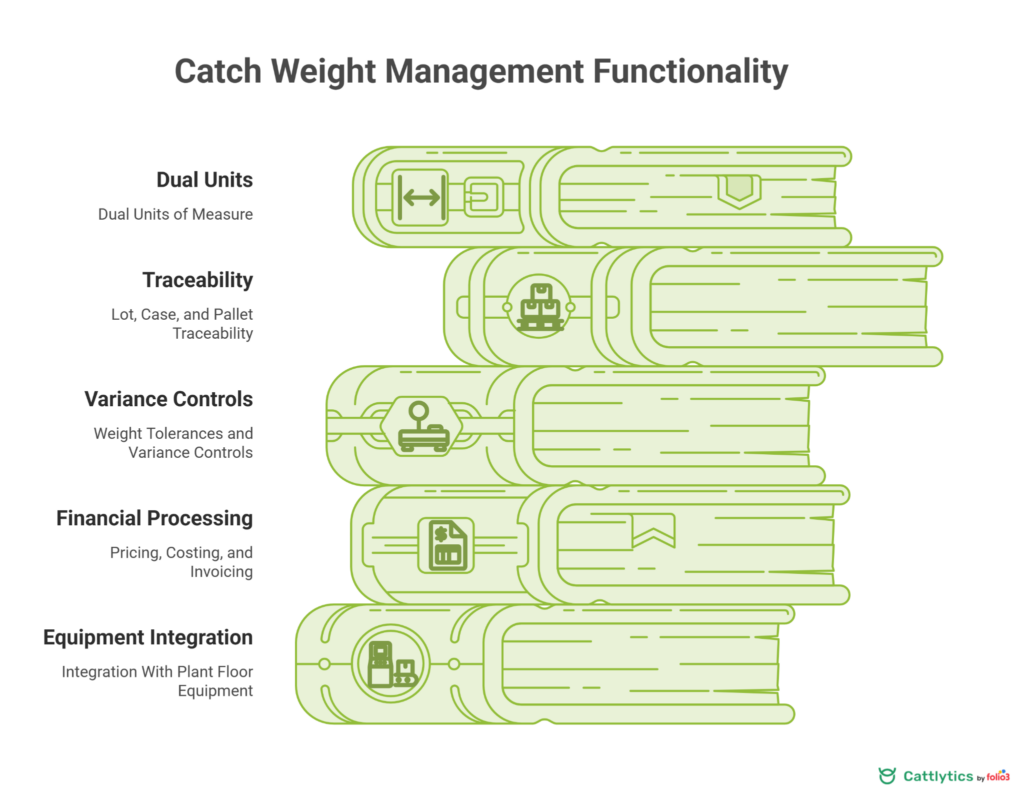
Dual Units of Measure
Your system must support count and weight independently without assuming a fixed conversion. You may need cases and pounds, pieces and pounds, or pallets and kilograms. GS1 defines variable measure trade items as products where the measure can vary while the trade item remains identifiable, confirming dual-unit tracking as an industry standard.
Lot, Case, and Pallet Traceability
The system should preserve the relationship between supplier lot, production lot, case, pallet, storage location, shipment, and customer. A quality issue with a specific case should be traceable back to its production lot, source material, and supplier without leaving the system.
Weight Tolerances and Variance Controls
Your ERP should support expected weight ranges, allowed tolerances, exception alerts, reweigh rules, and supervisor review workflows. The goal is not to eliminate all variance but to know when it is normal and when it signals a problem.
Pricing, Costing, and Invoicing
Catch weight data influences revenue, inventory value, cost allocation, and customer billing. Your ERP should support weight-based pricing so you invoice on actual shipped pounds, value inventory at actual weight, and allocate costs against measured output.
Integration With Plant Floor Equipment
Catch weight only works when data flows without manual reentry. Your ERP should connect with scales, barcode scanners, label printers, mobile devices, packaging equipment, warehouse systems, and EDI. If any connection is broken, someone is reentering data by hand.
How Does Catch Weight Traceability Work With Variable Weight Lots?
Catch weight traceability connects the measured weight of a variable weight item with its lot, item identifier, processing history, location, and downstream movement. The goal is not merely to know how many pounds exist, but to know which pounds belong to which traceable inventory record.
Maintaining Traceability When One Lot Becomes Many Products
In meat processing, a single source lot enters production and gets divided into multiple finished products. The source lot enters the floor, material is divided through cutting or grinding, and new products are created with their own identifiers. After that, actual output weights are captured, lot lineage stays associated from input to output, and cases inherit traceability attributes through to the customer.
Catch Weight Data Does Not Replace Regulatory Traceability
Catch weight is one part of the traceability record, not the whole picture. You may still need supplier records, production logs, lot documentation, sanitation logs, and food safety records depending on your products and regulations.
For example, USDA FSIS requires all establishments grinding raw beef to maintain supplier establishment numbers, lot numbers, production dates, and material names. Catch weight data supports these records but does not replace them.
What Goes Wrong When Catch Weight Is Managed Manually?
Manual processes do not scale. If your team is still managing variable weight inventory on paper and spreadsheets, these are the failure points to watch for.
Common Manual Catch Weight Failure Points
- Scale readings copied onto paper, then entered into a spreadsheet hours later.
- Different employees using different units or rounding conventions
- Weight updated but case quantity left unchanged, or the reverse
- Repacked product losing its original lot association
- Label weight differing from the inventory record
- Shipping adjusting weight while invoicing uses the original number
These errors are small individually, but across thousands of cases per week, they add up to real financial impact. A 1% yield variance may not sound significant, but for processors moving millions of pounds annually, that represents hundreds of thousands of pounds in untracked margin.
When Spreadsheets Stop Being Enough
If you are seeing frequent inventory adjustments, recurring invoice corrections, lengthy reconciliation cycles, duplicate weight entry, disconnected scales, unexplained stock variance, or difficulty tracing lots from production to customer, your tools are no longer adequate for the volume and complexity of your operation.
What Should Meat Processors Look for in Catch Weight ERP?
Choosing the right system requires knowing which capabilities are non-negotiable. Use this section as your evaluation framework when comparing solutions.
Catch Weight ERP Evaluation Checklist
Before selecting a system, confirm that it supports each of the following:
- Dual unit inventory (count and weight tracked independently)
- Actual weight capture at receiving, production, and packaging
- Nominal weight support for standard cost references
- Tolerance rules with exception handling
- Lot traceability from source through finished product
- Case-level tracking
- Pallet-level tracking
- Barcode support for identification and scanning
- Scale integration for automated weight capture
- Packaging line integration
- Label generation with accurate weight and lot data
- Inventory reconciliation tools
- Weight-based pricing
- Purchase and sales order handling by weight
- Customer invoicing on actual shipped weight
- Production and work-in-process support
- Cost allocation by actual weight
- Full audit history for weight changes
- ERP and warehouse system integration
Questions to Ask Before Selecting a System
When evaluating vendors, ask:
- Can the system track quantity and actual weight independently?
- Can weights come from scales without manual reentry?
- Does repacked product retain lot lineage?
- Can cases be traced from production to the customer?
- Can pricing and invoices use actual shipped weight?
- How does it integrate with current packaging equipment?
- Can finance and operations see the same inventory value?
The answers will tell you whether a system was built for variable weight operations or added catch weight as an afterthought.
How Cattlytics Can Support Connected Weight, Inventory, and Meat Processing Operations
If your operation needs one connected system instead of five disconnected ones, here is how Cattlytics Enterprise fits into the picture.
Connect Inventory, Weight, Traceability, and ERP Workflows
Processors should not need one record for source data, another for processing, another for weights, another for warehouse inventory, and another for finance. Cattlytics Enterprise serves as the connected operations and ERP layer that brings these records into the same flow.
The platform supports inventory tracked by weight and quantity, lot traceability across processing stages, meat processing inventory, and warehouse visibility. It facilitates scale and barcode integrations, ERP connectivity, and traceable records from source material to customer.
Conclusion
Accurate catch weight management gives you confidence that physical inventory, actual weight, traceability, valuation, and customer transactions reflect what actually moved through the plant. Connected records mean less reconciliation, less giveaway, and stronger numbers during audits.
If your operation is dealing with disconnected weight data and traceability gaps, talk to the Cattlytics team about how Cattlytics Enterprise can connect those workflows.
FAQs
How Does Catch Weight Affect Food Safety Compliance in Meat Processing?
Catch weight records support food safety compliance by linking actual weight data to lot and case identifiers. This connection strengthens your ability to isolate affected product during a recall and provide regulators with accurate, traceable documentation.
Can Catch Weight Management Reduce Product Giveaway in Meat Plants?
Yes. When actual weight is captured and invoiced instead of nominal weight, you stop giving away untracked pounds on every shipment. Even small per-case improvements compound into significant revenue recovery across high-volume operations.
What Is the Role of Checkweighers in Catch Weight Operations?
Checkweighers verify that packed cases fall within acceptable weight tolerances. They catch underweight and overweight cases before they leave the line, reducing giveaway, label inaccuracy, and downstream invoice disputes.
How Does Catch Weight Impact Inventory Valuation for Meat Processors?
Inventory valuation depends on actual weight, not count alone. Two cases of the same product with different actual weights carry different financial values. Systems that ignore this difference misstate inventory value on the balance sheet.
What Is the Relationship Between Catch Weight and Yield Management?
Catch weight and yield management work together. Catch weight tracks the actual output weight from each production run, while yield management compares that output against the input weight to measure efficiency and identify loss points.
How Do Seasonal Weight Variations Affect Catch Weight Tracking?
Seasonal changes in animal size, fat cover, and carcass weight introduce wider variability in incoming raw material. Your catch weight tolerances and nominal weight references may need seasonal adjustment to avoid excessive exception alerts without masking real problems.