

How you organize cattle within your operation has a direct effect on how well they grow, how reliably they reproduce, and how healthy they stay. This is not just a management preference. It is a production decision that affects your returns every single season. Bovine Respiratory Disease (BRD) alone costs the U.S. beef industry an estimated $800 million to over $1 billion annually in death loss, reduced feed efficiency, and treatment costs, according to research published in Frontiers in Veterinary Science. Much of that risk is shaped by how cattle are grouped, commingled, and housed after arrival or weaning.
Beyond disease, poor cattle grouping strategies lead to uneven nutrition delivery, social competition at the feed bunk, suppressed reproductive performance, and unnecessary stress that cuts into daily gain. Most of these losses are avoidable.
This blog covers the core principles behind effective cattle grouping strategies, how grouping decisions affect growth, reproduction, and health, and what commercial beef producers need to keep in mind when organizing their herds for maximum productivity.
What Are Cattle Grouping Strategies?
Cattle grouping strategies refer to how producers organize animals into pens, pastures, or management groups based on shared characteristics. The most common criteria used to group cattle include:
- Age and stage of production (cows, heifers, bulls, calves)
- Body condition score (BCS) and nutritional needs
- Weight and frame size
- Reproductive status (pregnant, open, lactating)
- Health status and disease risk
The purpose of cattle grouping strategies is to match management inputs, mainly feed, vaccination, and monitoring, to the actual needs of each group. When cattle with different nutritional requirements share the same pen or pasture without separation, some animals are overfed while others fall short. Neither outcome is productive or profitable.
The right cattle grouping strategy for your operation depends on your infrastructure, herd size, and production goals. But certain principles apply regardless of scale.
How Cattle Grouping Strategies Affect Growth Performance
Uniform Groups Grow More Consistently
One of the most practical benefits of effective cattle grouping strategies is more uniform growth across a group. When cattle of similar size and weight are penned together, ration formulation is more accurate, and feeding programs can be adjusted to match the specific requirements of that group rather than splitting the difference between animals at opposite ends of the weight range.
In feedlot settings, grouping by arrival weight and source is a standard cattle grouping strategy that also carries health implications. According to a USDA APHIS management report on U.S. feedlots, cattle placed at under 400 lbs carry the highest disease risk, while those arriving at 900 lbs or more tend to have the lowest risk. Mixing high-risk and low-risk animals in the same pen creates a situation where early-placed cattle expose newer arrivals to pathogens before their immune systems have adjusted.
The cattle grouping strategy of filling pens quickly and sourcing from fewer origins reduces this risk and produces more consistent growth across the group.
Social Dominance and Feed Bunk Competition
Cattle establish dominance hierarchies, and those hierarchies play out directly at the feed bunk. Research published in the Journal of Dairy Science found that when competitive situations exist at the feed bunk, dominant animals consistently spent more time eating than lower-ranking animals, resulting in greater dry matter intake for dominant individuals. For lower-ranked cattle in the same group, this means reduced intake, slower growth, and poorer body condition.
This is one reason why cattle grouping strategies that mix animals with large size or age disparities tend to underperform. The dominant animals eat well. The subordinate ones do not. The variance in daily gain within the pen widens, and the average performance of the group suffers.
Proper cattle grouping strategies minimize extreme social competition by placing animals of similar size, weight, and parity together. Adequate bunk space per head is equally important. If your cattle grouping strategy is sound but bunk space is insufficient, competition still develops and undermines performance.
Heifer Development and Early Growth
For replacement heifers, cattle grouping strategies during the development phase have long-term consequences. Heifers need to reach approximately 65% of their expected mature body weight before their first breeding. If heifers are mixed into the main cow herd, they often lose out at the bunk to larger, more dominant mature cows. The result is heifers that arrive at breeding season underweight and reproductively immature.
Separating heifers as their own management group is not optional if you are serious about getting them to target weight by breeding time. It also allows you to tailor the development ration more precisely to their growth needs without overfeeding the mature cow portion of your herd. This is one of the most impactful cattle grouping strategies a commercial producer can implement because the downstream effects on pregnancy rates and calf crop percentages are measurable and significant.
How Cattle Grouping Strategies Affect Reproduction
Separating First-Calf Heifers
First-calf heifers are one of the most nutritionally vulnerable groups in any cow-calf operation. They are still growing themselves while simultaneously recovering from their first calving and trying to rebreed. When they compete for feed alongside mature cows, their nutritional intake is compromised at exactly the moment when their body is under the most demand.
Oregon State University Extension recommends, at a minimum, grouping first-calf heifers separately from the main cow herd. This single cattle grouping strategy directly supports earlier return to estrus, higher pregnancy rates in the second breeding season, and better longevity in the cow herd, all of which have a measurable effect on the number of calves weaned per cow exposed over her lifetime.
Understanding the cattle breeding cycle is key to knowing when this separation matters most. The period between calving and rebreeding is where nutrition management has its greatest impact on reproductive outcomes.
Grouping by Body Condition Score
One of the most practical cattle grouping strategies for managing reproduction is sorting cows by body condition score ahead of the breeding season. Cows that fall below a BCS of 5 at calving are significantly less likely to return to estrus promptly compared to cows that calve in good body condition. When thin cows are grouped together, you can deliver targeted supplementation to address their deficits without overfeeding cows that are already in adequate condition.
This approach is well supported by extension research from Oregon State University, which identifies body condition at calving as one of the primary environmental factors influencing reproductive performance in beef cows. Mixing thin and moderate-condition cows in a single pasture or pen makes it nearly impossible to manage both groups appropriately.
The payoff of BCS-based cattle grouping strategies is measurable in pregnancy rates. More cows cycling early in the breeding season means more calves born early in the calving season, which means heavier calves at weaning.
Reducing Stress Around Breeding
Research published in PMC on the impact of stress on beef heifer development found that elevated cortisol from stress can interfere with reproductive hormone function, delay puberty, and reduce conception rates. Cattle grouping strategies that minimize social disruption during the breeding period, particularly avoiding regrouping cattle in the weeks immediately before or during AI or bull turnout, can have a real effect on reproductive outcomes.
When cattle are regrouped, the social hierarchy is disrupted and must be re-established. A study published in ScienceDirect found that cows moved to a new pen after regrouping reduced dry matter intake by approximately 9% on the day of the move compared to cows that remained in their home pen. That kind of intake reduction during the breeding window is exactly the type of setback that affects conception rates.
Keeping breeding groups stable during the breeding season is one of the simplest cattle grouping strategies that often gets overlooked.
How Cattle Grouping Strategies Affect Herd Health
Commingling and Disease Risk
Every time you mix cattle from different sources or different health histories, you introduce disease risk. The pathogens that one group has been exposed to and built immunity to may be new threats to another group. This is the fundamental driver of respiratory disease in feedlots and newly weaned calf groups.
Effective cattle grouping strategies around disease control include sourcing cattle from fewer origins, processing incoming cattle before mixing them with established groups, and maintaining age-sorted groups so that older calves with higher pathogen exposure do not share pens with younger, more vulnerable animals.
Cows that have not yet calved are moved progressively through a series of pastures, while pairs with similar calving dates remain behind in smaller, age-matched groups. This limits pathogen buildup in the environment and reduces the exposure of newborn calves to pathogens shed by older calves.
Sick Pen Management
No matter how good your cattle grouping strategy is, some animals will get sick. The question is whether your setup allows you to isolate and manage sick animals without disrupting the rest of the herd.
Feedlot management guidelines recommend maintaining hospital pens with capacity to handle roughly 2 to 5% of total feedlot inventory. Sick animals need to be pulled and managed separately as quickly as possible, both to protect the health of the rest of the pen and to give the sick animal the best chance of recovery.
Once an animal has been treated and recovered, the decision of whether to return it to its original pen or regroup it needs to account for the risk of re-exposure and the social disruption that regrouping causes. This is where accurate record keeping matters. Tracking treatment history per animal and per pen group is essential to making informed cattle grouping decisions over time. Tools like cattle group management software are designed to help commercial producers track these records pen by pen, so patterns in health events can be identified and used to inform future grouping decisions.
Age-Sorted Groups and Pathogen Load
Younger cattle are more vulnerable to disease than older animals. Cattle grouping strategies that mix age groups expose the youngest animals to a pathogen load their immune systems may not be prepared to handle.
Age-sorting is particularly important during the pre-weaning and post-weaning periods. The health management of newborn calves depends significantly on limiting their exposure to older calves that have had more time to acquire and shed pathogens. Even within a calving season, calves born in the first week face a different disease environment than those born later, which is part of the rationale behind age-segregated grouping strategies like the Sandhills system.
Grouping Strategies by Production Stage
Getting cattle grouping strategies right requires thinking about each stage of production independently. The grouping criteria that matter most shift as cattle move through the production cycle.
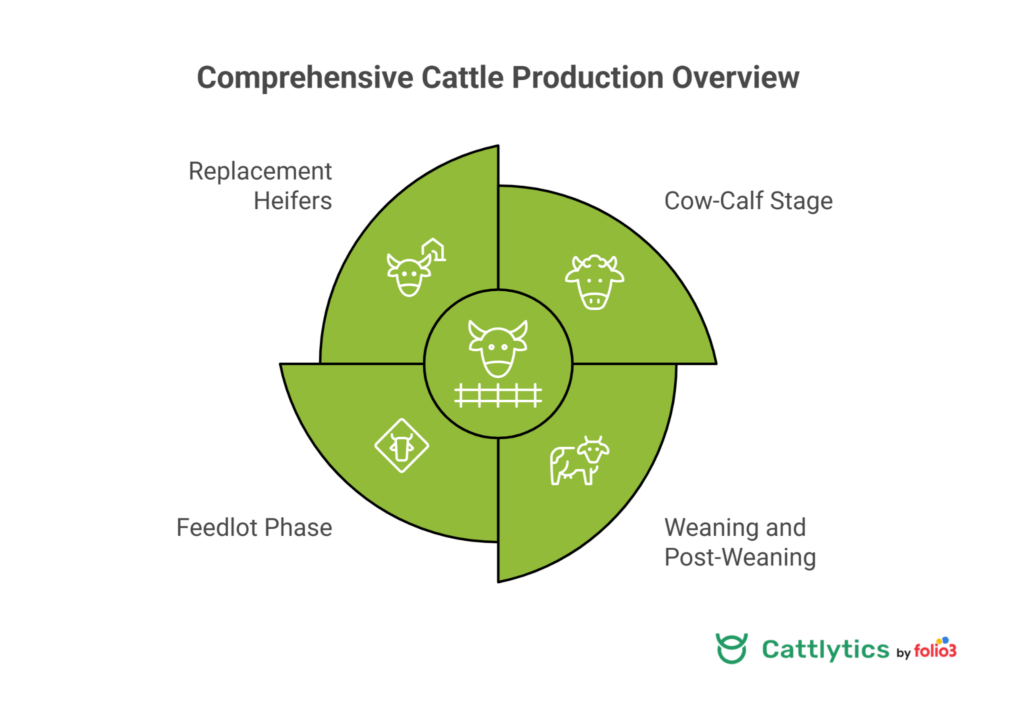
Cow-calf stage: The most important separations are first-calf heifers from mature cows, thin cows from moderate-condition cows, and bulls from the main herd outside the breeding season. Sorting cows by age and BCS allows targeted nutrition ahead of calving and breeding.
Weaning and post-weaning: This is the highest-risk period for respiratory disease. Cattle grouping strategies here should minimize commingling of animals from different sources, sort by weight to allow consistent ration delivery, and maintain stable pen groups to avoid the feed intake disruption that comes with regrouping. Creep feeding calves before weaning is a related management tool that reduces the nutritional stress of weaning and can improve the starting weight and health status of calves entering their post-weaning group.
Feedlot phase: Grouping by arrival weight, source, and health risk drives most of the cattle grouping strategy decisions in feedlots. Same-source and same-weight groups adapt more quickly, start eating sooner, and carry lower commingling-related disease risk. Pen consistency through the feeding period, avoiding adding new cattle to established pens, protects both the existing animals and new arrivals.
Replacement heifers: As discussed, heifers need to be managed as a separate group with their own target weights, nutrition programs, and breeding calendar. Mixing them into the main cow herd at any stage of their development tends to compromise their performance. Understanding bull selection criteria for breeding is part of the planning process that sits alongside your heifer grouping decisions, since the bulls exposed to heifer groups should be selected for calving ease above other traits.
The Role of Record Keeping in Cattle Grouping Decisions
The most effective cattle grouping strategies are built on data. Which groups had the best pregnancy rates last year? Which pens had the highest BRD pulls? Which age classes performed worst in terms of daily gain? Without accurate records per animal and per group, you are making grouping decisions from memory and gut feel rather than from evidence.
This is where digital cattle record management pays off in a practical way. When you can pull up the history of a pen group, see treatment events, track weights over time, and compare pregnancy rates between groups, you have the information you need to evaluate whether your cattle grouping strategies are working and where they need to change.
Good record keeping also supports better culling decisions. Animals that consistently perform poorly within a group, whether due to health problems, poor growth, or reproductive failure, are easier to identify and remove when your records are current and well-organized.
Conclusion
Cattle grouping strategies are not just a logistics exercise. They are one of the most cost-effective management levers you have as a commercial beef producer. The right grouping decisions reduce disease transmission, improve nutritional delivery, support reproduction, and result in more consistent growth across your calf crop.
The key principles are consistent: group animals with similar nutritional needs, minimize commingling from different sources and health histories, keep breeding groups stable during the breeding window, separate vulnerable animals like first-calf heifers and lightweight new arrivals, and use records to evaluate which strategies are working.
No two operations are identical, but every operation benefits from thinking more deliberately about how groups are structured and why. The decisions you make about cattle grouping strategies today shape the health, growth, and reproduction performance of your herd for the season ahead.
FAQs
What Are Cattle Grouping Strategies And Why Do They Matter?
Cattle grouping strategies are the methods producers use to organize cattle into management groups based on shared characteristics such as age, weight, body condition, reproductive status, or health risk. They matter because they determine how effectively you can match feed, health programs, and monitoring to the actual needs of each animal. Poor grouping leads to uneven nutrition, elevated disease risk, reduced reproductive performance, and lower average daily gain.
How Does Grouping Cattle By Body Condition Score Help Reproduction?
Cows that calve in poor body condition are slower to return to estrus and less likely to conceive early in the breeding season. When you group thin cows separately, you can provide targeted supplementation to improve their condition before breeding without overfeeding cows that are already at an adequate BCS. This directly improves pregnancy rates and gets more cows bred early in the season, which results in heavier calves at weaning.
Why Should First-Calf Heifers Be Grouped Separately?
First-calf heifers are still growing themselves while also recovering from calving and trying to rebreed. When they compete with mature cows for feed access, their nutritional intake suffers at the most critical time. Grouping them separately allows you to feed them to meet their specific requirements, which supports earlier return to estrus, higher second-pregnancy rates, and longer productive life in the herd.
What Is The Risk Of Commingling Cattle From Different Sources?
Cattle from different origins carry different pathogen exposures and immunity profiles. When they are mixed together, animals that lack immunity to pathogens carried by others become vulnerable. This is one of the primary drivers of bovine respiratory disease outbreaks in feedlots and post-weaning groups. Sourcing from fewer origins, sorting by weight and health risk, and avoiding adding new cattle to established pen groups are the most effective cattle grouping strategies for managing this risk.
How Often Should Cattle Groups Be Changed Or Reorganized?
Regrouping should be kept to a minimum, especially during critical periods like the breeding season, immediately after weaning, and during the first weeks on feed in a feedlot. Research shows that cattle moved to new pens can reduce their dry matter intake by around 9% on the day of the move as they re-establish a social hierarchy. Every unnecessary regrouping event is a setback to growth and potentially to reproduction. When regrouping is unavoidable, timing it outside of peak demand periods and minimizing size disparities between animals in the new group reduces the disruption.
How Does Group Size Affect Cattle Performance And Health?
Group size affects both management efficiency and animal behavior. Very large groups can reduce individual visibility, making it harder to detect sick animals early. Overcrowding regardless of group size reduces feeding activity, disrupts resting behavior, and increases competition at the bunk. Research suggests that while large groups per se are not necessarily problematic, management decisions around bunk space, water access, and pen density play a major role in determining whether large group cattle grouping strategies deliver good outcomes.