
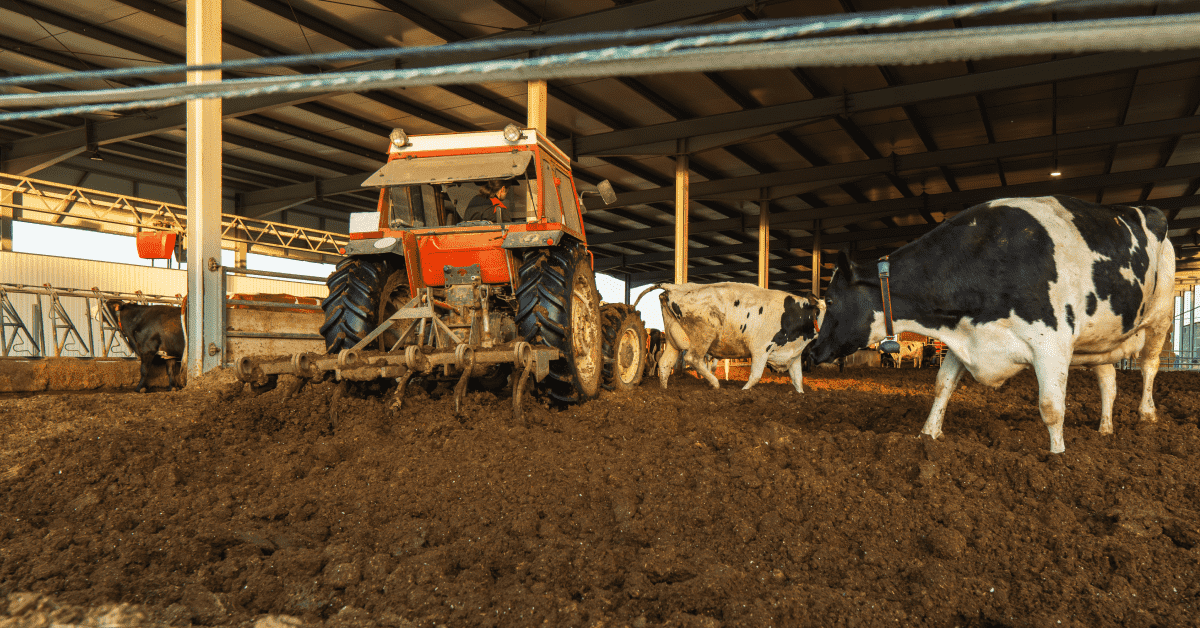

Dairy manure is both a waste challenge and a nutrient resource. Poor coordination between collection, storage, treatment, and application leads to nutrient loss, runoff, odor, excess methane, and gaps in recordkeeping.
Effective dairy manure management controls how manure is collected, stored, treated, recorded, and applied. A well-planned system can reduce waste, improve nutrient use, protect soil and water, lower certain emissions, and give dairy managers better control over manure-related costs and sustainability performance.
This guide covers four outcomes that matter most: waste control, nutrient recovery, environmental protection, and better operational decisions.
What Is Dairy Manure Management and Why Does It Matter?
Manure is unavoidable on a dairy. How you handle it shapes your costs, compliance, and long-term sustainability. Here is what dairy manure management actually means and why it deserves your attention.
What Is Dairy Manure Management?
Dairy manure management is the full process of collecting, transferring, storing, treating, recovering nutrients from, applying, and recording manure across your operation. It is not simply manure disposal.
Think of it as one connected system rather than a set of separate tasks. The barn-to-field concept means every step, from the moment manure leaves the cow to the moment it reaches your crop field, is part of a single workflow that should be planned together.
Why Is Manure Management Important for Dairy Farms?
A single lactating dairy cow produces roughly 150 pounds (18 gallons) of manure every day. On a 500-cow dairy, that adds up to over 27 million pounds of manure per year. Without a clear plan, that volume overwhelms storage, increases hauling costs, and creates environmental risk.
Good manure management addresses several priorities at once:
- Waste volume control
- Nutrient recovery for crop use, water protection
- Soil management
- Methane and odor reduction
- Labor efficiency
- Compliance readiness
- Sustainability documentation.
When these pieces work together, manure stops being a disposal headache and starts acting like a farm resource.
How Does Dairy Manure Management Improve Sustainability and Waste Control?
Sustainability on a dairy is not about checking a box. It is about running operations that protect your land, water, and air while keeping the farm profitable. Here is how better dairy manure management supports both goals.
Recycle Manure Nutrients Instead of Treating Them Only as Waste
Dairy manure contains valuable crop nutrients. Each ton of dairy cow manure holds approximately 10 pounds of nitrogen, 4 pounds of phosphorus (P2O5), and 8 pounds of potassium (K2O). When you sample your manure and match application rates to what your crops actually need, you can reduce how much commercial fertilizer you buy.
But more manure does not always mean better soil. Over-applying creates nutrient buildup, especially phosphorus, which moves slowly in soil and can accumulate to levels that harm water quality. The key is matching what the crop needs with what the manure provides through sampling and soil testing.
Protect Soil and Water Through Better Application Decisions
Runoff and nutrient leaching are the biggest water quality risks tied to manure. Whether nutrients stay in your fields or end up in nearby waterways depends on field slope, soil type, drainage, existing nutrient levels, application timing, application rates, weather conditions, and setback distances from water sources. When your nutrient management plan accounts for these factors, you protect both your pastures and nearby water sources.
Control Methane, Odor, and Other Environmental Impacts
Long-term anaerobic storage of liquid manure creates methane, a greenhouse gas with 28 times the warming potential of carbon dioxide. The EPA reports that manure management accounts for about 14% of total greenhouse gas emissions from the U.S. Agriculture sector.
How you store and treat manure changes those emissions. Covers, composting, solid-liquid separation, shorter storage periods, and anaerobic digestion can each influence methane output differently. No single practice is the right fit for every dairy, so your choice should match your herd size, infrastructure, and operational goals.
How Do Dairy Manure Management Systems Work From Barn to Field?
Every dairy manure management system follows the same basic sequence. Understanding each step helps you spot where your current process could improve. Let us walk through the barn-to-field workflow.
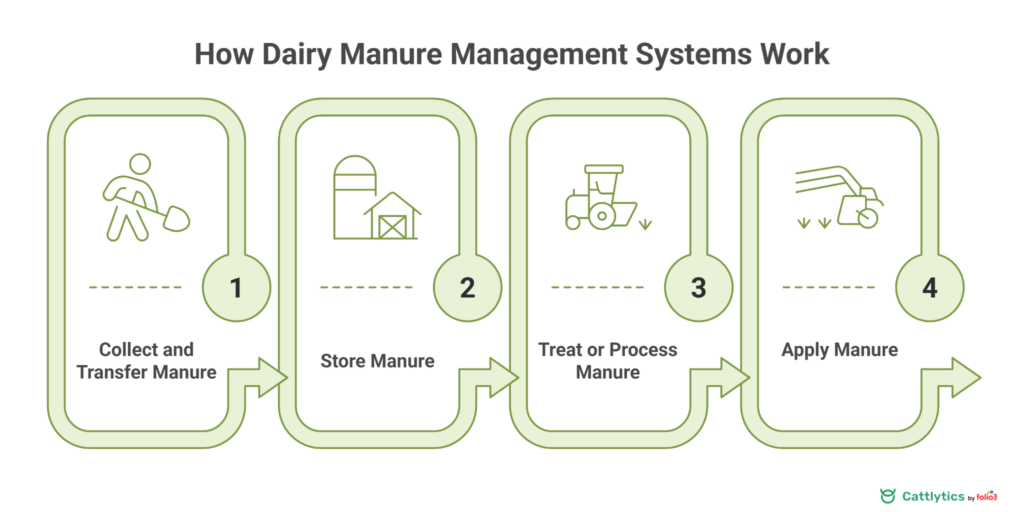
Step 1: Collect and Transfer Manure
Collection is where the process starts. Common methods include scraping with tractor-mounted or automatic alley scrapers, vacuum collection using tanker trucks, and flushing with recycled water in freestall barns. The right choice depends on your bedding type, water use, barn layout, and manure consistency. A mismatch here creates handling problems downstream.
Step 2: Store Manure Until It Can Be Used Safely
Once collected, manure needs storage until field conditions allow safe application. Options include pits beneath barns, above-ground tanks for slurry, lagoons for liquid systems, and stacking areas for solid manure. Storage capacity should account for your longest expected period between application windows, plus emergency reserve for weather delays. Undersized storage forces application at the wrong time, increasing runoff risk and nutrient loss.
Step 3: Treat or Process Manure Where It Adds Value
Not every dairy needs to treat manure beyond storage. But when treatment makes sense, four main paths exist:
- Direct storage and land application is the simplest approach. Manure is stored and spread on fields with no intermediate processing.
- Solid-liquid separation splits manure into a liquid fraction (easier to pump and irrigate) and a solid fraction (usable for bedding recovery or composting).
- Composting converts solid manure into a more stable, lower-odor product that reduces volume and can kill pathogens when managed correctly.
- Anaerobic digestion breaks down manure in an oxygen-free environment to produce biogas. A methane digester is simply another term for an anaerobic digester. Digesters generate biogas, but they do not eliminate the need to manage digestate nutrients. You still need a land application plan for what comes out.
Step 4: Apply Manure According to Crop and Soil Needs
Application is where nutrient value either gets captured or lost. A solid plan covers manure sampling before each application, current soil test results, crop nutrient demand, application timing aligned with uptake windows, appropriate rates and methods (injection, broadcast, drag hose), weather monitoring, and field-by-field records.
Which Dairy Manure Management System Is Right for Your Farm?
The right system depends on your specific operation, not on what works for the farm down the road. Here is how to evaluate your options.
Start With the Problem You Need to Solve
Before comparing equipment or systems, define the primary goal driving your decision. Ask whether you need to reduce hauling, control phosphorus buildup, relieve storage pressure, recover bedding, reduce odor or methane, generate energy, improve nutrient distribution, or strengthen compliance and recordkeeping.
Research supports starting with the farm’s goal rather than starting with equipment selection. When you let the problem drive the decision, you avoid expensive systems that do not solve your actual challenge.
Compare Systems Using Farm-Specific Criteria
Once you know your primary goal, compare options against what your farm actually looks like today. Here is a comparison framework:
| Criteria | Direct Storage & Application | Solid-Liquid Separation | Composting | Anaerobic Digestion |
| Manure consistency | Liquid or slurry | Any | Solid-dominant | Liquid or slurry |
| Herd size fit | Any | 200+ cows typical | Any | 500+ cows typical |
| Water content | High | Reduces liquid volume | Low moisture needed | High |
| Land requirement | High | Moderate | Low to moderate | Moderate |
| Storage requirement | Standard | Reduced liquid volume | Windrow or pad area | Digester plus digestate storage |
| Capital cost | Low | Moderate | Low to moderate | High |
| Labor requirement | Low to moderate | Moderate | Moderate to high | Low to moderate (once operational) |
| Nutrient control | Limited | Better nutrient targeting | Good | Good, but digestate still needs management |
| Methane reduction | None | Minimal | Moderate | High |
| Energy recovery | None | None | None | Yes (biogas) |
| Bedding recovery | None | Yes | Possible | None directly |
| Management complexity | Low | Moderate | Moderate | High |
| Best fit | Smaller herds, adequate land | Herds needing bedding or volume reduction | Operations with solid manure and composting space | Large herds with capital, energy goals, or emission targets |
The key point: system compatibility matters. Research shows that manure consistency and existing infrastructure strongly influence which alternatives are practical for your operation.
What Should a Dairy Manure Management Plan Include?
A good plan documents the full manure workflow and keeps your team aligned. Here is what to include.
Map the Entire Manure Flow
Document how manure moves across your operation: cow to barn to collection, then through transfer, storage, treatment, hauling, and field application. A simple flow map helps you spot bottlenecks where volume, nutrients, labor, or records may be lost.
Measure Manure Nutrients and Match Them With Field Needs
Your nutrient management plan depends on accurate, current data. That means sampling manure before each major application event, soil testing target fields regularly, and understanding crop nutrient requirements.
Further, you need to set rates based on the lower of manure supply or crop demand, review field history, and maintain a running nutrient balance for each field. Records from previous manure tests improve future planning because nutrient content shifts with diet, bedding, storage time, and dilution.
Maintain Storage, Application, and Compliance Records
Every application event should document the date, storage level, volume moved, destination field, application rate, method and equipment used, weather conditions, manure and soil analysis results, operator name, and any incidents. Exact legal requirements depend on your jurisdiction and operation status, but consistent records prepare you for any regulatory review.
Track a Small Set of Manure Management KPIs
You do not need a complicated dashboard. A few key measures tell you whether your system is working: manure volume generated versus storage capacity used, nutrients recovered versus fertilizer displaced, acres receiving manure, application rate variance, hauling distance, and methane or energy indicators where applicable. Avoid setting universal benchmark targets because farm systems vary too much. Track your own trends over time instead.
How Can Better Farm Records Improve Dairy Manure Management?
Records are the missing link in most dairy manure management plans. When your herd data, task records, and field information stay connected, manure decisions get sharper. Here is how.
Connect Herd Information With Manure Planning
Manure volume changes with herd size, animal groups, housing type, feed rations, and water use. Without reliable animal counts and group records, you are estimating infrastructure needs based on guesswork. Maintaining accurate herd records gives managers better context when reviewing whether storage, hauling capacity, and land base can handle what the herd produces today and after expansion.
Replace Scattered Notes With Consistent Operational Records
Spreadsheets, notebooks, and separate field reports create gaps. You lose the ability to compare seasons, hold team members accountable, and answer questions from regulators or buyers.
Timestamped, standardized records solve this. When your dairy management records live in one place, every team member works from the same information. Managers see what was done, when, and by whom, which is critical for benchmarking dairy performance over time.
Use Better Data to Support Sustainability Reporting
Sustainability claims carry more weight when farms can back them with consistent operational data. When herd size, production numbers, tasks, and management records connect, the data foundation for sustainability analysis is already in place.
Industry initiatives like the Dairy Sustainability Alliance reflect growing expectations for verifiable environmental performance. Farms with organized records are better positioned to participate without scrambling to backfill data.
What Dairy Manure Management Mistakes Should Farms Avoid?
Even experienced operations make costly errors. Recognizing these common mistakes helps you avoid them.
Seven Common Manure Management Mistakes
- Choosing equipment before defining the farm goal. You end up with expensive infrastructure that does not solve your actual problem.
- Treating collection, storage, and application as separate decisions. A mismatch between steps creates bottlenecks, nutrient loss, and wasted labor.
- Ignoring changes in herd size. Manure volume scales directly with animal numbers. Expanding the herd without upgrading storage or land base creates compliance and environmental risk.
- Applying manure without current nutrient information. Without a recent manure analysis, you cannot match application rates to crop needs, and you risk over- or under-applying.
- Allowing storage capacity to dictate application timing. Spreading manure because the pit is full, not because the field is ready, increases runoff and nutrient loss.
- Keeping incomplete hauling and application records. Missing records create liability during audits and make it impossible to compare performance across seasons.
- Assuming an anaerobic digester solves every manure problem. Digesters reduce methane and generate energy, but they do not eliminate nutrients. You still need a complete application plan for the digestate.
Turn Dairy Manure Into a Better-Managed Farm Resource
Dairy manure management works best when collection, storage, treatment, application, records, and farm planning operate as one connected system. What separates farms that manage manure well from those that struggle is the quality and consistency of information behind their decisions.
Better manure decisions depend on reliable information about your herd and daily operations. When animal counts, group movements, tasks, and field activities are tracked through a dairy management system, managers can make informed choices about storage timing, application rates, and infrastructure planning.
Consult with our experts to discover how Cattlytics helps dairy teams keep herd and operational records connected so managers can make better-informed farm decisions.
FAQs
How Often Should You Sample Dairy Manure Before Field Application?
Sample manure before each major application event. Nutrient content shifts with changes in diet, bedding, dilution, and storage time. Old test results lead to inaccurate rates and increase nutrient imbalance risk.
Can Small Dairies Benefit From a Formal Manure Management Plan?
Yes. Even operations with fewer than 100 cows benefit from mapping manure flow, testing nutrients, and keeping application records. A written plan helps avoid nutrient buildup, reduce fertilizer costs, and stay prepared for regulatory requirements.
What Is the Difference Between a Methane Digester and an Anaerobic Digester?
They are the same thing. Both terms describe a system that breaks down manure in an oxygen-free environment to produce biogas. “Methane digester” is the more common term in dairy circles, while “anaerobic digester” is used in engineering and regulatory contexts.
How Does Manure Storage Duration Affect Methane Emissions?
Longer storage in liquid or anaerobic conditions produces more methane over time. Shorter storage periods, solid-liquid separation, covers, and aerobic treatment can all reduce the amount of methane released before field application
What Role Does Soil Testing Play in Dairy Manure Application?
Soil testing tells you what nutrients your fields already have. Without it, you cannot determine how much manure to apply without risking phosphorus buildup or nitrogen loss. Pairing soil tests with manure analysis gives you the complete picture for setting accurate application rates.
How Can Dairy Farms Track Manure Management Performance Over Time?
Track manure volume produced, storage capacity used, nutrients recovered, acres receiving manure, and fertilizer costs displaced. Reviewing these numbers season by season reveals trends that help you adjust before small problems become expensive ones. Tools like livestock ERP platforms can centralize this data alongside herd and financial records.