
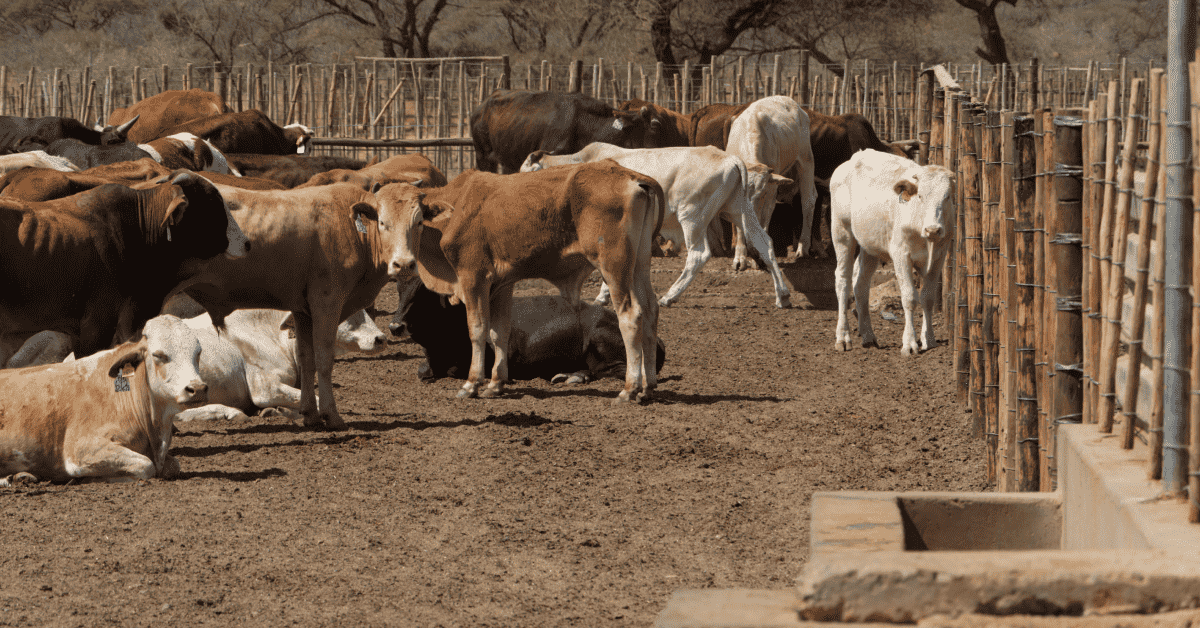

A feedlot is a confined feeding facility where beef cattle are fed a high-energy, grain-based diet until they reach market weight. Feedlot operations are the final production stage before cattle move to a processing plant. In the United States, commercial feedlots range from small family-run yards finishing a few hundred head to large commercial yards that place 100,000 or more cattle per year.
According to the USDA National Agricultural Statistics Service, feedlots with a capacity of 1,000 head or more marketed approximately 26.9 million cattle in 2024. Feedlot beef makes up the majority of the conventional beef supply reaching American grocery stores and food service channels.
This guide breaks down how feedlot farming works from the moment cattle arrive to the day they ship for harvest.
What Is a Feedlot?
A feedlot is a concentrated animal feeding operation (CAFO) designed to grow beef cattle to harvest weight on a grain-based diet. In an animal feedlot, cattle live in fenced, open-air pens rather than on pasture. They eat a precisely formulated total mixed ration (TMR) instead of grass.
Feedlot operations exist because pasture alone cannot grow cattle to market weight as quickly or as predictably as a grain-based feeding program can. On grass, a steer might gain 1.5 to 2 pounds per day. On a well-managed feedlot ration, that same animal can gain 3 to 3.5 pounds per day. That difference drives most of the economics behind commercial beef production.
Cow feedlots also vary significantly in how they are set up. A 1,000-head yard and a 100,000-head operation are both feedlots, but the management systems, staffing ratios, and technology requirements are entirely different.
How Feedlot Farming Works: The Four Phases
Feedlot farming follows a defined sequence. Each phase has its own performance targets, and decisions made early in the feeding period shape everything that comes after.
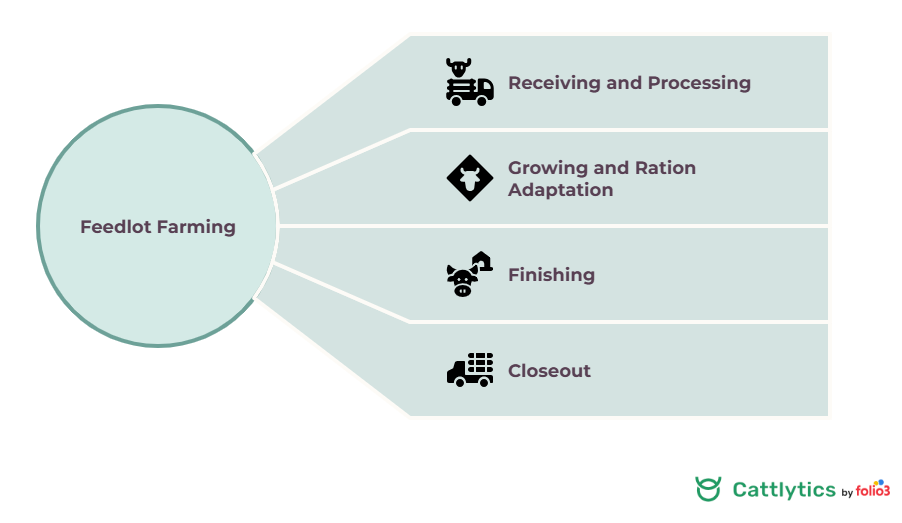
Phase 1: Receiving and Processing
When cattle arrive at a feedlot, the first priority is health. New placements often come from auction barns, ranches, and backgrounding yards. Mixing cattle from different sources creates stress and increases exposure to pathogens, especially those that cause bovine respiratory disease (BRD).
At processing, feedlot operations typically complete the following for each animal:
- Visual health examination and body condition score
- Arrival weight from the scale ticket
- Individual identification via EID button or visual ear tag
- Vaccination against BRD pathogens (IBR, BVD, BRSV, PI3, and Mannheimia haemolytica)
- Growth implant placement
- Internal and external parasite control
- Entry into the health and inventory record system
Cattle that went through a formal backgrounding program before arriving tend to transition more smoothly. They have usually received vaccines, learned to eat from a bunk, and had time to develop rumen function. Fresh calves coming straight off their mothers carry the highest health risk in the first 14 to 21 days of feedlot operations.
After processing, new arrivals go into a receiving pen for 7 to 14 days of observation before moving to a home pen.
Phase 2: Growing and Ration Adaptation
Once cattle have settled and passed their initial receiving period, feedlot operations move them through a ration step-up program. This transitions the animal from a forage-heavy diet to a high-energy finishing ration over 21 to 28 days.
The rumen needs time to adapt. Introducing too much grain too fast causes acidosis, a condition where rumen pH drops sharply. Acidosis leads to poor appetite, laminitis, and reduced performance. Feedlot operations that compress or skip the adaptation period often see it in their feed conversion numbers and in the sick pen.
Phase 3: Finishing
The finishing phase is where cattle spend most of their days on feed. On a high-energy corn or grain-based ration, feedlot operations typically finish cattle for 90 to 180 days, depending on placement weight and target market.
The main performance metric in finishing is feed conversion ratio (FCR): pounds of dry matter consumed per pound of body weight gained. A well-performing steer in the finishing phase might convert at 6.0 to 6.5:1. A poor performer in the same pen could sit at 8.0:1 or higher.
Feed conversion is where profit is won or lost in feedlot operations. A difference of 0.5 on FCR across a 300-head pen at $300 per ton of ration has a direct dollar impact on the closeout. For a deeper look at what drives that variation, our guide to feed efficiency in cattle production covers the key factors at both the animal and pen level.
Understanding how weight gain and fattening work is equally important. Our livestock fattening guide walks through the nutrition and management principles that apply directly to the finishing phase.
Phase 4: Closeout
The closeout is the financial summary of a pen’s performance. It compares total cost of placement, feed, yardage, health treatments, and other charges against sale weight and price. Closeouts tell feedlot operations whether a given placement was profitable, and they are the main tool for evaluating suppliers, breeds, and management decisions over time.
The most common closeout problems in feedlot operations:
- Feed delivery weights not reconciled against ration records
- Health costs recorded on paper and entered late, after decisions have already been made
- Shrink loss at purchase not properly reflected in cost-of-gain calculations
- Closeouts completed weeks after the pen shipped, too late to affect the next placement
Good closeouts require accurate daily records from the day cattle arrive. Without them, the numbers are guesses.
What Cow Feedlots Look Like: Layout and Infrastructure
Cow feedlots are built around pen capacity, feed delivery logistics, water access, and cattle flow through the working facility. The core components of most operations:
Pens: Open-air dirt lots, sized at roughly 125 to 250 square feet per animal. Pen capacity varies by operation and region. Drainage is a major design consideration. Poor drainage leads to mud, which raises energy costs for cattle just staying warm and moving, and pulls down performance.
Feed bunk: A concrete bunk runs along one side of each pen. Feed trucks deliver the total mixed ration once or twice per day. Bunk management (how much to deliver, how to read leftover feed levels) is one of the most consequential daily decisions in feedlot operations.
Water: Automatic waterers sized for pen capacity and climate. Water intake directly drives dry matter intake. A steer that loses access to water for six hours will eat less for the next 24 hours.
Processing facility: The working area for health treatments, implants, and scheduled procedures. Most operations use a circular handling tub, an alley, and a hydraulic squeeze chute.
Feed mill: Large commercial feedlot operations run an on-site mill that formulates, mixes, and loads rations by pen specifications. Smaller operations may purchase pre-mixed commodities and use a simple mixer wagon.
What Cattle Eat in a Feedlot
Feedlot beef cattle eat a total mixed ration (TMR) that changes in composition from the receiving period through finishing. A typical high-energy finishing ration looks like this:
| Ingredient | Role | Approximate inclusion (DM basis) |
| Steam-flaked corn | Primary energy source | 60 to 75% |
| Wet distillers grains or corn silage | Energy and fermentation buffer | 10 to 25% |
| Hay or roughage | Rumen health and acidosis buffer | 5 to 10% |
| Cottonseed hulls or beet pulp | Digestive function | 0 to 10% |
| Supplement pack | Vitamins, minerals, and ionophore | 2 to 4% |
The ionophore in the supplement pack (typically monensin or lasalocid) shifts rumen fermentation toward more efficient energy capture, reduces bloat risk, and lowers coccidiosis incidence.
Ration management is one of the highest-value levers available to feedlot operations. Commodity prices change throughout the year, and the optimal ration for a given set of cattle in September may look different from what worked in May.
Health Management in Animal Feedlots
Health events are the largest variable cost in feedlot operations after feed. The four most common disease categories:
Bovine respiratory disease (BRD): The leading cause of illness and death in U.S. feedlots. According to USDA APHIS surveillance data, BRD accounts for more than 70% of feedlot morbidity and more than 50% of feedlot mortality. It typically presents in the first 45 days of feedlot operations.
Digestive disorders: Acidosis, bloat, and liver abscesses linked to high-energy ration management.
Pinkeye (infectious bovine keratoconjunctivitis): Spreads quickly in dusty, crowded pen environments with fly pressure.
Lameness: Lameness in cattle is most common in pens with rocky lot surfaces, poor drainage, or animals finishing at heavy weights.
Early pull decisions are the most important factor in treatment success. An animal pulled within 24 to 48 hours of showing clinical signs responds to treatment at a far higher rate than one that has been symptomatic for three days. In feedlot operations, pen rider skill and observation frequency are the first line of defense.
Health records should capture the animal ID, clinical signs, diagnosis code, drug and dose, withdrawal period, and re-check outcome. Records that miss steps make it impossible to evaluate treatment protocols or identify patterns by source, pen, or season.
A Feedlots Example: One Day in a 10,000-Head Yard
To make this concrete, here is what daily feedlot operations look like on a 10,000-head commercial yard during summer feeding season:
5:30 AM: The feedmill starts the first batch. The nutrition manager reviews bunk scores from the previous evening and adjusts delivery amounts for each pen.
6:00 AM: Feed trucks start rounds. Each truck carries an onboard scale and delivers the exact ration weight called for each pen.
7:30 AM: Pen riders check every pen on horseback or by pickup. They look for fresh pulls: animals with a tucked-up appearance, droopy ears, nasal discharge, labored breathing, or cattle hanging back from the bunk.
8:00 AM: Pulled animals move to the processing facility. A veterinarian or trained technician examines each animal, records the diagnosis code, selects a treatment protocol, administers drugs, and enters the record before moving to the next one.
Midday: Second bunk check. Adjust afternoon delivery amounts based on what cattle cleaned up from the morning run.
Afternoon: Second feed round. Processing on scheduled pens for re-checks, implant rotations, or new arrivals.
Evening: Final bunk score and notes for tomorrow’s delivery.
This daily rhythm is consistent across feedlot operations of this size. What changes is the judgment: which animal to pull, when an intake dip warrants a ration adjustment, when a pen’s conversion is off enough to investigate. Those calls are better with data than without it.
Common Problems in Feedlot Operations
Ration delivery inconsistency: Feed truck drivers who estimate rather than weigh create compounding errors. A 5% delivery discrepancy across 50 pens is thousands of pounds of misfed ration every day, and it shows up in the closeout.
Delayed health records: Treatments recorded on paper end up in the system two to three days later. By then, the 48-hour re-check window has passed and withdrawal deadlines are harder to track.
Closeout gaps: Many feedlot operations finish a pen and find the numbers do not add up. The gaps are usually in feed delivery reconciliation, shrink estimates, or health charges entered after the fact.
Unexplained pen-to-pen variation: Some pens consistently underperform others. Without structured animal-level and pen-level records across multiple placements, the cause (arrival source, season, lot surface, pen position relative to the bunk) is hard to isolate.
Managing Feedlot Operations with Software
Tracking performance across large animal feedlots by hand creates gaps. Pen records, health event logs, ration delivery data, and closeout financials spread across paper notebooks and spreadsheets make it nearly impossible to catch problems in time to do something about them.
Purpose-built feedlot management software puts all of that in one place. With the right platform, feedlot managers can see daily feed delivery versus targets by pen, health event histories at the animal level, cost-of-gain trends across placements, and closeout summaries that pull from live data rather than being assembled after the fact.
Many feedlot systems fail not because the technology is inadequate, but because implementation does not match how the operation actually works. Teams often underestimate workflow complexity, rush training, struggle to connect legacy systems, or try to change too much at once.
As outlined in a Feed & Additive guide from the Cattlytics and Folio3 AgTech team, successful adoption requires careful planning, staff involvement, and a phased rollout. Cattlytics supports this approach with animal and pen level records, EID integration, offline data capture, and shared access that helps managers and crews work from the same operational data.
FAQs
What is a feedlot?
A feedlot is a confined feeding operation where beef cattle are fed a grain-based diet until they reach market weight. Most feedlot operations in the U.S. are classified as concentrated animal feeding operations (CAFOs) and are regulated under the EPA’s Clean Water Act.
How long do cattle stay in feedlot operations?
Most cattle spend 90 to 180 days in the finishing phase. Including receiving and growing phases, total time on feed usually runs 120 to 200 days, depending on placement weight and the target market grade.
What is feedlot beef?
Feedlot beef is beef from cattle finished in a confined feeding operation rather than on grass. The majority of conventional retail beef sold in the United States is feedlot beef.
What do cattle eat in a feedlot?
The ration is typically 60 to 75% steam-flaked corn on a dry matter basis. The rest includes roughage, distillers grains or silage as a buffer, and a supplement pack providing vitamins, minerals, and an ionophore for improved feed efficiency.
What is the biggest health challenge in feedlot operations?
Bovine respiratory disease (BRD) is the leading cause of illness and death in U.S. feedlots, accounting for more than 70% of morbidity and more than 50% of mortality according to USDA APHIS data.
How are feedlot operations regulated?
Feedlots above a specific head-count threshold are classified as CAFOs and face EPA regulations under the Clean Water Act, including requirements around manure management and runoff control. State-level rules vary by region.