

What Is Embryo Transfer in Cattle?
Embryo transfer multiplies the genetic contribution of your best cows far beyond what natural reproduction allows. It is one of the most widely adopted advanced reproductive tools across beef, dairy, and seedstock operations.
| Embryo transfer (ET) in cattle is a reproductive procedure in which embryos are collected from a genetically superior donor cow, evaluated for quality, and transferred into synchronized recipient females who carry the calves to term. The resulting offspring inherit the genetics of the donor dam and selected sire, not the recipient. |
How Does Embryo Transfer Work in Cattle?
A donor cow is hormonally stimulated to produce multiple eggs, bred with selected semen, and embryos are recovered approximately seven days after estrus. Each viable embryo is then transferred into a recipient cow whose reproductive cycle has been aligned to match the donor’s. The calf born from that recipient carries the genetics of the donor and sire only.
Here is how the process works from start to finish:
- A genetically valuable donor is stimulated to produce multiple eggs through superovulation
- The donor is bred using artificial insemination (AI) with selected semen
- Embryos are recovered from the donor or produced through IVF
- Each viable embryo is transferred into a properly synchronized recipient
- The recipient carries the pregnancy to term
- The calf’s genetics come entirely from the donor and sire, not the recipient
Why Is Embryo Transfer Used in Cattle Breeding?
ET gives you the ability to get significantly more offspring from your best females each year. Used strategically, it compresses the generation interval and expands the value of every elite mating in your program.
Produce More Offspring From Elite Donor Females
A cow naturally produces one calf per year. With ET, that same female can contribute dozens of calves over the same period. For seedstock and genetics operations and cow-calf producers, this is the single biggest advantage ET offers. It dramatically increases how fast you can move superior maternal genetics into your herd.
Accelerate Genetic Gain Across the Herd
Each generation is a chance to improve your herd. ET shortens the time it takes for elite genetics to reach your replacement heifer pool. When you combine it with genomic selection, you can increase genetic progress per year at a measurable rate, especially when selecting donors based on current testing rather than phenotype alone.
Expand the Value of High Merit Matings
Pairing a proven donor with high-value semen creates embryos with real market potential. Each embryo represents a specific mating that can be frozen, stored, and sold. That flexibility extends the value of your genetics well beyond what calving season alone can deliver.
That said, genetic value must justify the added reproductive expense. ET amplifies the return from matings that are already economically sound. It does not make a poor mating worth doing.
What Are the Steps of Embryo Transfer in Cattle?
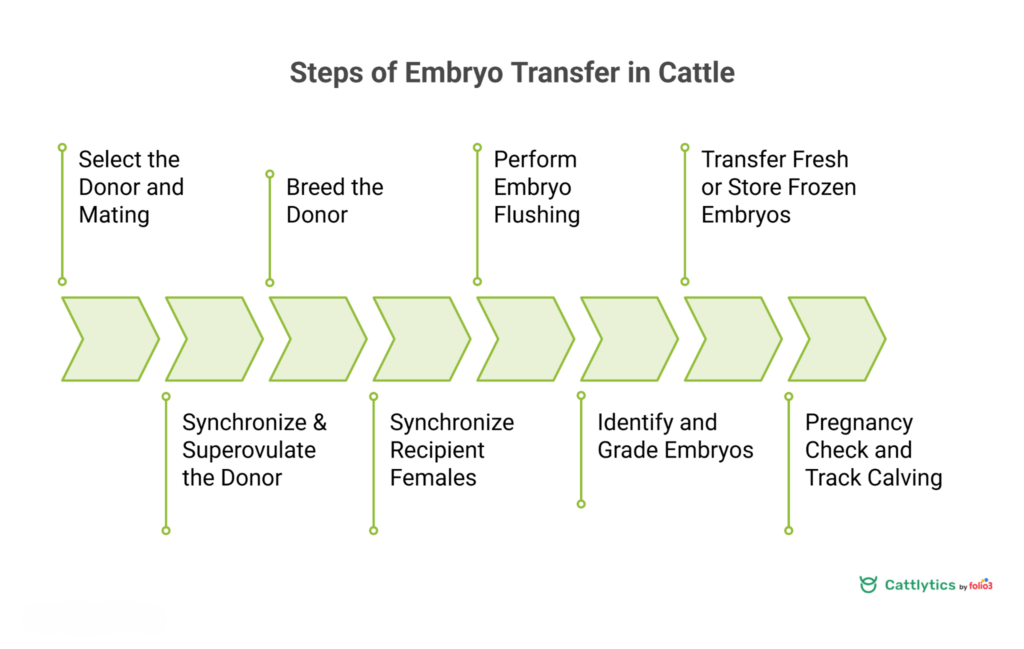
A consistent, well-documented ET protocol gives your program the best chance of producing viable embryos and confirmed pregnancies. Every step connects to the next, so gaps in timing or records create problems that compound quickly.
Step 1: Select the Donor and Mating
Start by identifying a donor whose genetics justify the cost of the program. Look at her EPDs, genomic results, pedigree, reproductive history, and phenotype. Then select a sire whose genetics complement her strengths and produce calves with proven commercial or sale value.
Step 2: Synchronize and Superovulate the Donor
The donor’s estrous cycle is controlled using a hormonal protocol. Follicle-stimulating hormone (FSH) is administered to stimulate superovulation, encouraging multiple follicles to develop rather than a single ovulation. Drug protocols should always be established with your veterinarian or reproductive practitioner based on the individual cow’s history and program needs.
Step 3: Breed the Donor
The donor is bred at the appropriate time using AI with the selected semen straws. Some producers consider sexed semen to control calf sex within their donor program, though conception rates with sexed semen may differ from conventional semen.
Step 4: Synchronize Recipient Females
Recipients must be synchronized so their reproductive cycle aligns with the donor’s. A recipient whose cycle is out of phase with the embryo’s developmental stage will not maintain the pregnancy. Proper estrus synchronization in recipients is one of the most controllable variables in the entire ET process.
Step 5: Perform Embryo Flushing
Conventional embryos are collected from the donor’s uterus by flushing. This typically occurs around day seven after estrus, when embryos are at the morula or early blastocyst stage. The flush is performed non-surgically through a catheter placed transcervically.
Step 6: Identify and Grade Embryos
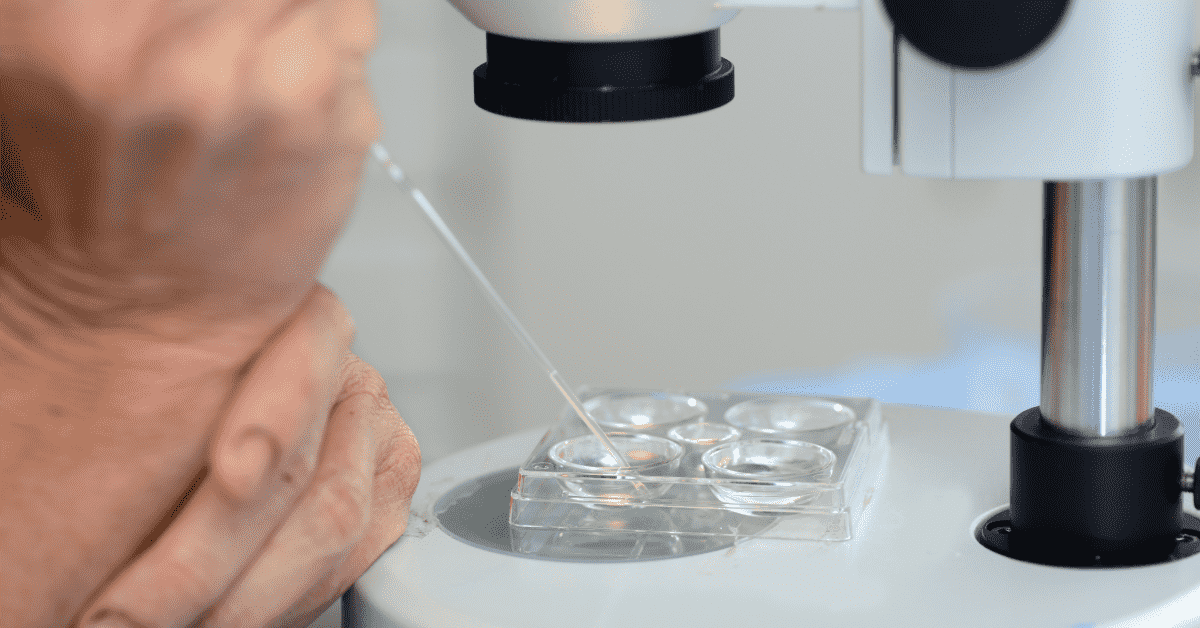
Recovered embryos are examined under a microscope. Each embryo is assessed based on its development stage, morphology, and overall quality. Only embryos that meet the grading criteria for transfer eligibility are used fresh or frozen. Embryo ID and grade are recorded at this stage.
Step 7: Transfer Fresh or Store Frozen Embryos
Viable embryos can be transferred immediately into synchronized recipients as fresh transfers. Alternatively, they can be cryopreserved in liquid nitrogen for future use, transport, or sale. Fresh transfers generally yield higher pregnancy rates, while frozen embryos offer greater scheduling flexibility and allow you to hold genetics until the right recipients are ready.
Step 8: Pregnancy Check and Track the Calving Outcome
Recipients are pregnancy checked approximately 25 to 35 days after transfer. Every confirmed pregnancy should link the recipient, donor, sire, semen batch, transfer date, and embryo grade in a single record. Track through to calving and record the calf ID, calving date, and outcome. This data builds your program’s performance history over time.
How Should Donor and Recipient Cows Be Selected?
Choosing the right animals on both sides of an ET program is where results are made or lost. Poor selection increases cost without improving outcomes.
What Makes a Good Donor Cow?
Donor selection should be based on documented genetic merit and reproductive soundness. A reliable donor checklist includes:
- Superior genetic merit and desirable phenotype
- Strong reproductive history with no known fertility problems
- Sound health and appropriate body condition (BCS 5 to 7)
- A valuable planned mating with a proven or high-merit sire
- Proven or promising genomic merit supported by current testing
- Expected calf value that justifies the cost of the ET program
The genetic value of the donor and the projected value of the resulting calves need to justify every dollar the program spends. A donor producing average offspring is not a sound ET candidate.
What Makes a Good Recipient Cow?
Recipient selection directly affects transfer success. Use this readiness checklist when evaluating recipients:
| Criterion | What to Confirm |
| Cycling status | Cycling normally at time of synchronization |
| Body condition | BCS 5 to 7 with a consistent nutritional plan |
| Reproductive tract | Sound, no prior fertility issues |
| CL status | Appropriate corpus luteum confirmed at transfer |
| Health | Current on vaccination program |
| Temperament | Calm and manageable in handling situations |
| Size | Adequate frame for the expected calf |
| Identification | Reliable, permanent ID in place |
For replacement heifer programs that rely on ET-produced calves, recipient management is as important as donor selection. Nutrition, health, reproductive condition, and stress levels all affect whether a recipient holds her pregnancy.
What Is the Success Rate of Embryo Transfer in Cattle?
Pregnancy rates in ET are not fixed numbers. They reflect the quality of every decision made from donor selection through transfer day, and they vary considerably across operations.
What Pregnancy Rate Should Producers Expect?
There is no single embryo transfer pregnancy rate that applies to every cattle operation. Results depend on embryo quality, recipient management, synchronization accuracy, and technician skill.
| Embryo Type | Transfer Condition | Typical Benchmark | Key Variable |
| Fresh, in vivo | Correctly timed | ~65% pregnancy rate | Recipient synchronization accuracy |
| Frozen, in vivo | Thawed and transferred | ~50 to 55% pregnancy rate | Freeze quality and CL status |
| IVP (OPU/IVF) | In vitro produced | Variable by lab & protocol | Embryo source and lab management |
Research reports approximately 65% pregnancy rates with correctly timed fresh embryos and approximately 50 to 55% with frozen embryos, with actual results varying based on management quality.
What Factors Affect Embryo Transfer Success?
Seven factors consistently separate high-performing ET programs from lower-performing ones:
- Embryo quality at the time of transfer or freezing
- Recipient fertility and reproductive history
- Synchronization accuracy between donor and recipient
- Corpus luteum (CL) status in the recipient at transfer
- Nutrition and body condition leading up to transfer
- Health and stress levels in the recipient herd
- Technician skill and handling technique during transfer
Pregnancy failure in ET can often be traced to the embryo, the recipient, or the technique. Knowing which factor caused a loss helps you adjust the next cycle.
How Can Pregnancy Rates Be Improved?
Focus on what you can control before and during each transfer:
- Confirm CL quality in every recipient before transferring
- Keep recipients on a consistent nutritional program through the transfer window
- Minimize handling stress on transfer day and in the days that follow
- Transfer embryos graded as excellent or good only, and avoid questionable morphology
- Verify synchronization protocols are followed precisely every cycle
- Work with an experienced technician or reproductive veterinarian
Conventional ET, MOET, IVF and OPU: What Is the Difference?
Multiple technologies fall under the category of embryo transfer in livestock. Understanding the differences helps you choose the right method for your donors, program goals, and available resources.
| Method | How Embryos Are Produced | Donor Treatment | Collection Method | Common Use | Fresh or Frozen |
| Conventional ET / MOET | Superovulation + AI | FSH protocol | Uterine flush ~Day 7 | Seedstock and purebred herds | Both |
| OPU / IVF | Eggs aspirated from follicles, fertilized in lab | Minimal or none | Follicle aspiration (OPU) | Young donors, heifers, frequent collections | Fresh preferred |
MOET (multiple ovulation and embryo transfer) is the standard conventional method. OPU (ovum pick-up) paired with IVF is increasingly common because it does not require superovulation and allows more frequent collections from the same donor.
Global in vitro-produced (IVP) cattle embryo transfers exceeded two million in 2024, while conventional in vivo-derived transfers totaled fewer than 300,000 over the same period. IVP through OPU and IVF is now the dominant method globally, and its adoption in the U.S. continues to grow.
What Does Embryo Transfer in Cattle Cost, and When Does It Pay?
ET is a significant reproductive investment. Understanding the full cost structure is the only way to know whether your program is generating value or just generating calves.
What Costs Should Be Included?
A realistic cost-per-pregnancy calculation must account for every line item:
- Donor preparation hormones
- Semen and AI fees
- Veterinary and technician fees
- Embryo flushing and grading
- Freezing and liquid nitrogen storage
- Recipient synchronization hormones and feed costs
- Transfer fees and pregnancy diagnosis
- Labor and travel
Calculate Cost per Confirmed Pregnancy
Use this formula to evaluate your program’s efficiency:
Total embryo program cost ÷ confirmed ET pregnancies = cost per pregnancy
Once you have that number, take it further:
- Cost per live ET calf
- Cost per retained or marketed genetic calf
This tells you whether the genetics being produced are worth what you are spending to produce them.
When Can ET Improve ROI?
ET makes financial sense when:
- Donor genetics are clearly superior to the rest of the herd
- The planned mating has high expected calf value or market demand
- ET calves support a replacement female strategy that needs accelerated genetic progress
- Genetics sales are part of the operation’s revenue model
- Reducing generation interval across the cowherd is a defined breeding goal
More embryos do not automatically mean more profit. The value of what you are producing has to justify every dollar spent producing it.
What Are the Pros and Cons of Embryo Transfer in Cattle?
ET accelerates every genetic decision in your program, in both directions. Before committing to a program, it helps to understand both sides clearly.
| Benefits | Limitations |
| Faster multiplication of elite maternal genetics | Higher reproductive cost per pregnancy |
| Greater genetic selection intensity | Variable donor response to superovulation |
| More offspring from high-value matings | Risk of pregnancy failure post-transfer |
| Ability to freeze, store, and transport embryos | Requires skilled technicians and veterinary support |
| Greater flexibility in recipient use and timing | Demanding recipient management requirements |
| Potential to build strong replacement heifer genetics | More complex scheduling across donor and recipient groups |
| Access to global genetics through frozen embryo trade | Comprehensive embryo and reproductive record requirements |
| Reduces generation interval in herd improvement programs | Genetic mistakes are also multiplied quickly |
That last point is worth noting. ET accelerates genetic decisions in both directions. If a donor has a hidden weakness or a planned mating turns out to be poorly matched, ET multiplies that problem across far more calves than natural service would. Strong bull selection and rigorous donor evaluation before the flush are not optional steps; they are foundational to a program that produces real returns.
Why Embryo Management Matters as ET Programs Grow
Each embryo your program creates represents a significant investment of cost, time, and genetic potential. Without organized records, that investment becomes difficult to manage and impossible to optimize over time.
What Records Should Be Maintained During Embryo Transfer?
Every flush, transfer, and resulting pregnancy should have a complete record. Here is a practical ET record checklist:
Donor and Mating Records
- Donor ID and pedigree
- Sire and semen batch or straw ID
- Synchronization protocol and treatment dates
- Flush date and flush number for the donor
Embryo Records
- Number of embryos recovered
- Development stage and morphology grade for each embryo
- Fresh vs. frozen status
- Storage location, tank ID, and freeze information
Transfer Records
- Recipient ID
- CL status confirmed at transfer
- Embryo grade transferred
- Transfer date and technician
Post-Transfer Records
- Pregnancy check date and result
- Pregnancy loss if applicable
- Calving date, calving ease, and outcome
- Calf ID and genetic registration information
Standardized embryo transfer and freezing documentation, including internationally recognized freeze codes, supports breed registration requirements and protects the genetic integrity of every calf you produce.
Which Embryo Transfer Metrics Should You Track?
Tracking the right numbers turns your ET program from a reproductive procedure into a measurable business strategy. These metrics belong in every cattle management system you use.
ET Program Scorecard:
- Transferable embryos per flush
- Freezable embryos per flush
- Pregnancy rate per transfer
- Pregnancy loss rate
- Pregnancy rate by donor
- Pregnancy rate by recipient group
- Pregnancy rate by embryo grade
- Fresh vs. frozen pregnancy rate comparison
- Calving rate from ET pregnancies
- Cost per confirmed pregnancy
- Cost per live ET calf
- Calf performance through weaning and beyond
How to Manage Embryo Transfer Records Without Spreadsheets and Paper?
As donor and recipient numbers grow, records become interconnected fast. A single ET calf can involve donor history, sire details, semen inventory, treatment protocols, embryo grading, cryostorage information, transfer records, pregnancy checks, and calving outcomes.
Splitting those records across spreadsheets, paper files, and separate systems makes it difficult to evaluate any individual donor’s performance or trace the full history of any calf in the program.
Cattlytics keeps donor profiles, recipient records, breeding and embryo transfer data, health events, pedigrees, pregnancy tracking, calving records, semen and embryo inventory, and financial records connected in one place.
Plus, the platform supports IVF and embryo transfer records within its breeding management capabilities, so your ET program data stays linked to the animals it belongs to, from flush to calf. For larger seedstock and genetics operations, the Livestock ERP layer adds the operational and financial visibility a growing program needs.
Turn Embryo Transfer Into Measurable Genetic Progress
Embryo transfer creates opportunity. The value comes from selecting the right genetics, managing the right recipients, maintaining embryo quality, and measuring what happens after each transfer.
Producers who get the most from ET treat it as a data-driven program, not just a procedure. Every flush adds to your understanding of a donor. Every transfer adds to your understanding of your recipient herd. And every calf tells you whether the genetics you invested in are actually delivering.
If you are managing a growing reproductive program, explore how connected cattle breeding and embryo records can help you track every animal from donor selection to calf performance.
FAQs
How Many Embryos Can One Donor Cow Produce Per Flush?
The number of transferable embryos per flush varies by donor and protocol. Most operations can expect between 4 and 8 transferable embryos per flush on average, though response to superovulation differs from cow to cow and changes across repeat flushes from the same donor.
Can Embryo Transfer Be Used in Heifers?
Yes. Heifers can serve as both donors and recipients in ET programs, provided they are cycling normally and meet reproductive readiness criteria. In OPU-IVF programs, heifers are especially useful as donors because superovulation is not required for egg collection.
How Long Can Cattle Embryos Be Stored in Liquid Nitrogen?
Properly frozen cattle embryos stored in liquid nitrogen can remain viable for decades when cryopreservation protocols are followed correctly. There is no defined maximum storage limit, which makes frozen embryos a valuable long-term genetic asset for any operation.
Can Frozen Embryos Be Transported Across State or Country Lines?
Yes. Frozen embryos can be transported within the U.S. and internationally, subject to applicable state and federal health certificate requirements and import or export regulations for the destination country. This makes frozen embryo trade a practical option for buying and selling genetics.
What Is the Difference Between a Donor Cow and a Recipient Cow in Embryo Transfer?
The donor cow contributes the genetic material through the embryo. The recipient cow carries the pregnancy and delivers the calf but passes no genetics to the offspring. Selection criteria for each role are entirely different, and recipient quality affects program results just as much as donor quality does.
Does Repeat Flushing Harm a Donor Cow’s Long-Term Fertility?
Research generally shows that repeat flushing does not significantly compromise long-term fertility when programs are managed correctly, and appropriate rest intervals are observed between flushes. Your reproductive veterinarian can advise on flush frequency and rest periods for individual donors based on their response history.