
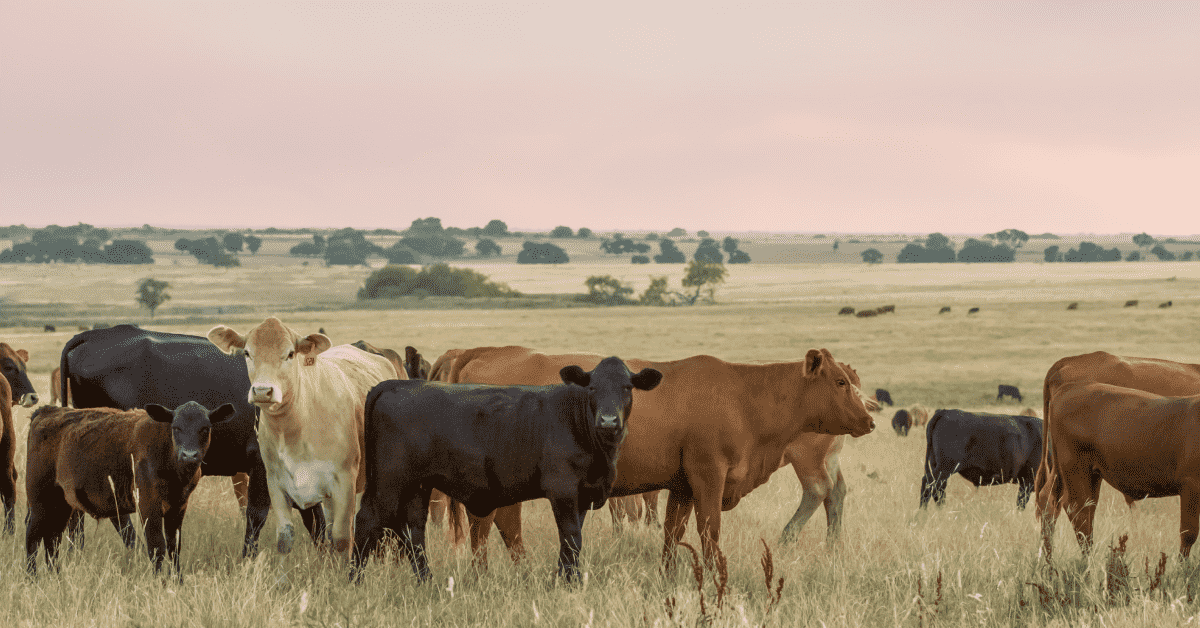

The U.S. beef industry manages roughly 87.2 million head of cattle, and every animal generates valuable production data from birth through harvest. The challenge is not collecting that information. It is keeping it connected as cattle move between ranches, feedlots, processors, and the various systems each participant uses.
Beef cattle records lack uniformity, and relatively little data is shared between vertical supply chain participants. This article explains how a connected cattle history supports both traceability and better economic decisions across the beef supply chain.
What Is an Integrated Beef Supply Chain and How Does It Work?
An integrated beef supply chain connects cattle, people, processes, and records across production stages so information created by one participant can support decisions made by the next. Unlike a traditional segmented model where records stop at every point of sale, cattle data moves forward with the animal, and performance feedback flows back to earlier producers. Businesses do not need to share ownership. They share agreed-upon information.
The Main Stages of the Beef Supply Chain
Cattle pass through several production stages before reaching the consumer:
- Cow calf: Calves are born, identified, vaccinated, and weaned.
- Stocker and backgrounding: Calves gain weight on pasture or forage before entering a feedlot.
- Feedlot: Cattle are finished on a ration designed for gain and carcass quality.
- Packer and processor: Animals are harvested, graded, and broken into primal cuts.
- Distributor and retailer: Beef products reach the consumer.
Each stage creates data. The question is whether it survives the transition to the next.
Traditional Beef Supply Chain Compared With an Integrated Beef Supply Chain
| Factor | Traditional Supply Chain | Integrated Supply Chain |
| Animal identification | May change at each stage | Persistent ID follows the animal |
| Record continuity | Breaks at every point of sale | Records carry forward across stages |
| Data sharing | Minimal between participants | Agreed information shared with approved partners |
| Performance feedback | Rarely returns upstream | Carcass and feedlot data flow back to the ranch |
| Traceability | Limited to individual operations | Connected across the full production chain |
| Decision making | Based on incomplete information | Informed by lifecycle data |
Independent operations can participate by agreeing on which information to share and how.
Where Does Cattle Information Get Lost Across the Beef Supply Chain?
Data loss is the biggest obstacle to supply chain connectivity. Here is where and why it happens.
Why Animal Records Often Stop at the Point of Sale
Cattle records break down when animals change hands for several reasons:
- Paper records that do not transfer
- Independent spreadsheets at each operation
- Separate ranch and feedlot systems with no integration
- Group-level records instead of individual animal identification
- New ID numbers assigned downstream
- Incompatible data formats
- No agreed standard for which information should be shared
- Concerns about data ownership and commercial sensitivity.
The result is that an animal’s history restarts every time it changes hands.
Why Valuable Downstream Data Rarely Returns to the Producer
A cow calf producer creates genetics, breeding, vaccination, and early growth history. A feedlot adds health events, gain performance, feed efficiency, and closeout data. A processor generates yield and carcass quality information. If those records cannot reconnect to the original animal, the producer who made the breeding and management decisions never sees how those choices played out.
What Data Should Follow Cattle Through the Beef Supply Chain?
Knowing which records matter most helps you prioritize what to capture and share.
Identity, Origin, and Chain of Custody Records
Every connected cattle record starts with identity and movement data: EID or RFID number, visual tag ID, premises or ranch of origin, birth date, ownership records, location and movement dates, sale and transfer events, and group or lot relationships.
Health, Breeding, and Performance Records
Production data tied to individual animals is what turns records into management tools. Therefore, individual identification is essential for calculating useful production metrics in cow-calf operations.
Key records include parentage and genetics, breeding events and reproductive history, vaccinations and treatments, drug withdrawal dates, birth weight, weaning weight, yearling weight, average daily gain, health events and mortality, and preconditioning information.
Feedlot and Carcass Feedback That Should Return Upstream
That’s where the supply chain loop closes. Carcass data can help cow-calf producers assess cattle quality and adjust herd genetics, yet only about 9% of producers had collected carcass data on their cattle.
Downstream records that should return to the ranch include feedlot average daily gain, feed efficiency, health outcomes, days on feed, final live weight, hot carcass weight, quality grade, yield grade, marbling score, and carcass value including grid premiums or discounts. These records can directly influence breeding decisions, genomic selection, health protocols, purchasing strategy, and marketing timing.
What Data Should Move Through the Beef Supply Chain
| Production Stage | Data Created | Feedback That Should Return | Decision Supported |
| Cow calf | Birth, parentage, genetics, vaccinations, weaning weight | Carcass quality, feedlot health outcomes | Breeding, genetic selection, culling |
| Stocker/Backgrounder | Gain, health events, preconditioning records | Finishing performance, carcass results | Nutrition programs, marketing timing |
| Feedlot | ADG, feed efficiency, health, days on feed, final weight | Carcass grade, yield, premiums/discounts | Ration formulation, marketing endpoint |
| Processor | Carcass weight, quality grade, yield grade, marbling | All carcass metrics return to producer | Quality assurance, value-based marketing |
How Does an Integrated Beef Supply Chain Improve Cattle Traceability?
An integrated beef supply chain improves traceability by maintaining a connected animal history from birth through harvest. A single persistent identity ties every event, location, and ownership change to the same animal.
Build a Connected Animal History Instead of Separate Records
A connected animal history follows a clear sequence: a unique identity is assigned at birth, events are recorded against that identity, location is attached to each event, movements and custody changes are captured, new events at each stage append to the same record, and downstream results reconnect to the original animal.
The EID tag identifies the animal. The record system surrounding it provides the meaningful history. Without a system that tracks cattle inventory at the individual level, the tag is just a number.
Maintain Cattle Chain of Custody Across Ownership and Location Changes
Chain of custody in cattle production means establishing who had the animal, where, and when. It is built from origin records, ownership documentation, movement timestamps, and identification continuity.
USDA APHIS defines animal disease traceability as knowing where diseased and at-risk animals are, where they have been, and when they were there. That definition focuses on rapid disease response. Commercial traceability goes further by connecting production, health, and performance records to support management decisions and value-based marketing. Both depend on the same foundation: a persistent animal identity and continuous record-keeping.
How Can Connected Beef Production Data Improve Producer Profitability?
Better records do not just support traceability. They create real financial value for your operation.
Turn Animal History Into Better Production Decisions
Tracking the physical performance impacts of management decisions is the first step in tracking economic impacts. When cattle data stays connected, those connections become actionable:
- Connected breeding and carcass data help evaluate which sires produce calves that grade well and gain efficiently.
- Health history and feedlot outcomes help refine preconditioning programs and vaccination protocols.
- Weights and gain data help identify high-performing cattle and cattle breeding traits worth selecting for.
- Carcass feedback helps assess whether your marketing endpoint matches your cattle’s genetic potential.
- Production plus financial data helps calculate which animals or groups actually generate margin.
Create a Feedback Loop From Carcass Results Back to the Ranch
A ranch records sire, dam, vaccination history, and weaning data. The feedlot adds health events, average daily gain, and feeding performance. The processor records carcass weight, quality grade, and marbling. Those results return to the producer, who identifies which genetics produced better outcomes and adjusts accordingly.
USDA-funded whole-chain traceability research identifies this type of information feedback as a benefit of connected records. Connected records do not automatically produce premiums, but they improve your ability to identify performance differences, verify claims, and make better decisions.
How Should Cattle Data Sharing Work Between Producers, Feedlots, and Processors?
Data sharing is the backbone of an integrated supply chain. Getting it right requires direction and structure.
Information Needs to Move Both Forward and Backward
Forward flow (ranch to processor) includes identity, origin, ownership, health records, vaccinations, weights, drug withdrawal information, and movement history.
Backward flow (processor to ranch) includes feedlot health outcomes, average daily gain, feed efficiency, carcass performance, carcass value, and grid premiums or discounts. It is a two-way data exchange, rather than a one-direction pipeline.
Data Interoperability, Ownership, and Privacy Matter
Practical requirements include common animal identifiers, consistent data fields, integration between platforms, permission-based sharing, clear ownership agreements, and the ability to exchange data without replacing existing systems. Research in Computers and Electronics in Agriculture identifies interoperability, privacy, security, and high investment requirements as continuing barriers to wider digital traceability adoption.
How Can Producers Build an Integrated Beef Supply Chain Record?
Building a connected system starts at your operation. Here is a practical framework to guide the process.
Use the Connected Cattle Record Framework
- Identify: Give each animal a persistent identity using an EID or RFID tag that stays with it for life.
- Record: Capture lifecycle events including health, breeding, weight, movement, and performance data.
- Connect: Keep events tied to the same animal instead of scattered across notebooks or disconnected systems.
- Exchange: Make relevant information available to approved supply chain participants.
- Feedback: Reconnect feedlot, carcass, and financial outcomes back to earlier production decisions.
Checklist for Evaluating Your Current Record System
Ask yourself:
- Can every animal be uniquely identified?
- Can you retrieve its complete history in one place?
- Can records survive an ownership transfer?
- Can an EID scan open the associated animal record?
- Can health and movement records stay attached?
- Can data move into other systems without retyping?
- Can downstream performance be tied back to source animals?
- Can participants control access?
If you answered “no” to more than a few, there is a clear opportunity to strengthen your record system.
How Cattlytics Helps Create Connected Cattle Records
An integrated beef supply chain depends on record continuity. That requires a system that preserves individual animal identity and connects events across the animal lifecycle.
Cattlytics is built around this principle. It gives you a centralized platform where individual animal records stay connected from birth through sale:
- Individual animal profiles with complete lifecycle history
- EID and RFID integration through Bluetooth reader support
- Health and treatment records including withdrawal tracking
- Breeding history tied to sire, dam, and reproductive events
- Weight and performance records across stages
- Movement history with location and custody tracking
- Group and lot management by pen, pasture, or program
- Centralized records on web and mobile with reporting and analytics
See how Cattlytics can help you build a connected animal record from birth through sale. Book a free consultation with our experts today.
FAQs
What Is the Difference Between Animal Disease Traceability and Commercial Traceability?
Animal disease traceability focuses on locating diseased or at-risk animals quickly during a disease event. Commercial traceability goes further by connecting production, health, and performance records to support management decisions and value-based marketing.
Do I Need to Own Every Stage of the Beef Supply Chain to Integrate Records?
No. Independent producers, feedlots, and processors can share agreed-upon data through compatible systems and permission-based access while keeping their operations separate.
What Is the Most Important First Step for Building Connected Cattle Records?
Start with individual animal identification. Without a unique, persistent ID, you cannot connect events across stages. An EID or RFID tag paired with a digital record platform is the practical starting point.
How Does Carcass Feedback Help a Cow Calf Producer Make Better Decisions?
Carcass data reveals how your genetics and management translate into quality grade, yield, and value at harvest. That feedback helps you identify which sires or health protocols produce the best outcomes and adjust accordingly.
Can Small Operations Benefit From an Integrated Beef Supply Chain?
Yes. Connected records help you identify your best and worst performers regardless of herd size. Even a small cow-calf operation benefits from tracking individual animal performance and receiving downstream feedback.
What Are the Biggest Barriers to Cattle Data Sharing Between Supply Chain Participants?
The main barriers include incompatible software systems, lack of common data standards, data ownership and privacy concerns, high technology investment costs, and no industry-wide agreements on what to share.