
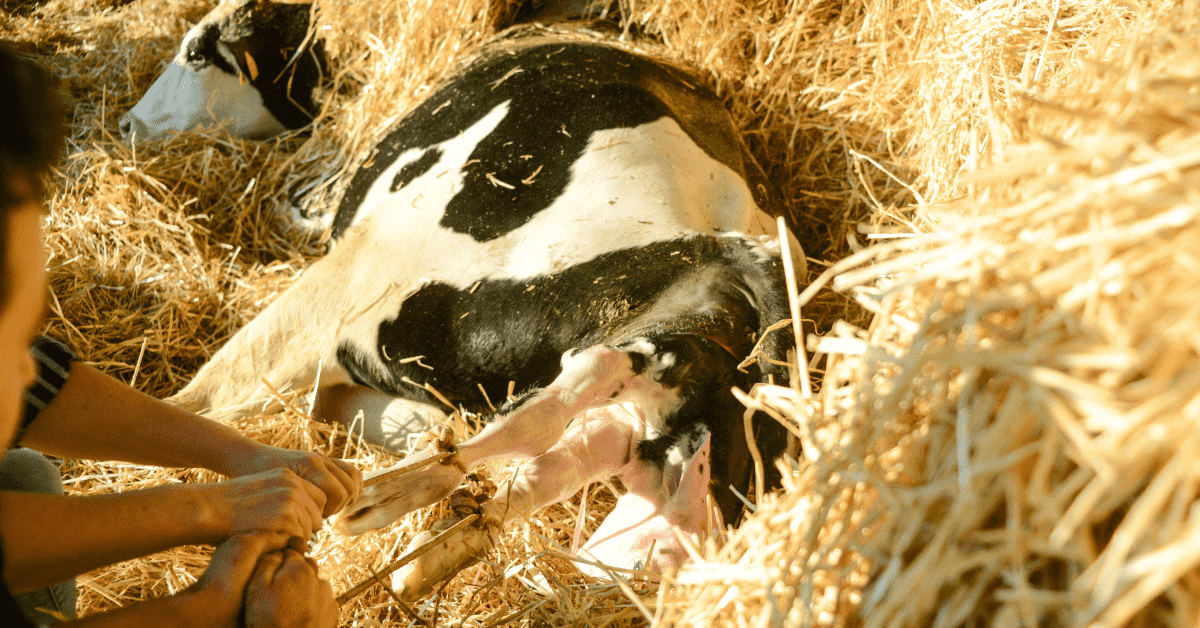

Dystocia in Cattle
Calving season is the most high-stakes time on any cattle operation. You know the drill. Sleepless nights, eyes glued to barn cameras, constant herd checks, and that gut-level dread when a cow has been laboring too long with nothing to show for it. When things go wrong at calving, every minute counts.
This guide is built to help you protect your cows, save more calves, and keep your operation profitable when dystocia strikes. Whether you run 50 head or 5,000, the principles are the same. You need to know what you are dealing with, when to step in, and how to do it right.
Quick Takeaway: Dystocia simply means an abnormal or difficult birth that requires human assistance. It is the leading cause of calf loss in both beef and dairy herds, and early intervention is the single biggest factor in survival for both the cow and the calf.
What Is Dystocia in Cattle?
Dystocia in cows is any calving where the cow cannot deliver her calf on her own. In plain terms, the birth is stuck, abnormal, or taking too long and needs help. It can range from a simple pull to a full-blown veterinary emergency. The word itself comes from Greek, meaning “difficult birth,” and it covers everything from a slightly mispositioned leg to a completely sideways calf.
To understand dystocia in cattle, you first need to know how a normal calving works. Bovine parturition has three stages:
- Stage 1 – Cervical Dilation: The cow becomes restless, her udder swells, and the cervix begins to open. This stage can last 2 to 6 hours. The cow may isolate herself, stop eating, and pace. Uterine contractions start but are not visible from the outside.
- Stage 2 – Fetal Expulsion: This is the active delivery stage. The water bag appears, followed by the front feet and nose. In a normal delivery, the calf is born within 30 minutes to 2 hours after the feet appear. This is where dystocia occurs when something goes wrong.
- Stage 3 – Placental Expulsion: The afterbirth passes, usually within 2 to 8 hours after delivery. A retained placenta (beyond 12 hours) signals trouble and needs monitoring.
Dystocia disrupts Stage 2. The calf gets stuck in the birth canal due to its size, position, or problems with the cow herself. When Stage 2 stalls, the clock starts ticking. The longer the delay, the higher the risk of losing the calf and injuring the cow. For a deeper look at what each stage looks like in practice, check out our calving stages guide for beef and dairy herds.
The Hidden Costs: Economic Impact of Dystocia on Beef and Dairy Operations
The direct losses from dystocia in beef cattle and dairy herds are obvious: dead calves and dead cows. But the indirect costs are what really add up over a production cycle. According to research, dystocia costs the U.S. dairy and beef industries an estimated $400 million annually, including calf losses, early culling, reduced milk production, and delayed rebreeding.
Here is what dystocia costs you beyond the immediate event:
- Increased veterinary bills: Emergency vet calls, C-sections, and post-calving treatments add up fast.
- Delayed return to estrus: Cows that experience calving difficulty take longer to start cycling again. Research from the U.S. Meat Animal Research found that only 54% of cows with dystocia bred back during a 45-day AI season, compared to 69% of unassisted cows.
- Reduced milk yield: Dairy cows that go through difficult calvings produce measurably less milk in the following lactation.
- Higher culling rates: Cows with severe dystocia are more likely to develop infections, prolapse, or chronic reproductive issues that lead to early culling.
- Calf health problems: Calves pulled hard or born oxygen-deprived are weaker, absorb less colostrum, and are more susceptible to scours and respiratory disease in the first weeks of life.
Every difficult calving you prevent or manage well is money saved across the entire production year.
Primary Causes of Dystocia in Cattle
The causes of dystocia in cattle fall into two categories: problems with the cow (maternal) and problems with the calf (fetal). In many cases, it is a combination of both.
Maternal Causes
- Feto-Pelvic Disproportion (FPD): This is the most common cause of dystocia in first-calf beef heifers. The calf is simply too big for the birth canal. It happens when heifers are bred to high-birth-weight bulls or when heifers themselves are too small at breeding. Reports suggest that at least one-third of all calf losses on a given operation are associated with dystocia, and FPD drives the majority of those cases in heifers.
- Uterine Inertia: The uterus does not contract strongly enough to push the calf out. This is more common in older dairy cows and is often linked to hypocalcemia (milk fever). The cow may show initial labor signs but then stall completely with no visible straining.
- Inadequate Body Condition Score (BCS): Both extremes cause problems. Overly fat cows (BCS 7+) have excess fat lining the pelvic canal, physically narrowing the birth passage. Severely thin cows (BCS 4 or below) lack the energy reserves to sustain strong contractions through delivery. Hitting the right BCS target at calving is one of the most controllable factors in preventing cow dystocia.
Fetal Causes
- Fetal Oversize: A large calf relative to the dam is the most predictable cause. Genetics play the biggest role here, especially sire selection. Bulls with high birth weight EPDs consistently produce calves that cause more calving difficulty.
- Twinning: Two calves trying to enter the birth canal at the same time creates a jam. Twins are also associated with higher rates of malpresentation and premature delivery. For dairy herds running beef-on-dairy programs, managing twin pregnancies is an ongoing challenge.
- Fetal Abnormalities: Conditions like hydrocephalus (fluid on the brain causing an enlarged head), schistosomus reflexus (a severely deformed calf), or ankylosis (locked joints) can make natural delivery impossible regardless of intervention.
Common Types of Dystocia in Cattle
A normal delivery position looks like a diver going into a pool. Both front feet come first, pads down, with the head resting on the knees between the legs. Any deviation from this position is a malpresentation, and each type requires a different approach.
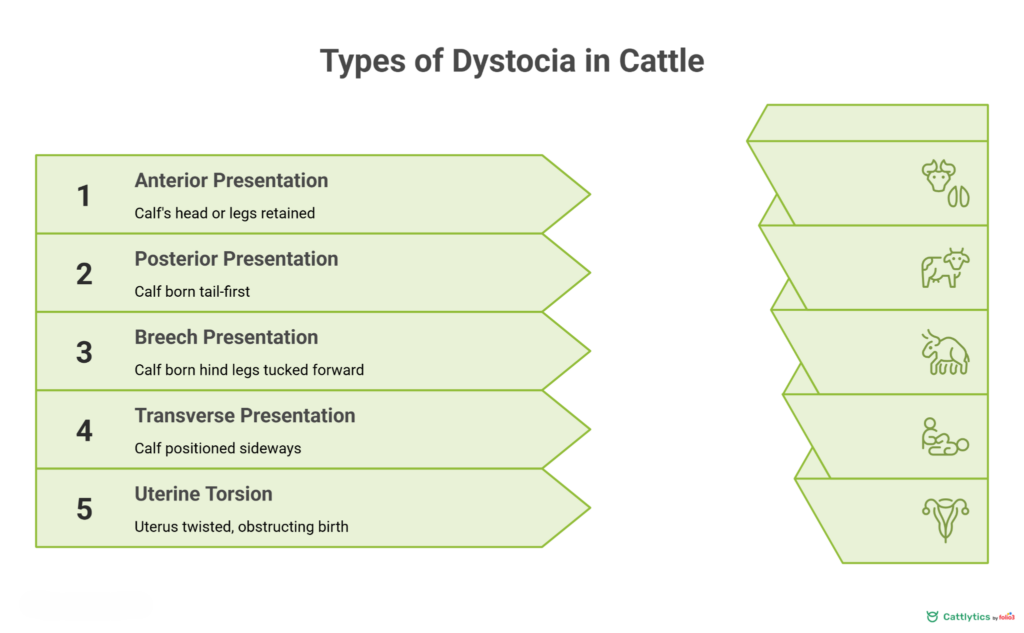
Anterior Presentation with Retained Head or Leg
You see one or both front feet, but the head is turned back, or one front leg is tucked underneath. This is the most common malpresentation. If you can feel a foot but no nose, the head is likely bent to the side. If you feel the head but only one foot, the other leg is retained. Both need to be corrected before you can pull.
Posterior Presentation (Backward)
The calf is coming tail-first with the hind legs extended into the birth canal. You will feel the bottom of the hooves facing up (the soles) and the hocks. A backward calf can be delivered, but speed is critical because the umbilical cord gets pinched early, cutting off the calf’s oxygen supply before the head clears.
Breech (Tail First, Hind Legs Tucked Forward)
The calf’s rump is at the pelvic inlet, but the hind legs are tucked forward under the body. You will feel the tail but no legs. This is one of the hardest presentations to correct because you need to push the calf forward and bring each hind leg back one at a time without tearing the uterus. This one usually needs a vet.
Transverse Presentation
The calf is lying sideways across the birth canal. You might feel a spine or ribs on your internal exam. Delivery in this position is impossible without correction, and it almost always requires veterinary intervention.
Uterine Torsion (Twisted Uterus)
The uterus itself has rotated, twisting the birth canal shut. The cow may show labor signs but make no progress. On internal exam, you will feel a spiral fold in the vaginal wall. The direction of the twist (clockwise or counterclockwise) determines the correction method. Mild torsions can sometimes be corrected by rolling the cow; severe cases need surgery.
Symptoms of Dystocia in Cattle: Knowing When to Intervene
The hardest decision at calving time is knowing when to step in. Waiting too long or jumping in too early both carry risks. Understanding the symptoms of dystocia in cattle takes the guesswork out of your timing.
Every producer asks the same question: “Am I giving her enough time, or have I already waited too long?” The table below gives you a practical timeline.
The Calving Intervention Timeline
| Observation | Meaning | Action Required |
| Water bag visible for 2+ hours with no feet showing | Possible malpresentation, oversized calf, or uterine torsion | Restrain cow and perform an internal exam |
| Only one foot visible | Retained leg or head | Assist immediately; correct the position before pulling |
| Nose visible with no hooves | Both front legs are retained | Do not pull on the head; bring both legs forward first |
| Active straining for 30+ minutes with no progress | Feto-pelvic disproportion or malpresentation | Examine, reposition if needed, apply traction |
| Cow stops straining and appears exhausted | Uterine fatigue or secondary inertia | Intervene; she will not deliver without help |
| Dark red or brown discharge without calf | Possible placental separation or dead calf | Call your veterinarian immediately |
Beyond the timeline, watch for these physical symptoms:
- The cow is lying flat, exhausted, and no longer trying to push
- Abnormal or foul-smelling discharge
- Swollen vulva with visible tissue damage
- Calf’s tongue is swollen and protruding (prolonged compression)
Recognizing early signs of calving in beef cattle and pairing that awareness with the intervention timeline above will help you act at the right moment.
Step-by-Step Dystocia Treatment in Cattle
Dystocia in cattle treatment follows a logical sequence. Rushing through steps or skipping preparation leads to injured cows, dead calves, and avoidable vet bills.
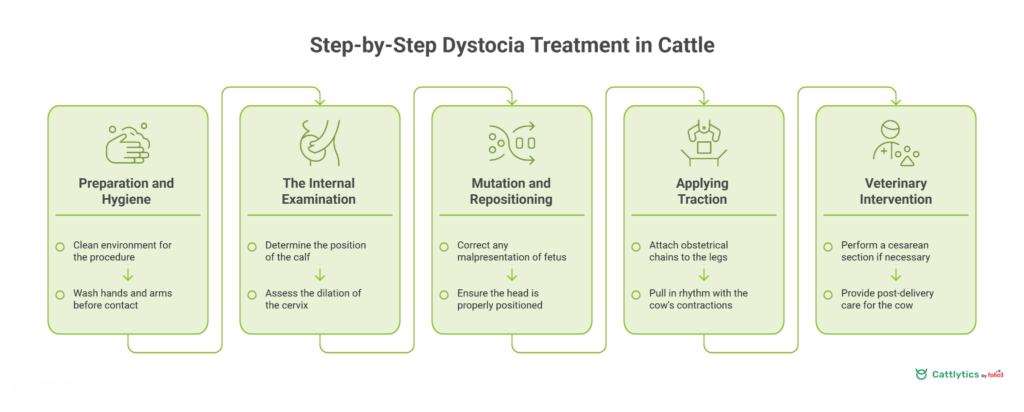
1. Preparation and Hygiene
Restrain the cow safely in a head catch or calving chute. A cow in active labor can go down suddenly, so make sure your chute allows you to release her quickly if she collapses.
Wash the vulva and surrounding area with warm water and a mild disinfectant. Then apply obstetrical lubricant generously. There is an old saying in cattle obstetrics: “You can never use too much lube.” This is not an exaggeration. Friction causes tears, and tears cause infections that can cost you the cow weeks after the calf is delivered. Have at least a full gallon of OB lube on hand.
Put on shoulder-length OB sleeves and lube your arm before going in.
2. The Internal Examination
Once you are clean and lubed, perform a careful internal exam to determine what you are dealing with.
Determine if the calf is alive: Pinch the skin between the toes. A live calf will pull its foot away. Insert a finger into the mouth; a live calf will have a swallowing reflex. If the calf is alive, you have urgency. If it is dead, you shift to protecting the cow as the priority.
Identify front vs. back legs: This is critical and commonly confused. Count the joints. Front legs have three joints below the shoulder (fetlock, knee, elbow), and the knee bends in the same direction as the fetlock. Hind legs have three joints too (fetlock, hock, stifle), but the hock bends in the opposite direction of the fetlock. If the soles of the hooves face up, you are dealing with a backward calf.
Assess the position: Is the head coming? Are both front legs present? Is there room to work? Your exam dictates the next step.
3. Mutation and Repositioning
If the calf is malpresented, you need to correct the position before applying any traction. This is called “mutation.”
Push the calf back into the uterus to create working room. This is best done between contractions when the cow relaxes. To reposition a retained head, cup your hand behind the calf’s poll and guide the nose toward the birth canal. For a retained leg, cup the hoof in your palm (protecting the uterine wall from the sharp hoof) and walk it forward into the correct position.
Never pull on a malpresented calf. You will injure both the cow and the calf. Patience here saves lives.
4. Applying Traction (Pulling)
Use OB chains, not ropes. Chains are easier to clean and less likely to slip. Apply a double loop: one loop above the fetlock and one below, creating a half-hitch that distributes pressure evenly across the pastern. This reduces the risk of breaking the calf’s leg.
Pull in rhythm with the cow’s contractions. Apply steady, downward traction (toward the cow’s hocks) as the calf clears the pelvis. Two people pulling by hand is usually sufficient for a normal-sized calf. For a backward calf, pull fast and steady once you commit because the umbilical cord is already compressed.
Using a mechanical calf puller (calf jack): A calf jack is a powerful tool that can generate significant force. Use it carefully. The key rules:
- Brace the base against the cow’s pins, not the ground
- Pump slowly. One pump, pause, one pump, pause
- Never crank it continuously; you will fracture the calf’s ribs or tear the cow’s uterus
- If you do not see progress after reasonable effort, stop and call your vet
5. Veterinary Intervention
If you cannot reposition the calf within 15 to 20 minutes, it is time for professional help. If the calf is dead and too large to extract, your vet may perform a fetotomy, which is the surgical division of the dead calf inside the uterus for removal in pieces. If the calf is alive but stuck despite proper positioning, a cesarean section (C-section) may be the best option.
A C-section performed early, before the cow is exhausted and the calf is oxygen-deprived, has a much better survival rate for both animals than one performed as a last resort. Building a strong veterinary relationship before calving season starts is one of the smartest investments you can make.
Post-Treatment Protocols to Save the Cow and Calf from Dystocia
After a difficult delivery, what you do in the first few hours determines whether both animals make it. Proper dystocia treatment in cattle does not end when the calf hits the ground.
For the Calf
Clear the airway immediately. Wipe mucus from the nose and mouth with a clean towel. A piece of straw gently inserted into the nostril can trigger a sneeze reflex to clear the passages. If the calf is not breathing, vigorous rubbing of the chest can stimulate respiration.
Avoid hanging the calf upside down for more than 60 seconds. This is a common mistake. Hanging compresses the diaphragm with gut contents and makes breathing harder, not easier. A brief inversion to drain fluid is fine, but get the calf into a sternal (upright) position as quickly as possible.
Colostrum is non-negotiable. A dystocia calf needs 3 to 4 liters (approximately 10% of its body weight) of high-quality colostrum within the first 2 hours of life. These calves are often too weak to nurse on their own, so have a clean esophageal feeder ready. Timely colostrum delivery is the difference between a calf that thrives and one that develops scours or respiratory issues within the first week.
For the Cow
Before you walk away, check for a second calf. Twins are more common than many producers realize, and missing one can be fatal for both the cow and the undelivered calf.
Administer a non-steroidal anti-inflammatory (NSAID), such as flunixin meglumine (Banamine), per your vet’s protocol. Pain relief encourages the cow to eat and get back on her feet, which speeds recovery.
Monitor her closely for the next 72 hours for these complications:
- Retained placenta: If the afterbirth has not passed within 12 hours, do not pull it. Call your vet for treatment.
- Metritis: Watch for foul-smelling discharge, fever, and reduced appetite in the days following delivery.
- Uterine prolapse: A rare but life-threatening emergency where the uterus turns inside out after delivery. This needs immediate veterinary attention.
How to Prevent Dystocia in Beef and Dairy Herds
The best way to handle dystocia in cows is to prevent it from happening. Most cases are predictable and manageable with the right pre-calving strategy.
Genetics
Sire selection is your first line of defense. When breeding heifers, use bulls with proven low-birth-weight and high calving-ease EPDs. Calving Ease Direct (CE or CED) predicts how easily a bull’s calves will be born. Birth Weight (BW) EPD predicts the expected birth weight of his calves. Select bulls in the top 25% of the breed for calving ease when breeding heifers. For more on using EPDs in cattle to make smarter breeding decisions, we have a full breakdown.
Your bull selection criteria should always factor in calving ease as a non-negotiable trait for heifer bulls.
Pelvic Measuring
Have your veterinarian measure the pelvic area of replacement heifers before breeding. Heifers with a small pelvic opening relative to their body size are at much higher risk for FPD. Culling or selectively breeding these heifers to the easiest-calving bulls in your lineup is a proactive way to reduce dystocia rates. Combining pelvic measurements with preg checking protocols gives you a complete picture of each heifer’s calving risk.
Nutrition Management
Feed to hit the right BCS at calving. For beef cows, the target is 5.5 to 6.0 on a 9-point scale. For dairy cows, aim for 3.25 to 3.5 on a 5-point scale.
Avoid overfeeding energy and protein in the final trimester, especially to heifers. Excessive nutrition in late gestation increases calf birth weight and fat deposition in the pelvic canal, both of which increase dystocia risk. At the same time, underfeeding leads to weak contractions and poor calf vigor. Proper mineral supplementation for cattle also supports uterine function and calf vitality at birth.
Technology
Modern tools give you an edge that previous generations did not have. Calving cameras and barn-mounted monitoring systems let you watch cows remotely without disturbing them. Tail-mounted motion sensors (like Moocall) detect the onset of labor by measuring tail movements and send alerts directly to your phone.
Digital cattle management software helps you track breeding dates, expected calving dates, and calving history for every animal so you know exactly which cows and heifers need close watching. Setting up smart monitoring alerts for heifers and high-risk cows lets you intervene earlier and prevent losses.
Conclusion: Proactive Management Is Your Best Defense
Dystocia in cattle is an unavoidable reality of livestock production, but it does not have to be a crisis every time it happens. The producers who lose the fewest calves are not the ones who never face difficult calvings. They are the ones who prepare early, watch closely, act quickly, and know when to call for help.
Build your prevention program around smart genetics, proper nutrition, and good heifer development. Equip your calving area with the right tools. And invest in a strong working relationship with your veterinarian before the first calf hits the ground.
Ready to track breeding dates, calving history, and herd health records in one place? Connect with our experts to see how Cattlytics can simplify your calving season management.
FAQs
What Is the Most Common Cause of Dystocia in First-Calf Heifers?
Feto-pelvic disproportion, where the calf is too large for the heifer’s birth canal, is the leading cause. Selecting low-birth-weight, high calving-ease bulls and measuring pelvic areas before breeding are the two best prevention strategies.
How Long Should You Wait Before Assisting a Cow in Labor?
If the water bag is visible and no feet appear within 2 hours, or if feet are showing with no progress for 30 minutes of active pushing, it is time to examine her. Waiting longer than this significantly increases calf mortality risk.
Can a Cow Survive a C-Section During Dystocia?
Yes. Survival rates for C-sections performed early, before the cow is exhausted, are generally high. The key is calling your vet before the situation becomes desperate rather than after all other options have failed.
Does Dystocia Affect a Cow’s Ability to Breed Back?
Absolutely. Cows that experience calving difficulty have delayed return to estrus. Research shows pregnancy rates drop from 85% in unassisted cows to around 69% in cows that needed help, extending your cattle breeding cycle and pushing calves later into the season.
Is Dystocia More Common in Beef or Dairy Cattle?
Dystocia rates tend to be higher in beef cattle, particularly in first-calf heifers bred to bulls with heavy birth weight genetics. However, dairy cattle, especially Holsteins, face significant dystocia risk from twinning and metabolic conditions like milk fever that weaken contractions.
Should You Pull a Backward Calf Faster Than a Forward Calf?
Yes. In a posterior (backward) presentation, the umbilical cord gets compressed early in the delivery. Once you commit to pulling a backward calf, work quickly and steadily. The calf’s oxygen supply is already at risk, so speed matters more than in a normal forward delivery.