

Weaning calves is one of the most critical management decisions you will make each year. Get it right, and you set your calves up for strong gains, solid health, and a smooth transition to the next production stage. Get it wrong, and you are looking at sick calves, lost weight, and added feed costs that eat into your margins.
The USDA NAHMS Beef Cow-Calf Study reported that the average weaning age across U.S. operations is roughly 7 months. But the “right” age for your operation depends on cow condition, forage supply, calf readiness, and market timing. This guide covers everything you need to make that call with confidence, from choosing the best age and method to feeding weaned calves for maximum performance.
What Does Weaning Calves Mean?
Weaning is the process of separating calves from their dams so they stop nursing and transition fully to solid feed. In a managed cow-calf operation, this is a deliberate event where you physically separate the pair and shift the calf onto forage, supplements, or a starter ration.
This is different from what happens in nature. In unmanaged herds, cows gradually reject nursing attempts over several months until the calf stops trying on its own. Managed weaning speeds up this process so you can control the timing and reduce the nutritional drain on your cows before winter or the next breeding season.
When Do Calves Wean Naturally (And Why Managed Weaning Is Different)
Left on their own, beef cows will naturally wean their calves somewhere between 8 and 11 months of age. The cow slowly reduces milk production and pushes the calf away when it tries to nurse. It is a gradual, low-stress process that happens over weeks.
However, waiting that long creates real problems on a working ranch. An older calf nursing into late fall pulls body condition off the cow right when she needs it most. That means higher winter feed bills, lower rebreeding rates, and calves that may miss the best market windows. Managed weaning at 5 to 8 months gives you control over all of those variables while the calf is still young enough to adapt quickly to solid feed.
Best Age to Wean Calves: 5 Months, 6 Months, or Later?
There is no universal answer to when you should wean a calf. The best age depends on your cows, your grass, and your goals.
Standard Weaning: 6 to 8 Months (180-240 Days)
Most beef producers wean calves between 6 and 8 months of age. The industry benchmark is 205 days, which is also the standard adjustment age used in cattle performance testing programs.
By this age, the calf’s rumen is well developed. It is already eating significant amounts of forage and only getting a small share of its nutrition from milk. Weaning calves at 6 months gives the cow enough recovery time before winter to rebuild body condition for her next calving season.
Weaning Calves at 5 Months: When It Makes Sense
Early weaning at 5 months works well in specific situations. By 150 days of age, a calf is only getting about 30% of its nutrition from the dam. That means the cow is spending a lot of energy producing milk the calf barely needs.
Consider weaning calves at 5 months when your cows have a body condition score (BCS) below 5, when drought has limited your forage, or when you want to capture a market opportunity. Just know that younger calves need higher-protein rations and closer monitoring during the transition.
Factors That Determine the Right Weaning Age for Your Herd
Rather than following a fixed date, use these triggers to decide when to wean a calf on your operation:
- Cow body condition: If cows are scoring below BCS 5, it is time to pull calves regardless of age.
- Forage availability: Short grass or drought conditions push weaning earlier.
- Calf size and weight: Calves should be eating solid feed consistently before separation.
- Breeding season timing: Weaning before or early in breeding season can boost rebreeding rates for thin cows.
- Market conditions: Strong calf prices may justify weaning and selling sooner.
- Weather forecast: Plan weaning for mild conditions. Avoid heat waves, cold snaps, or mud.
Early Weaning Calves: Benefits, Risks, and When to Consider It
Early weaning calves means separating them from their dams before 5 months of age. Very early weaning, at 45 to 90 days, is reserved for extreme situations like severe drought or thin cows that need to rebreed. Calves can be successfully weaned at 6 to 8 weeks of age and raised to normal weaning weight in a drylot.
Benefits of early weaning:
- Improves cow BCS by eliminating lactation demand
- Increases rebreeding rates, especially if done before or during breeding season
- Stretches pasture for the remaining herd
- Early-weaned calves on high-concentrate diets can achieve higher USDA quality grades at slaughter
Risks to manage:
- Calves under 70 days have an immature rumen and need specialized starter rations
- Higher labor and feed management demands
- Greater susceptibility to respiratory disease if health protocols are not tight
Early weaning is worth exploring during drought years or when feed costs make it cheaper to feed the calf directly rather than through the cow. Work with your veterinarian to build a health plan for these younger calves, and make sure you understand the signs of stress in cattle so you can intervene quickly.
Best Time to Wean Calves: Seasonal Timing and Planning
For spring-born calves, the best time to wean is typically September through November. Fall-born calves are usually weaned between April and June. The goal is to align weaning with mild weather, good forage availability, and favorable market conditions.
Weather Effect
Weaning during extreme heat, bitter cold, or wet and muddy conditions amplifies stress on your calves and increases the risk of bovine respiratory disease (BRD). Aim for a stretch of mild, dry weather when you can.
Market Timing
If fall-weaned calves are bringing strong prices, you might choose to wean a few weeks earlier to capture that window. Keeping an eye on calf supply and demand can make a real difference in your bottom line.
Some producers also follow traditional timing guides like the Farmers’ Almanac or moon signs for scheduling weaning days. While there is no published research backing those methods, many experienced ranchers swear by them, and there is value in any system that gets you planning ahead.
How Long Does It Take to Wean a Calf?
How long it takes to wean a calf depends largely on the method you use. Calves separated abruptly may bawl and pace for 5 to 7 days but remain at elevated stress for 2 to 3 weeks. Calves weaned through low-stress methods like fenceline weaning typically settle within 3 to 4 days.
Here is a quick comparison:
| Weaning Method | Time to Adjustment | Stress Level | Labor Required |
| Abrupt / Truck | 5-7 days | High | Low |
| Fence-line | 3-7 days | Low | Medium |
| Two-stage | 7-14 days total | Low-Moderate | High |
| Drylot | 5-10 days | Moderate | Medium |
| Day weaning | 10-14 days | Low | High |
The key takeaway: Low-stress methods get calves eating sooner, and calves that eat sooner gain faster and get sick less often.
Calf Weaning Methods: Which One Fits Your Operation?
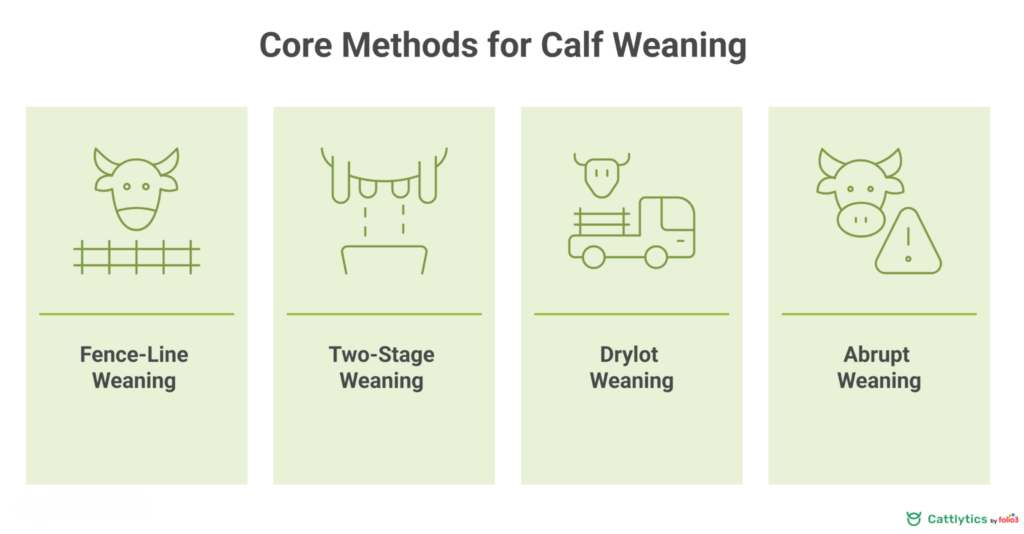
Your facilities, labor, and goals should drive which weaning method you choose. Here is what works and why.
Fence-Line Weaning (Low Stress)
Fence-line weaning separates cows and calves with a sturdy fence while allowing nose-to-nose contact. Fence-line weaned calves were treated for illness half as often as abruptly weaned calves. They also spent more time eating and less time pacing. You need strong fencing, page wire, or at least 6 strands of barbed wire, to keep calves from crawling back through. Keep pairs separated for at least 3 to 4 days. For a deeper breakdown, see our full guide on fenceline weaning for beef cattle.
Two-Stage Weaning with Nose Flaps (Low Stress)
Two-stage weaning uses anti-suckling nose paddles. You insert the device for 4 to 7 days while the calf stays with the cow. The calf can graze and drink but cannot nurse. After removing the paddle, you separate the pair. Research showed that two-stage weaned calves vocalized 97% less and spent 23% more time eating compared to abruptly weaned calves. Nose paddles cost about $2-$3 each. This method requires extra handling but delivers excellent results for small to mid-size herds.
Drylot Weaning (Moderate Stress)
Drylot weaning moves calves to a confined pen with bunk feed and hay. It works well when you want calves to learn bunk feeding before entering a backgrounding program or feedlot. You can reduce stress by placing cows in an adjacent pen for visual contact. The main benefit is easier health monitoring and controlled feed intake.
Abrupt Weaning (High Stress)
Abrupt weaning means complete, immediate separation, sometimes combined with shipping the same day. It is the most stressful approach. Research consistently shows it leads to the highest rates of BRD, the most weight shrink, and the poorest early gains. The Beef Quality Assurance (BQA) program strongly discourages “weaning on the truck.” Use this only when labor or infrastructure leaves no other option.
How to Choose the Right Method
Match the method to your reality, as the key is picking a method you can execute well and consistently.
- If you have good fences and adjacent pastures, fence-line weaning is hard to beat.
- If you are working a smaller herd and can handle calves twice, two-stage weaning delivers the lowest stress.
- For operations planning feedlot placement, drylot weaning builds bunk-ready calves.
What to Feed Weaning Calves: Nutrition for a Smooth Transition
A solid feeding plan can make or break your weaning program. What you feed matters as much as how you wean.
Pre-Weaning Nutrition: Start Before You Separate
The best thing you can do for a smooth transition is to start creep feeding calves 3 to 4 weeks before weaning. This bunk-breaks the calf while it still has the comfort of its dam. Offer high-quality grass hay and clean water so calves know where to find feed and water after separation. Calves that already know how to eat from a bunk will start consuming feed within hours of weaning instead of days.
Post-Weaning Ration: What Your Calves Need
Newly weaned calves have low dry matter intake (DMI) for the first 3 to 14 days. During this period, intake runs about 1% to 1.5% of body weight. That means your starter ration needs to pack a lot of nutrition into a small amount of feed.
Target these ranges for your weaning ration:
- TDN (Total Digestible Nutrients): 65-75%
- Crude Protein: 14-16% for early-weaned calves; 13-14% for standard-age calves
- DMI Target: 2.75-3.25% of body weight once calves are fully on feed
- Minerals: Supplement copper, zinc, manganese, cobalt, and selenium
- Vitamins: Include A, D, and E
Use palatable, dust-free ingredients. Introduce new feeds gradually over several days to avoid digestive upset.
Common Feeding Mistakes to Avoid
- Feeding straight corn right away (causes acidosis risk)
- Putting unpalatable feed in the bunk on day one (calves may not come back)
- Not providing enough bunk space (allow 18-24 inches per calf)
- Making a major diet change at the same time as separation
- Skipping mineral and vitamin supplementation
How to Increase Calf Weaning Weight
Beef calf weaning weight is influenced by genetics, cow nutrition, parasite load, and management practices. Here are the levers you can pull:
- Cow nutrition during lactation: A well-fed cow produces more milk. Calves typically gain 2.0 to 2.3 lbs per day while nursing. Better cow nutrition means more milk and heavier calves.
- Creep feeding: Adding a creep feed program can add 30 to 50 lbs to weaning weight depending on forage quality and feeding duration.
- Parasite control: Internal parasites drag down calf performance. Deworm calves at the same time you vaccinate, at least 2 weeks before weaning.
- Genetics: Selecting for cattle breeding traits like higher milk EPDs and growth EPDs in your cow herd pays dividends at the scale every year.
- Mineral supplementation: Trace minerals, especially selenium, copper, and zinc, support immune function and growth. Deficiencies in these minerals are common and often go unnoticed.
- Track and compare weaning weights: You cannot improve what you do not measure. Recording individual calf weights at birth and weaning helps you identify underperformers, make culling decisions, and benchmark progress year over year. A cattle management tool makes it easy to log weights, compare seasons, and spot trends across your herd.
Pre-Weaning Checklist: Preparing Your Calves and Your Operation
A little preparation before weaning day saves a lot of trouble after. Use this checklist to get your calves and your facilities ready.
- Vaccinate calves 2 to 4 weeks before weaning. Give a 5-way or 7-way respiratory vaccine plus a clostridial vaccine. Vaccinating at weaning adds stress and reduces vaccine effectiveness.
- Castrate and dehorn well ahead of time. Handle these procedures at least 2 weeks before weaning. Learn more about the ideal castration timing for calves.
- Deworm at vaccination time.
- Start creep feeding 3 to 4 weeks out to bunk-break calves while they are still on the cow.
- Check and repair fencing, especially if you plan to use fence-line weaning.
- Set feed bunks and water troughs at the right height for calves.
- Plan your post-weaning feeding program and source feeds before weaning day.
- Schedule weaning for mild weather.
- Consult your veterinarian on vaccination protocols specific to your region and risk factors.
Preconditioning After Weaning: Why the Extra 30-45 Days Pay Off
Preconditioning means weaning your calves, vaccinating them, teaching them to eat from a bunk and drink from a trough, and holding them for at least 30 to 45 days before sale or shipment. Preconditioned calves transition better to feedlots, get sick less often, and perform more efficiently on feed.
For sellers, the payoff is a premium at the sale barn. Buyers consistently pay more for calves that are weaned, vaccinated, and bunk-broke because they know those calves carry lower health risk. If you are running stocker cattle or backgrounding calves, preconditioning is an investment that almost always returns more than it costs.
Conclusion: Maximizing Post-Weaning Profitability
Low-stress calf weaning is not just good animal husbandry. It directly protects your bottom line. Calves that transition smoothly eat sooner, get sick less, gain faster, and command better prices at the sale barn. Every dollar you invest in the right weaning method, a solid nutrition plan, and timely vaccination comes back multiplied at marketing time.
The next step is tracking what actually happens in your herd after weaning calves each season. Individual calf weights, health treatments, and average daily gains tell you where you are winning and where to improve. Cattlytics makes that tracking simple, so your weaning program gets sharper every year.
FAQs
How Long Should You Keep Calves Separated After Weaning?
Keep calves separated from their dams for at least 5 to 7 days. With fence-line weaning, 3 to 4 days of fence-line contact is usually enough before moving cows further away. Most cows stop actively seeking their calves after about a week.
Does the Moon Phase Actually Affect Weaning Success?
There is no peer-reviewed research confirming that moon phases influence calf behavior during weaning. However, many experienced producers follow the Farmers’ Almanac for weaning dates and report positive results. If it helps you plan ahead and stick to a schedule, it can serve as a useful planning tool.
What Vaccines Should Calves Get Before Weaning?
Calves should receive a modified-live 5-way viral respiratory vaccine, a 7-way clostridial vaccine, and a dewormer at minimum. Some regions also warrant a Mannheimia haemolytica vaccine. Always work with your veterinarian to tailor protocols to your area and risk level.
Can You Wean Calves and Ship Them the Same Day?
You can, but it is the most stressful option and carries the highest risk of BRD. The BQA program recommends weaning at least 30 days before shipping. Even 7 days of on-farm weaning before shipping has been shown to significantly reduce sickness at the feedlot.
How Do You Know a Calf Is Ready to Be Weaned?
A calf is ready when it is consistently eating forage or solid feed, has a functioning rumen, and is gaining weight independently of milk. At 5 to 6 months old, most calves meet these criteria. Watch for calves that spend significant time grazing rather than nursing.
What Is the Ideal Bunk Space Per Calf During Weaning?
Provide 18 to 24 inches of bunk space per calf so all calves can eat at the same time. Crowded bunks create competition, and timid calves may not eat at all during the critical first few days post-weaning.